
Description
Book Details
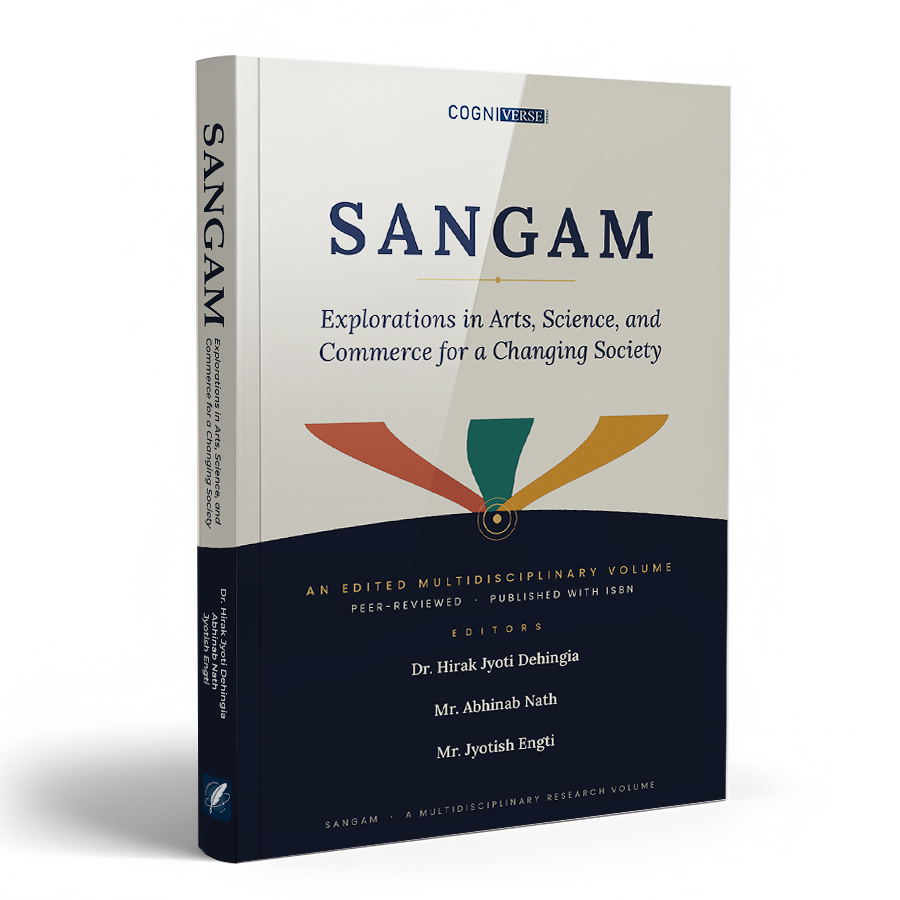
Title: Sangam: Explorations in Arts, Science, and Commerce for a Changing Society
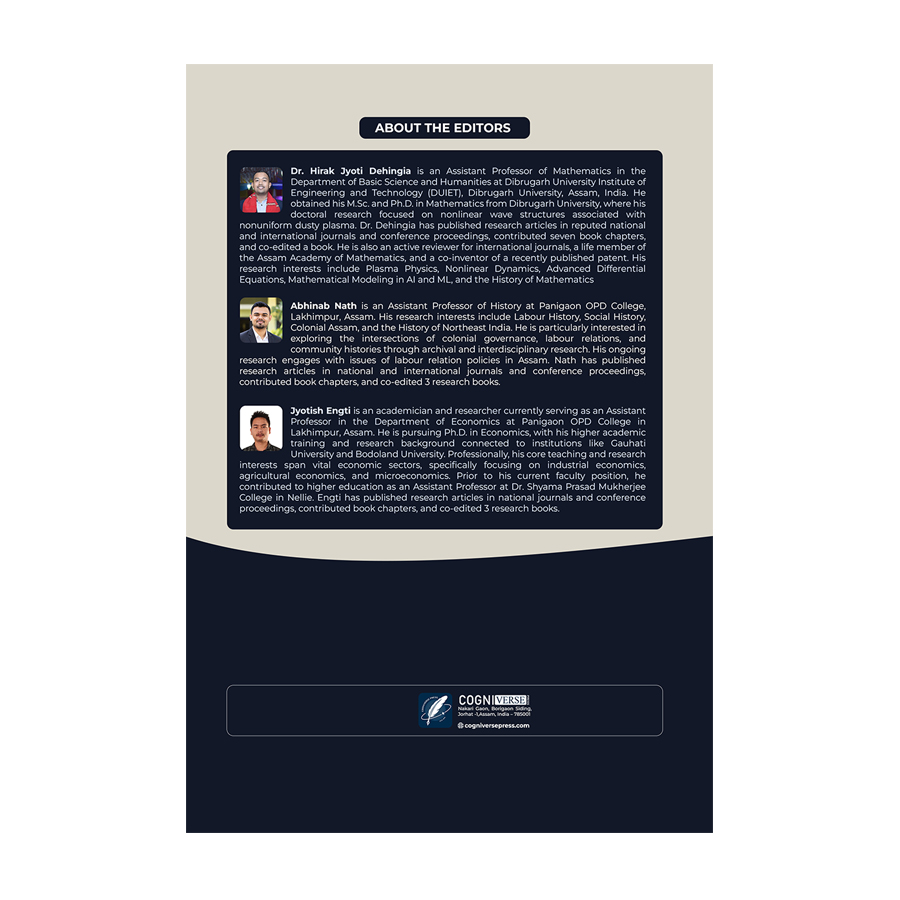
Editors: Dr. Hirak Jyoti Dehingia, Abhinab Nath, Jyotish Engti
Publisher: Cogniverse Press
Edition: First Edition
Publication Date: September, 2026
ISBN: 978-81-68073-33-3
e-ISBN: 978-81-68073-34-0
DOI: https://doi.org/10.5281/zenodo.22874632
Total Pages: 351
Preface
Knowledge, in its truest sense, has never grown in isolation. It has always flourished at the confluence of ideas, disciplines, and perspectives where the humanities meet the sciences, commerce meets ethics, and tradition meets innovation. It is this very spirit of confluence that inspired the title of this volume, Sangam, a word that evokes the meeting of rivers, of streams arriving from different origins to unite into something larger and more powerful than any single current could achieve alone. The idea for this edited volume was born out of a shared conviction among its editors that the challenges confronting contemporary society can no longer be understood through the lens of a single discipline. Sangam is our modest attempt to create a platform for genuine interdisciplinary dialogue.
This volume brings together twenty-six original contributions from academicians, researchers, educators, industry professionals, and independent scholars working across a remarkably wide spectrum of fields, and the chapters themselves bear witness to the confluence the title promises. Questions of environment and technology are taken up in chapters such as “Climate Change and Green Technology: Their Linkage with Sustainable Inland Waterways in Assam,” “Roots of Green Chemistry in the Ethnochemical Wisdom of Ancient India,” and “Influence of Green Skills in Innovation and Waste Reduction in Brick Manufacturing Process,” while the applied sciences find expression in studies on the electron energy distribution function in low-temperature plasmas, artificial intelligence in reservoir engineering, the environmental impacts of drilling operations, and the temperature-based behaviour of Assam crude oil in pipeline flow.
History and heritage occupy an equally prominent place in this collection. Readers will encounter “Print Media and Political Awakening in Colonial Assam,” “The Economic History of Bengal: Historical Evolution, Structural Transformation, and Regional Development (1757–2025),” “Material Culture of Knowledge at Nālandā Mahāvihāra,” and “Durjjayanagari: An Extinct Political Centre of Early Medieval Assam” — chapters that, together, trace the layered civilizational memory of the subcontinent from ancient centres of learning to the print cultures of the colonial era. Alongside these, “Religious Tourism and Socio-Economic Development: A Study of Kamakhya Temple, Assam” situates heritage within the living economic life of the region.
A substantial cluster of chapters engages with gender, livelihood, and social transformation, including “The Informal Economy and Women’s Livelihood: Street Vending in Jorhat Municipal Area of Assam,” “Women’s Labour Force Participation in Urban Assam,” “Changing Patterns of Women’s Time Use in India,” “Early Marriage as a Social Barrier in Assam,” “Family Support System and Academic Achievement among Women Students in Higher Education,” and “Achieving Sustainable Development Goal 5: The Role of Education in Promoting Gender Equality.” Together, these chapters offer a sustained, empirically grounded meditation on gendered inequality and resilience in contemporary Assamese and Indian society.
Education and pedagogy form another vital thread, represented by “Cultivating Pedagogical Empathy: Loving Kindness Meditation in Teacher Education,” “Education in the Digital Age,” “Digital Education in India: Rhetoric vs. Reality,” and “Lifelong Learning and a Skill-Based Economy: A Study of Asharikandi Terracotta Craft.” Economy and development are explored in “Structural Changes in Agriculture and Rural Economic Development in Dhubri District,” “Organizational Culture and Communication,” and “Can India Achieve the Sustainable Development Goals by 2030?” — with the volume’s range extending further still to a taxonomic study of Euploca baclei. This diversity is the book’s design principle: each chapter, rooted in its own tradition, speaks to larger questions of social progress, sustainability, and critical thought.
Every chapter included in this volume has undergone a rigorous process of peer review, ensuring that the work presented here meets high standards of scholarly originality and academic integrity. We are deeply grateful to our contributors, whose dedication and intellectual generosity made this volume possible, and to the reviewers and publisher whose support brought this project to print.
It is our hope that Sangam will serve not only as a repository of scholarly work but as an invitation to readers, students, and fellow researchers to think across boundaries and recognise that the most enduring insights often emerge precisely where different streams of knowledge meet. We invite you to immerse yourself in the confluence of ideas that follows.
Table of Contents
- Roots of Green Chemistry in the Ethnochemical Wisdom of Ancient India — Gitalee Sharma
- Assistive Tools or Cognitive Substitute? AI Use Among Undergraduate Students – Insights from Cotton University, Guwahati — Gyandeep Bhattacharyya
- Religious Tourism and Socio-Economic Development: A Study of Kamakhya Temple, Assam — Anshuman Nath, Ashim Nath
- The Economic History of Bengal with Historical Evolution, Structural Transformation, and Regional Development (1757–2025) — Mayukh Konwar, Bijoy Krishna Borah, Syed Eirfan Atthar
- Organizational Culture and Communication: Fostering Their Impact on Organizational Effectiveness in the Workplace — Dr. Sonit Dutta, Dr. Anuradha Nongmaithem
- Material Culture of Knowledge at Nālandā Mahāvihāra: Libraries, Manuscripts, and the Socio-Institutional Framework — Nishanta Bhattacharyya
- Digital Education in India: Rhetoric vs. Reality — Simantika Sharma, Jatin Sarmah
- Pitambar Dev Goswami as a Reformer of Assam: Religion, Social Reform, Cultural Transformation, and the Reconstruction of Vaishnavite Society — Joyprakash Bhuyan
- Climate Change and Green Technology: Their Linkage with Sustainable Inland Waterways in Assam — Ananya Borgohain
- Temperature-Based Analysis of the Kinematic Viscosity of Assam Crude Oil in Pipeline Flow — Bondita Robidas, Aparajita Dutta
- Education and Sustainable Development: Challenges and Opportunities in SDG4 in Assam — Dr. Jatindra Borah, Dhritimoni Bhaswati
- Early Marriage as a Social Barrier in Assam: Historical Legacies, Gendered Inequalities, and Socio-economic Transformation — Mainee Saikia
- Structural Changes in Agriculture and Their Implications for Rural Economic Development in Dhubri District of Assam — Manisha Ray, Dr. Sarat Hazarika
- Print Media and Political Awakening in Colonial Assam — Surajit Changmai, Lakhinandan Taye
- Education in the Digital Age: Opportunities, Challenges and Strategies for Transformation — Sumo Gogoi
- Cultivating Pedagogical Empathy: An Auto ethnographic Exploration of Loving-Kindness Meditation in Teacher Education — Sukanya Gargiee Saikia
- Lifelong Learning and a Skill-Based Economy: A Study of Asharikandi Terracotta Craft — Nandini Barman, Dr. Sarat Hazarika
- Government Policies and Initiatives Promoting Women’s Higher Education in India: A Study of Assam Women’s University, Jorhat — Arunika Engtipi
- Achieving Sustainable Development Goal 5: The Role of Education in Promoting Gender Equality — Antara Nath Chowdhury
- Influence of Green Skills in Innovation and Waste Reduction in the Brick Manufacturing Process — Dipanjali Sarma, Dr. Ajit Debnath, Dr. Bichitra Bikash Nath
- A Note on the Distribution and Taxonomic Status of Euploca Baclei (DC.) Diane & Hilger (Boraginaceae: Sub Family-Heliotropiaceae) — M. P. Rijuraj
- Determination of Electron Energy Distribution Function (EEDF) and Magnetic Confinement in Low-Temperature Plasmas using Single Langmuir Probe — Pallab Gogoi, Aritra Tarafder
- Changing Patterns of Women’s Time Use in India: Evidence from the Time Use Survey 2019 and 2024 with Policy Implications for Assam — Pragati Kanu
- Women’s Labour Force Participation in Urban Assam: Determinants, Barriers, and Pathways Toward Inclusive Growth — Richita Basumatary
- Can India Achieve the Sustainable Development Goals by 2030? Challenges, Opportunities, and the Way Forward — Rupjyoti Das
- Durjjayanagari: An Extinct Political Center of Early Medieval Assam — Akash Protim Boruah
- An Analysis of the Socio-Economic Conditions and Income Determinants of Agarwood Industry Workers of Hojai District of Assam — K. Mohima Singha, Dr. Barnali Hazarika


Reviews
There are no reviews yet.