

Description
Book Details
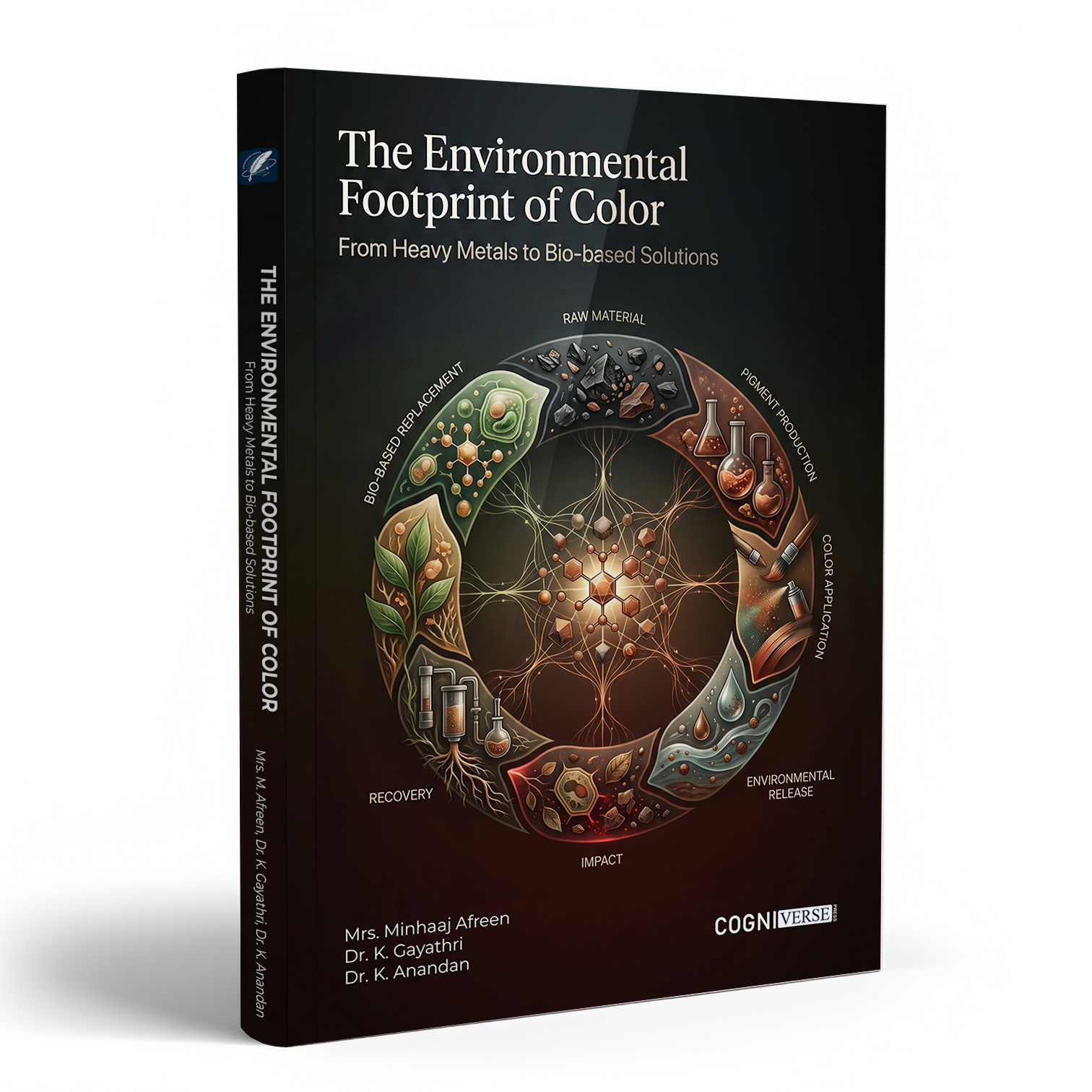
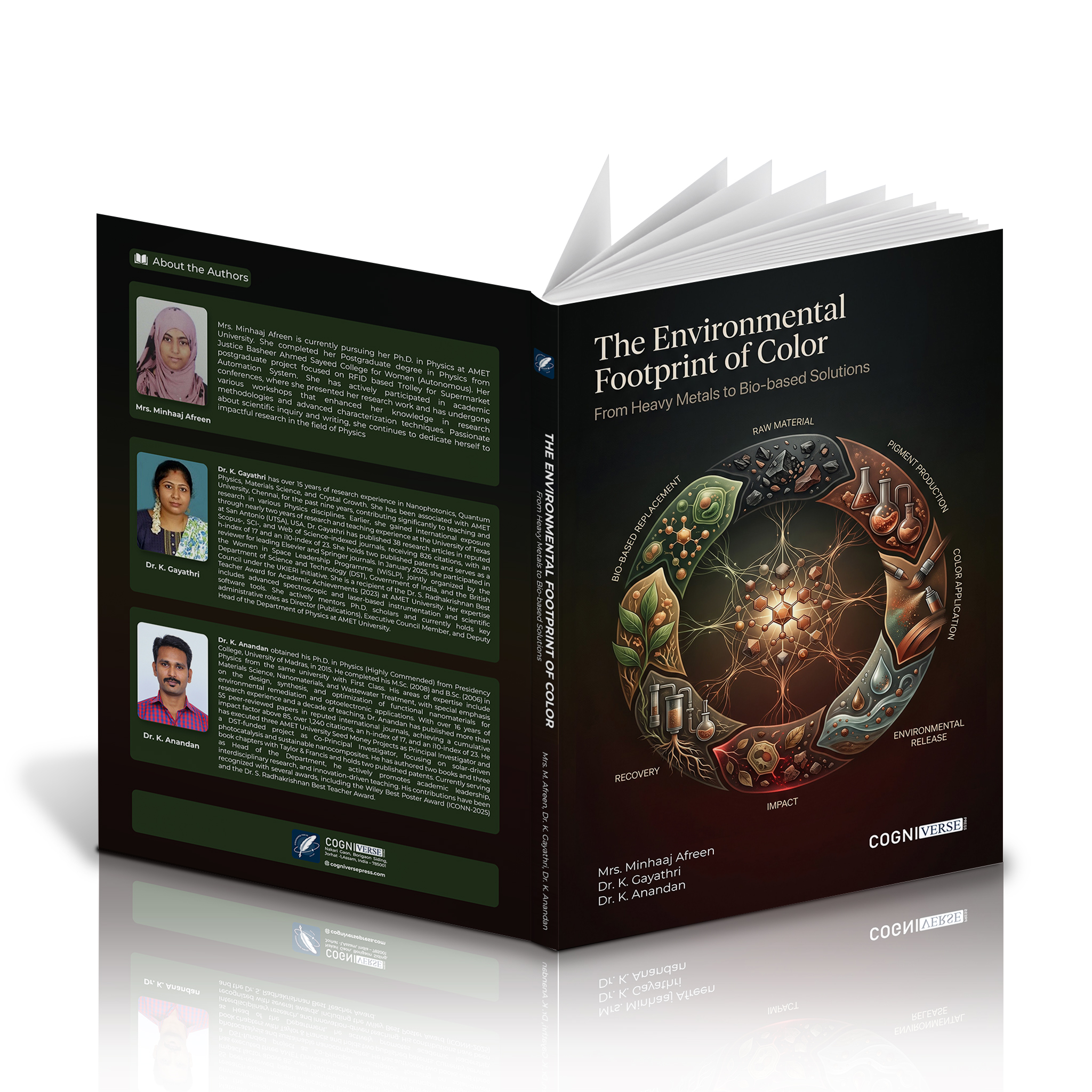
Title: The Environmental Footprint of Color: From Heavy Metals to Bio-based Solutions
Author(s): Mrs. Minhaaj Afreen, Dr. K. Gayathri, Dr. K. Anandan
Publisher: Cogniverse Press
ISBN: 978-81-68073-25-8
e-ISBN: 978-81-68073-26-5
DOI: https://doi.org/10.5281/zenodo.22296292
Edition: First Edition (September, 2026)
Preface
The environmental consequences of industrial pigmentation have, until recently, occupied a curiously marginal position within the broader discourse on chemical pollution. Considerable scholarly attention has been directed toward pesticides, plastics, and persistent organic pollutants, while the colorants saturating the textile, automotive, packaging, and coatings industries have received comparatively little systematic treatment as a distinct hazard category.
This book addresses that gap through an integrated account of the chemistry, toxicology, and ecological consequences of industrial color, alongside the technological and regulatory responses now emerging to mitigate its impact.
The approach is deliberately interdisciplinary. Pigment chemistry cannot be understood apart from the toxicological mechanisms by which its products act on biological systems, nor can either be separated from the ecological consequences of discharge, or from the regulatory and economic structures determining whether such discharge occurs at all.
The book therefore moves systematically from molecular structure and synthesis, through mechanisms of toxicity and environmental fate, to questions of policy, remediation, and emerging alternatives — reflecting the conviction that a material’s footprint can only be assessed across its full life cycle.
Particular attention is given to the chemical logic connecting industrial utility to environmental harm: the same molecular stability that makes a pigment commercially desirable is shown to be structurally continuous with its environmental persistence. This principle recurs across the discussion of heavy metals, azo compounds, and microplastic pigment carriers. The concluding sections, on microbial biosynthesis and structural color, are presented as promising but not yet fully mature alternatives.
This work assumes a background in environmental chemistry or materials science, and is intended for researchers and policymakers alike.
Table of Contents
Chapter 1. Introduction: The Paradox of Color
- 1.1. The Anthropocentric Power of Vision and Visual Cognition
- 1.2. The Historic Shift: From Geological Palettes to Synthetic Dominance
- 1.3. The Legacy of Chromatic Permanence in the Biosphere
- 1.4. Heavy Metals, Metalloids, and Chemical Structural Hazards
- 1.5. The Regulatory Landscape and Economic Imperatives
Chapter 2. Classification of Pigments and Historical Context
- 2.1. Inorganic Pigments
- 2.2. Synthetic Organic Pigments (SOPs)
- 2.3. Environmental, Toxicological, and Kinetic Persistence Challenges
Chapter 3. The Chemistry of Color: Synthesis and Manufacturing Processes
- 3.1. The Synthesis of Synthetic Organic Pigments (SOPs)
- 3.2. Inorganic Pigment Manufacturing: Calcination and Precipitation
- 3.3. The Physical Transformation: Micronization and Surface Treatment
- 3.4. The “Hidden” Chemistry: Solvents and Intermediates
Chapter 4. The Chemistry of Toxicity: Heavy Metals and Aromatic Amines
- 4.1. The Persistence of Heavy Metals
- 4.2. The Carcinogenic Potential of Azo Pigments
- 4.3. Toxicological Profiling of Key Pigment Classes
- 4.4. Ecotoxicological Cascade and Environmental Bio-Magnification
Chapter 5. Environmental Impact on Aquatic Ecosystems
- 5.1. Light Penetration and Photosynthetic Inhibition
- 5.2. Chemical Oxygen Demand (COD) and Hypoxia
- 5.3. Bioaccumulation and Bio-magnification across Trophic Levels
- 5.4. Genotoxicity, Mutagenicity, and Chronic Sublethal Effects
- 5.5. Alteration of Microbial Community Dynamics
- 5.6. Synergistic Effects with Co-pollutants
Chapter 6. Microplastics and the “Pigment Carrier” Problem
- 6.1. The Microplastic Vector and Polymer Matrix Fragmentation
- 6.2. Bioaccumulation, Trophic Transfer, and Chemical Co-Transport
- 6.3. Trophic Bio-magnification and the Human Health Interface
- 6.4. Analytical Challenges and Future Remediation Directions
Chapter 7. Sustainable Alternatives: The Rise of Microbial Pigments
- 7.1. Advantages of Microbial Sources and Waste Valorization
- 7.2. Key Microbial Pigments in Development
- 7.3. Technical and Scale-Up Hurdles in Biopigment Production
Chapter 8. Regulatory Challenges and the Circular Economy
- 8.1. Market Failures and the Economics of Environmental Externalities
- 8.2. Policy Frameworks, Regulatory Safe Harbours, and International Friction
- 8.3. The Structural Color Paradigm: Engineering Pigment-Free Materials
- 8.4. Cellulose Nanocrystals (CNCs) and Biopolymer Scaling Pathways
- 8.5. Life Cycle Assessment (LCA) and the End-of-Life Revolution
- 8.6. A Comparison of Color Paradigms
Chapter 9. Remediation Technologies: Strategies for the Decontamination of Color-Laden Effluents
- 9.1. Advanced Oxidation Processes (AOPs)
- 9.2. Sustainable Adsorption and Biosorption
- 9.3. Biological Remediation (Bioremediation)
- 9.4. Nano-Remediation and Hybrid Systems
Chapter 10. Conclusion
References




Reviews
There are no reviews yet.