


Description
Book Details
Title: Applied Laser Physics and Engineering Applications
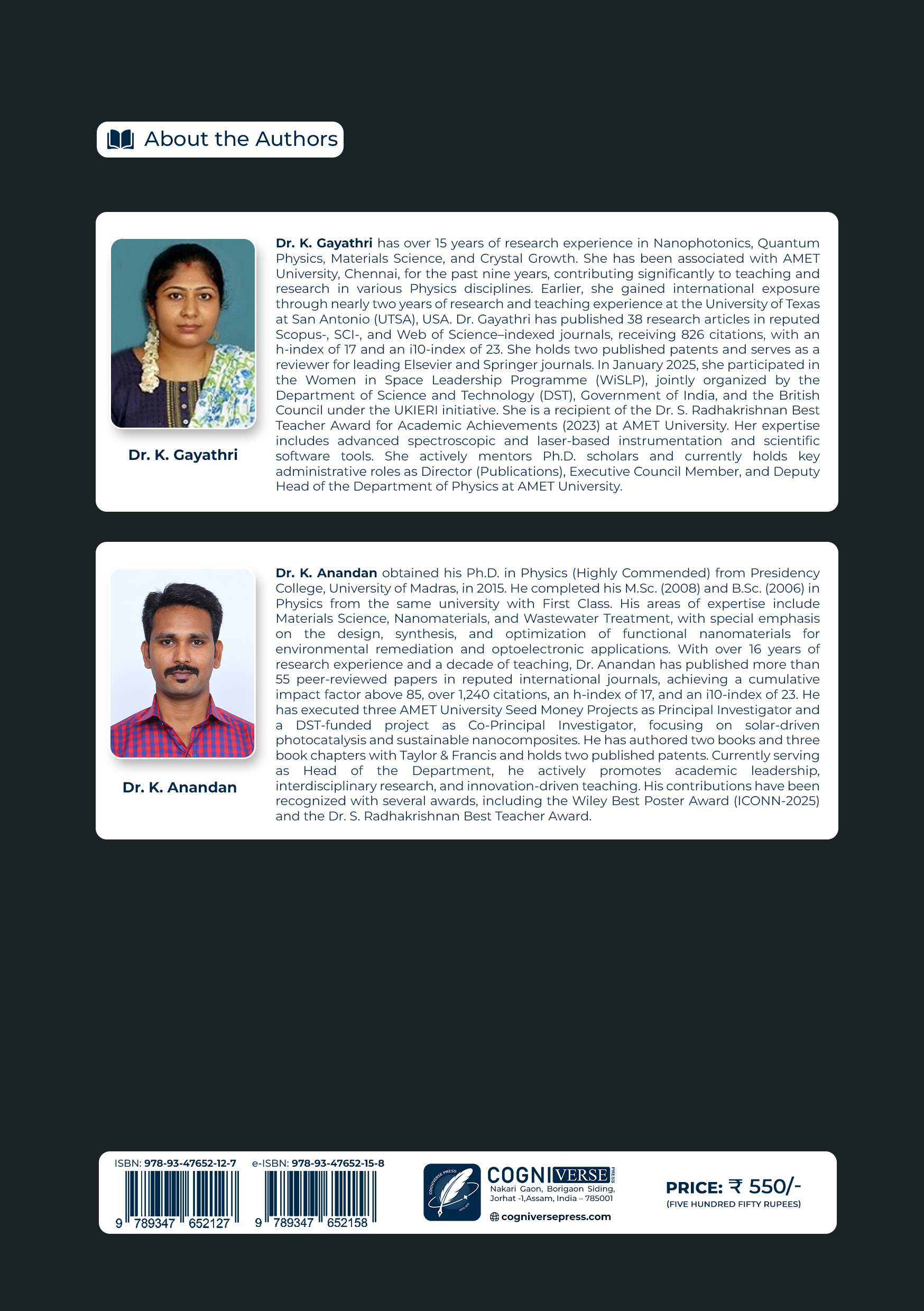
Authors: Dr. K. Gayathri and Dr. K. Anandan
Publisher: Cogniverse Press, Jorhat, Assam, India
Edition: First Edition, April 2026
DOI: https://doi.org/10.5281/zenodo.19768047
ISBN: 978-93-47652-12-7 (Print Edition)
e-ISBN: 978-93-47652-15-8 (Digital Edition)
Cover Designing: Cogniverse Press Digital Team
Website: cogniversepress.com
Email: cogniversepress@gmail.com
Authors
Dr. K. Gayathri
Associate Professor and Dy. Head, Director – Publications, Department of Physics, AMET Deemed to be University, ECR, Kanathur, Chennai, India – 603112
Dr. K. Anandan
Associate Professor and Head, Department of Physics, AMET Deemed to be University, ECR, Kanathur, Chennai, India – 603112
Preface
With the rapid advancement of science and technology, lasers have become indispensable tools in a wide range of applications, from industrial manufacturing and medical treatment to communication and defense systems. Building upon the fundamental principles presented in Volume I, this book, Applied Laser Physics and Engineering Applications, focuses on the practical aspects and modern applications of laser technology.
This volume is designed to provide students and professionals with a comprehensive understanding of how laser systems are utilized in real-world scenarios. It covers important topics such as laser modulation techniques, beam control, measurement methods, and instrumentation. In addition, it explores diverse application areas including material processing, medical applications, optical communication, and emerging technologies.
Emphasis has been given to explaining how theoretical concepts are translated into practical systems. The inclusion of modern developments such as ultrafast lasers, fiber lasers, and advanced sensing techniques ensures that the content remains relevant to current technological trends.
This volume aims to bridge the gap between theory and application, enabling readers to appreciate the versatility and significance of laser technology in contemporary science and engineering. Together with Volume I, it provides a complete and coherent understanding of laser physics and its wide-ranging applications.
Key Themes
- Laser beam modulation and control techniques
- Laser instrumentation and measurement methods
- Industrial laser processing and manufacturing
- Medical and communication applications of lasers
- Advanced laser technologies and emerging applications
- Ultrafast lasers, fiber lasers, and nonlinear optics
- LIDAR systems and environmental monitoring
Table of Contents
Chapter 1: Laser Beam Modulation and Control
- Introduction
- Fundamentals of Laser Modulation
- Amplitude Modulation (AM)
- Frequency Modulation (FM)
- Phase Modulation (PM)
- Q-Switching: Generation of High-Power Pulses
- Mode Locking: Ultra-Short Pulse Generation
- Pulse Generation and Temporal Control
- Beam Shaping and Spatial Control
- Optical Switching Devices
- Summary
Chapter 2: Laser Instrumentation and Measurement Techniques
- Introduction
- Laser Power and Energy Measurement
- Photodetectors
- Interferometry
- Holography
- Spectroscopy
- Optical Sensors
- Laser Alignment Techniques
- Calibration Techniques
- Summary
Chapter 3: Laser Material Processing and Industrial Applications
- Introduction
- Fundamentals of Laser-Material Interaction
- Laser Cutting
- Laser Welding
- Laser Drilling
- Surface Treatment
- Additive Manufacturing (Laser-Based)
- Microfabrication
- Advantages of Laser Processing in Industry
- Industrial Impact and Future Trends
- Summary
Chapter 4: Laser Applications in Medicine and Communication
- Introduction
- Medical Applications of Lasers
- Laser Surgery
- Lasers in Ophthalmology
- Lasers in Dermatology
- Fiber Optic Communication
- Optical Fibers
- Signal Transmission in Optical Fibers
- Advantages of Laser Communication Systems
- Challenges and Future Trends
- Summary
Chapter 5: Advanced Laser Technologies and Emerging Applications
- Introduction
- Ultrafast Lasers
- Fiber Lasers
- Nonlinear Optics
- Lasers in Defense and Space Applications
- LIDAR Systems
- Environmental Monitoring
- Future Trends in Laser Technology
- Summary
References
References section begins on Page 62.
Publication Note
© Authors. The views, interpretations, and research findings presented in this publication are solely those of the respective authors. The publisher bears no responsibility or liability for the accuracy, completeness, or validity of the content herein.
Printed at Cogniverse Press, Nakari Gaon, Borigaon Siding, Jorhat – 1, Assam, India.



Reviews
There are no reviews yet.