

Description
Book Details
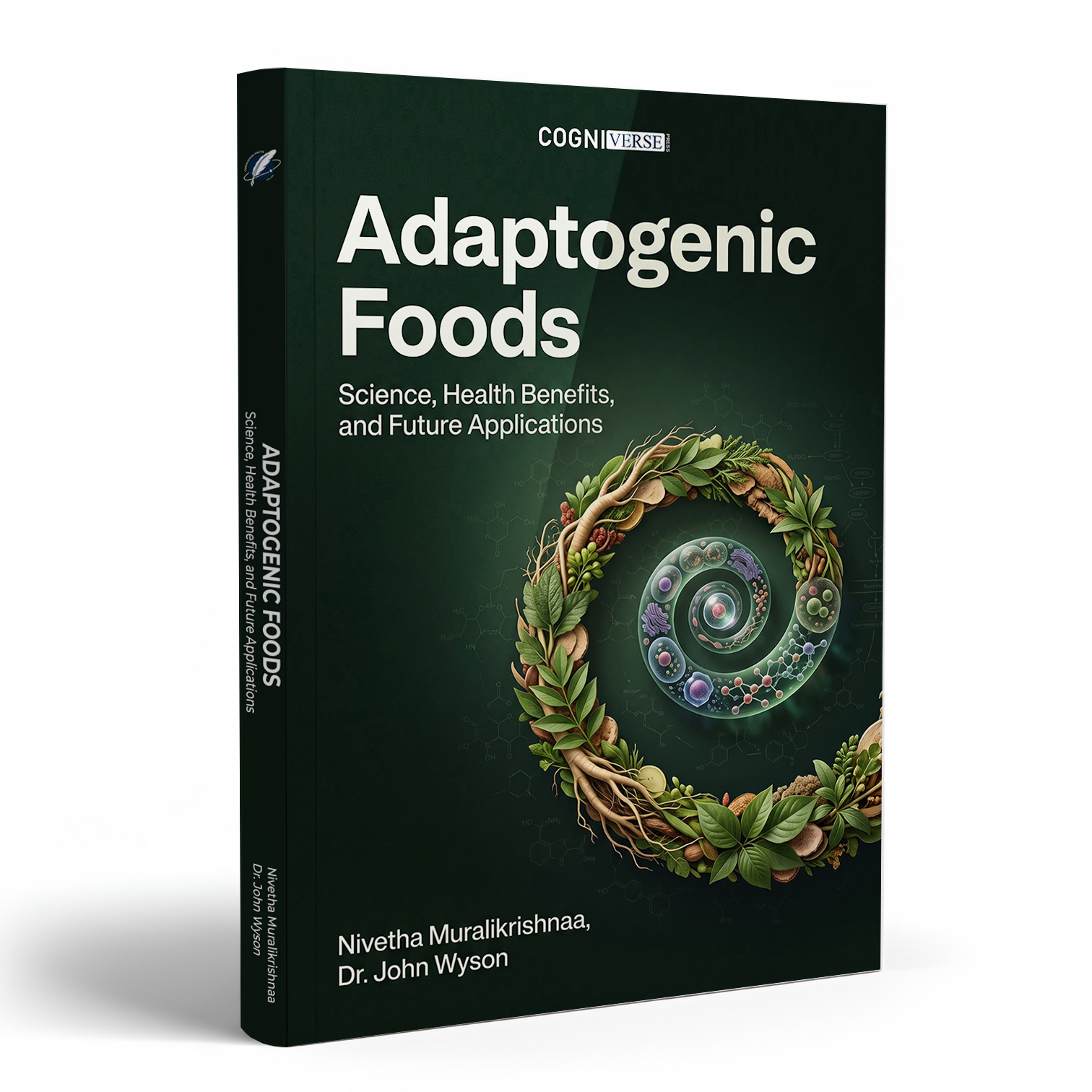
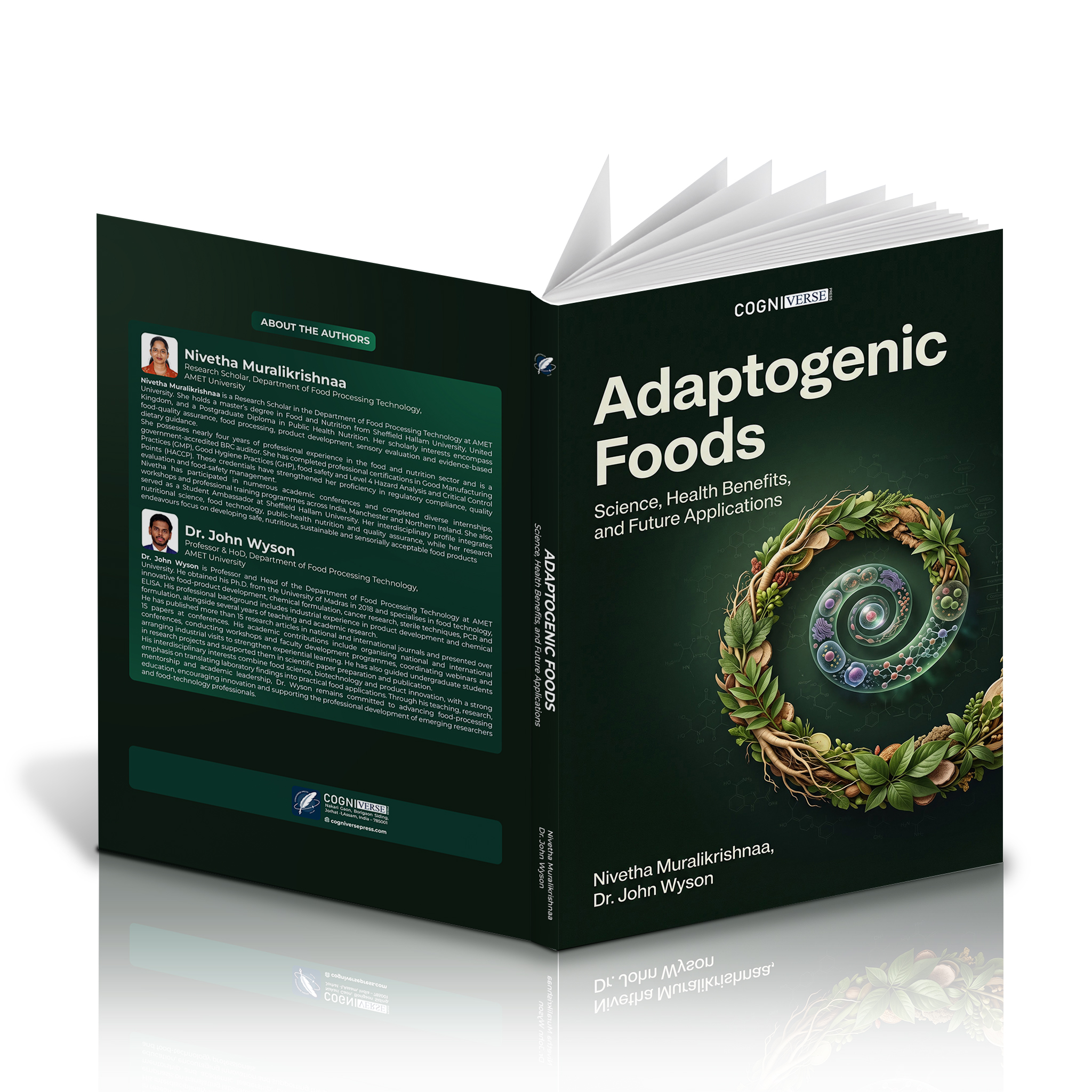
Title: Adaptogenic Foods: Science, Health Benefits, and Future Applications
Authors:
Nivetha Muralikrishnaa, Department of Food Processing Technology, Academy of Maritime Education and Training (AMET), Deemed to be University, Chennai, Tamil Nadu, India
Dr. John Wyson, Department of Food Processing Technology, Academy of Maritime Education and Training (AMET), Deemed to be University, Chennai, Tamil Nadu, India
Publisher: Cogniverse Press, Nakari Gaon, Borigaon Siding, Jorhat – 1, Assam, India
First Edition: August 2026
DOI: https://doi.org/10.5281/zenodo.22085148
ISBN: 978-81-68073-15-9 (Print Edition)
e-ISBN: 978-81-68073-16-6 (Digital Edition)
Published by: Cogniverse Press, Jorhat, Assam, India
Cover Designing: Cogniverse Press Digital Team
Copyright: © Authors
The views, interpretations, and research findings presented in this publication are solely of the respective authors. The publisher bears no responsibility or liability for the accuracy, completeness, or validity of the content herein.
Printed at:
Cogniverse Press
Nakari Gaon, Borigaon Siding, Jorhat – 1
Website: cogniversepress.com
Email: cogniversepress@gmail.com
Phone: +91-9101730579
Preface
The increasing prevalence of stress-related disorders, lifestyle diseases, and chronic health conditions has strengthened the search for dietary approaches that support human resilience and overall well-being. Within nutritional science, adaptogenic foods have emerged as a promising category of functional foods because of their potential to improve the body’s ability to respond to physical, psychological, and environmental stressors. Rooted in traditional medicinal systems and increasingly examined through modern scientific research, adaptogens represent an important intersection of nutrition, preventive healthcare, and health promotion.
Adaptogenic foods contain bioactive compounds that may contribute to physiological balance, stress regulation, immune support, and metabolic and cognitive health. Ingredients such as ashwagandha, ginseng, rhodiola, holy basil, schisandra, maca, and medicinal mushrooms have attracted global interest for their potential role in enhancing resilience and promoting wellness. Growing consumer demand for natural health products has also encouraged research, product innovation, and commercial development within the functional-food and nutraceutical sectors.
This book, Adaptogenic Foods: Science, Health Benefits, and Future Applications, presents a comprehensive account of the scientific foundations, mechanisms, health benefits, technological developments, and future prospects of adaptogenic foods. It integrates evidence from nutrition, food technology, phytochemistry, functional-food development, and public health to provide a multidisciplinary perspective on this evolving field.
The opening chapters introduce the concept, history, and traditional use of adaptogens before examining the physiological and molecular mechanisms underlying their activity. Subsequent chapters discuss major adaptogenic food sources, important bioactive compounds, and evidence concerning their health-promoting effects. The book also considers functional-food formulation, processing and extraction technologies, encapsulation, fermentation, product stability, quality assurance, safety, clinical validation, regulation, health claims, and sustainability. The concluding sections explore emerging opportunities involving precision nutrition, biotechnology, digital health, and personalized functional foods.
This volume is intended for researchers, academicians, postgraduate students, food scientists, nutritionists, healthcare professionals, product developers, and industry stakeholders interested in functional foods and nutraceuticals. By connecting traditional knowledge with contemporary scientific evidence, it aims to encourage critical understanding, responsible innovation, and further research.
Authors
Nivetha Muralikrishnaa
Dr. John Wyson
Table of Contents
Chapter 1. Introduction to Adaptogenic Foods
- 1.1. Definition and Concept of Adaptogens
- 1.2. Historical Development of Adaptogenic Research
- 1.3. Traditional Medical Systems and Adaptogens
- 1.4. Adaptogens versus Conventional Therapeutics
- 1.5. Adaptogenic Foods in Modern Nutrition
- 1.6. Scope and Objectives of the Book
- 1.7. Summary
Chapter 2. Biological Basis of Adaptogenic Activity
- 2.1. Understanding Stress and Human Physiology
- 2.2. The Hypothalamic–Pituitary–Adrenal Axis
- 2.3. Mechanisms of Adaptogenic Action
- 2.4. Neuroendocrine Regulation
- 2.5. Immunomodulatory Effects
- 2.6. Antioxidant and Anti-Inflammatory Activities
- 2.7. Biomarkers Used in Adaptogen Research
- 2.8. Summary
Chapter 3. Major Adaptogenic Foods and Ingredients
- 3.1. Classification of Adaptogenic Foods
- 3.2. Ashwagandha (Withania somnifera)
- 3.3. Ginseng (Panax spp.)
- 3.4. Rhodiola (Rhodiola rosea)
- 3.5. Holy Basil (Ocimum sanctum)
- 3.6. Schisandra (Schisandra chinensis)
- 3.7. Maca (Lepidium meyenii)
- 3.8. Adaptogenic Mushrooms
- 3.9. Emerging Adaptogenic Plant Sources
- 3.10. Summary
Chapter 4. Bioactive Compounds in Adaptogenic Foods
- 4.1. Introduction to Adaptogenic Phytochemicals
- 4.2. Polyphenols and Flavonoids
- 4.3. Alkaloids and Terpenoids
- 4.4. Saponins and Glycosides
- 4.5. Polysaccharides and Bioactive Fibres
- 4.6. Synergistic Effects of Bioactive Compounds
- 4.7. Bioavailability and Metabolism
- 4.8. Summary
Chapter 5. Health Benefits of Adaptogenic Foods
- 5.1. Stress Reduction and Mental Well-Being
- 5.2. Cognitive Function and Brain Health
- 5.3. Physical Performance and Endurance
- 5.4. Immune-System Support
- 5.5. Cardiovascular Health
- 5.6. Metabolic Health and Diabetes Management
- 5.7. Sleep Quality and Fatigue Management
- 5.8. Healthy Ageing and Longevity
- 5.9. Clinical Evidence Supporting Adaptogenic Benefits
- 5.10. Summary
Chapter 6. Adaptogenic Foods in Functional-Food Development
- 6.1. Functional Foods and Adaptogens
- 6.2. Adaptogenic Beverages
- 6.3. Adaptogenic Dairy Products
- 6.4. Adaptogenic Snack Foods
- 6.5. Fortified and Novel Adaptogenic Foods
- 6.6. Consumer Acceptance and Market Trends
- 6.7. Commercial Applications
- 6.8. Summary
Chapter 7. Processing and Stability of Adaptogenic Foods
- 7.1. Processing Technologies
- 7.2. Extraction of Bioactive Compounds
- 7.3. Encapsulation Technologies
- 7.4. Fermentation Approaches
- 7.5. Drying and Preservation Methods
- 7.6. Storage Stability
- 7.7. Quality Assurance and Control
- 7.8. Summary
Chapter 8. Safety, Regulations, and Health Claims
- 8.1. Safety Assessment of Adaptogenic Foods
- 8.2. Toxicological Evaluation
- 8.3. Clinical Validation and Evidence Requirements
- 8.4. Regulatory Frameworks Across Regions
- 8.5. Labelling and Consumer Information
- 8.6. Health Claims and Scientific Substantiation
- 8.7. Ethical Considerations
- 8.8. Summary
Chapter 9. Sustainability and Future Perspectives
- 9.1. Sustainable Cultivation of Adaptogenic Plants
- 9.2. Climate Change and Resource Challenges
- 9.3. Circular Bioeconomy Approaches
- 9.4. Biotechnology and Innovation
- 9.5. Precision Nutrition and Personalised Adaptogens
- 9.6. Digital Health and Adaptogenic Foods
- 9.7. Future Research Opportunities
- 9.8. Summary
Chapter 10. Conclusion
- 10.1. Key Takeaways
- 10.2. Public Health Implications
- 10.3. Future Outlook
- 10.4. Final Conclusion
References
References are provided at the end of the book.
Key Themes
- Scientific foundations and biological mechanisms of adaptogenic activity
- Traditional and modern applications of adaptogenic foods
- Major adaptogenic foods, plants, mushrooms, and ingredients
- Bioactive compounds, phytochemicals, bioavailability, and metabolism
- Health benefits and clinical evidence
- Functional-food development and commercial applications
- Processing, extraction, encapsulation, fermentation, and preservation technologies
- Safety assessment, toxicology, regulations, and health claims
- Sustainability, biotechnology, precision nutrition, and digital health
- Future research and emerging opportunities in adaptogenic foods



Reviews
There are no reviews yet.