
Description
Book Details
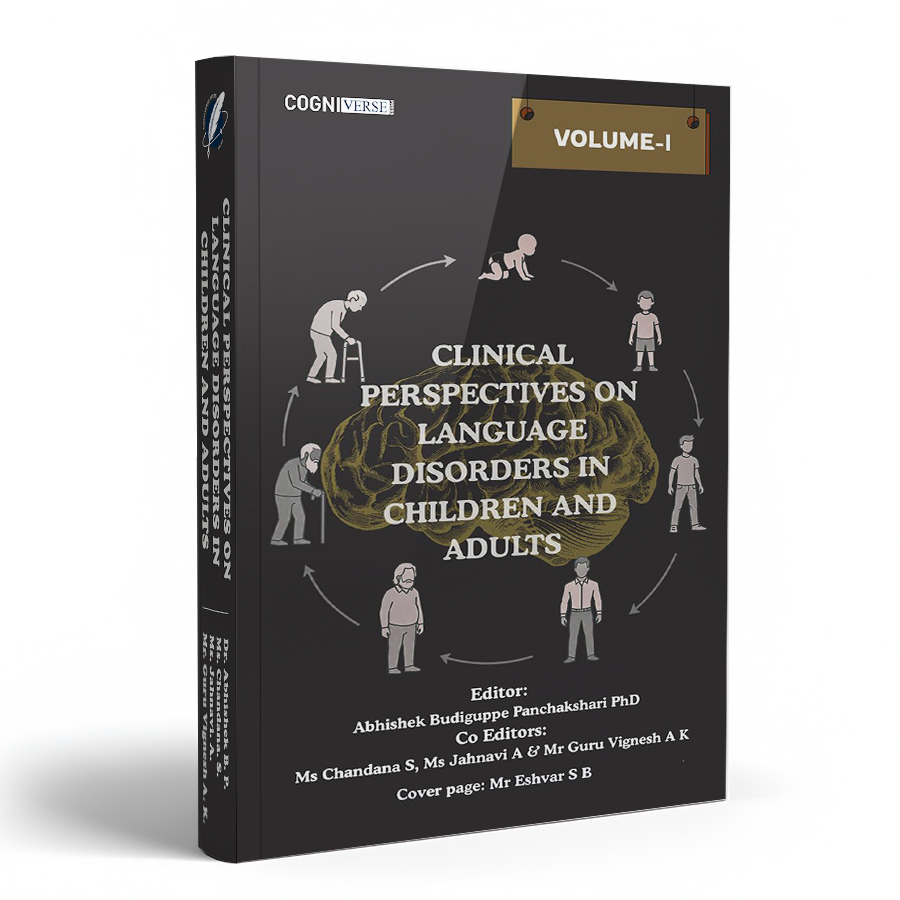
Title: Clinical Perspectives on Language Disorders in Children and Adults
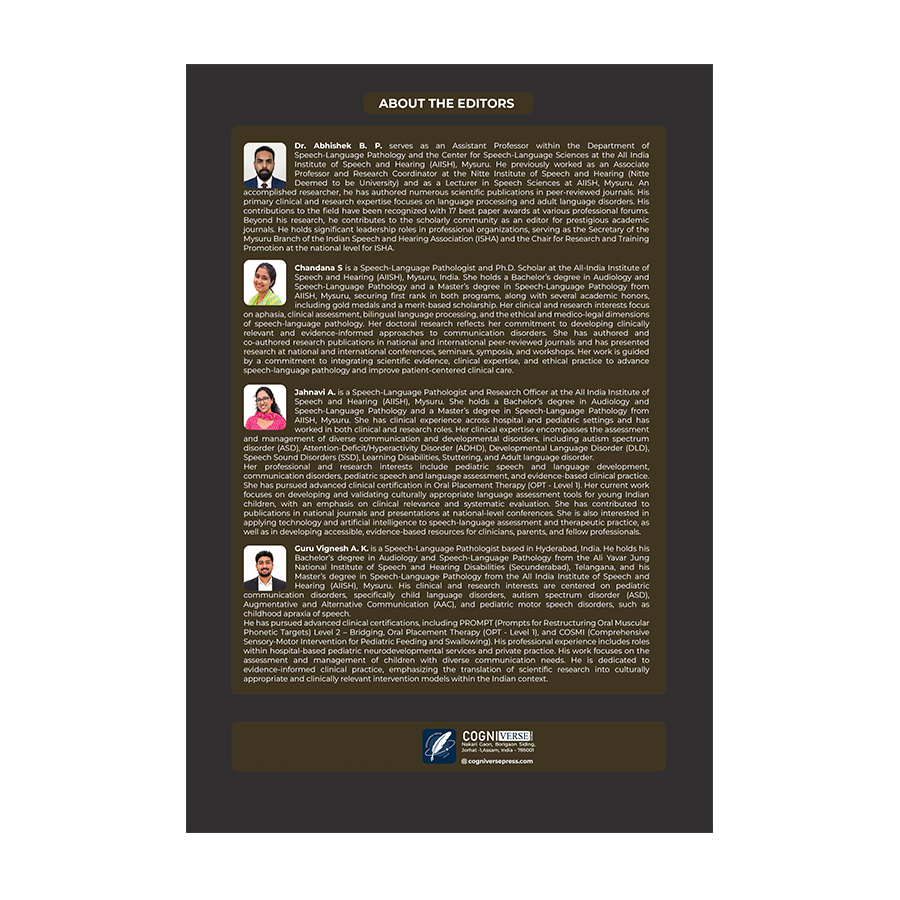
Editor(s): Dr. Abhishek B. P., Ms. Chandana S., Ms. Jahnavi A., Mr. Guru Vignesh A. K.
Publisher: Cogniverse Press
Edition: First Edition
Publication Date: September, 2026
ISBN: 978-81-68073-41-8 (Print Edition)
e-ISBN: 978-81-68073-42-5 (Digital Edition)
Preface
Human communication and hearing are pivotal for learning, indulging in social participation, emotional well-being, and independent functioning. When these capacities are disrupted by neurological damage, developmental differences, progressive conditions, or sensory impairment, the consequences extend far beyond the individual, affecting families, educational settings, workplaces, and communities. Effective practice in speech-language pathology and audiology imposes demands not only on a sound understanding of the underlying mechanisms of disorder but also on an appreciation of the lived experience of communication and swallowing difficulties, the contexts in which they occur, and the range of evidence-based options available for assessment, intervention, and support. It is within this broader context that the present volume has been conceptualized, bringing together a range of contemporary topics that span neurogenic and adult language disorders, dysphagia, developmental and child language disorders, augmentative and alternative communication, and audiology.
The volume begins with an examination of neurogenic communication disorders and adult language disorders, recognizing that acquired impairments of language and communication constitute a major area of clinical practice. Initial chapters provide an overview of neurogenic communication disorders, setting the stage for more detailed discussions on adult language disorders, including frameworks for evidence-based assessment and functional intervention that link diagnostic information to meaningful, participation-focused goals. Within this domain, the often-underrecognized literacy challenges faced by individuals with aphasia are addressed by focusing on reading and writing disorders, offering clinical perspectives on assessment and intervention that extend beyond traditional oral-language tasks. The discussion then moves to primary progressive aphasia, first outlining its clinical characteristics and subsequently considering approaches to assessment and management, thereby highlighting the need for early identification, differential diagnosis, and longitudinal support tailored to the condition’s evolving nature. In a similar paired format, right hemisphere damage is examined in separate chapters on assessment and management, highlighting the subtle yet functionally significant communication and cognitive-communicative deficits that may arise following right-sided lesions. Importantly, the section does not limit its focus to linguistic and cognitive aspects alone; it also includes chapters on psychological problems among persons with aphasia and their caregivers, as well as tools for assessing these concerns. These contributions reflect a growing recognition that emotional, psychosocial, and mental health dimensions are integral to comprehensive care and that effective intervention must attend to both communication and overall well-being.
Building on this foundation, the volume transitions to the domain of dysphagia, acknowledging that disorders of swallowing frequently co-occur with communication impairments, particularly in neurological conditions, and that they carry significant implications for health, nutrition, safety, and quality of life. An overview of swallowing across the lifespan in the context of neurological disorders provides practical guidelines for understanding normal and disordered swallowing, considering developmental and age-related changes, and applying this knowledge to clinical decision-making. This lifespan perspective is further refined in a chapter devoted to swallowing disorders in children, which addresses assessment and management issues specific to pediatric populations. Together, these contributions underscore the importance of interdisciplinary collaboration, individualized intervention, and the integration of swallowing management within broader rehabilitation and care plans.
From acquired and co-occurring disorders, the focus shifts to developmental and child language disorders, which represent another substantial area of practice and inquiry. The section opens with a chapter on language development from infancy through adolescence, providing a foundation for understanding typical trajectories and milestones against which atypical patterns may be identified. This developmental framework informs subsequent discussions on developmental language disorder (DLD), covering definition, diagnosis, and assessment support clinical practice. The volume then broadens its lens to consider language breakdown in neurodevelopmental disorders from a processing-capacity perspective, as well as pragmatic and social communication disorders, reflecting contemporary shifts towards dimensional and transdiagnostic understandings of language difficulties and an increased focus on social participation and real-life communication. A chapter titled “Beyond the Test Kit” advocates for integrating standardized, dynamic, and technology-based assessment approaches, encouraging clinicians to move beyond sole reliance on norm-referenced instruments and to consider more ecologically valid and responsive methods. Further chapters examine executive dysfunction and decision-making biases in neurodevelopmental disorders, metacognition in language disorders from a transdiagnostic clinical perspective, and a developmental psychology approach to early language that considers roots and risks in the emergence of language difficulties. Collectively, these contributions situate language disorders within broader cognitive, psychological, and developmental frameworks, promoting a more holistic understanding of the individual and reinforcing the need for interventions that address not only linguistic form and content but also the underlying processes that support communication and learning.
In parallel with these discussions, the volume recognizes that for some individuals, natural speech and language may be insufficient to meet their communication needs, necessitating augmentative and alternative communication (AAC). The section on AAC begins with an overview of the current Indian scenario, providing important contextual information about availability, accessibility, cultural and linguistic considerations, and service delivery models relevant to AAC in India. This contextual grounding is complemented by a chapter on AAC assessment and management from a clinical perspective, outlining processes for identifying communication needs, selecting appropriate systems and strategies, and supporting implementation across environments. These chapters emphasize the role of AAC in enabling participation, autonomy, and inclusion for individuals with complex communication needs, and they highlight the importance of viewing AAC not as a last resort but as an integral component of comprehensive communication intervention.
Finally, the volume extends its scope to audiology, acknowledging the close interrelationship between hearing, communication, language, and learning. Chapters on hearing disorders in children and adults address the identification, characterization, and implications of hearing loss across the lifespan, recognizing that undetected or inadequately managed hearing impairment can have profound effects on language development, academic achievement, social participation, and quality of life. By including audiological perspectives, the volume underscores the importance of interdisciplinary collaboration among speech-language pathologists, audiologists, educators, and other professionals in supporting individuals with communication and sensory challenges, and reinforces the need for integrated pathways for screening, diagnosis, intervention, and follow-up.
This book is intended for a broad audience, including undergraduate and postgraduate students in speech-language pathology and audiology, educators and trainers, clinicians working in hospitals, rehabilitation centers, schools, and community settings, and researchers engaged in related areas of inquiry. It may also be of interest to professionals in psychology, special education, occupational therapy, physiotherapy, social work, and other disciplines who encounter individuals with communication, swallowing, or hearing difficulties in their practice.
— Dr. Abhishek BP (Editor)
Table of Contents
- Neurogenic Communication Disorders: Foundations and Speech-Language Disorders
Aparna Prasanna, Sheena Aisha - Neurogenic Communication Disorders: Cognitive Communication Disorders and Associated Impairments
Aparna Prasanna, Sheena Aisha - Adult Language Disorders: A Comprehensive Framework for Evidence-Based Assessment and Functional Intervention
Ms. Sandhya Koteshwara, Dr. Mereen Rose Babu - Assessment and Intervention Approaches for Reading and Writing Disorders in Aphasia: Clinical Perspectives
Dharamkar Santosh - Psychological Well-Being in Aphasia: Addressing the Emotional Burden of Persons with Aphasia and Their Caregivers
Dr. Apoorva Choudhary - Tools for Assessment of Psychosocial Impact on Caregivers of Persons with Aphasia
Priyanka J P, Abhishek B P - Assessment of Individuals with Right Hemisphere Damage
Dr. Yashaswini B C, Dr. Hema N - Intervention Strategies in Individuals with Right Hemisphere Damage
Dr. Yashaswini B C, Dr. Hema N - Primary Progressive Aphasia: Clinical Characteristics and Variants
Ms. Chandana Shiva Shankar Murthy, Dr. Satyapal Puri Goswami - Primary Progressive Aphasia: From Diagnosis to Management
Ms. Chandana Shiva Shankar Murthy, Dr. Satyapal Puri Goswami - Overview of Swallowing Across the Lifespan in Neurological Disorders: Practical Guidelines
Pooja R Aradhya, Dr. Mereen Rose Babu - From First Feed to Functional Swallow: A Comprehensive Guide to Pediatric Dysphagia
Priyanka. N - Language Development in Children: From Infancy Through Adolescence
Ms. Suja Kumari S - Understanding Developmental Language Disorder: Definition, Diagnosis, and Assessment
Dr. Haritha S Mohan, Dr Anjana A V - Language Breakdown in Neurodevelopmental Disorders: A Processing Capacity Account
Sruthi Raveendran - Pragmatic Communication Disorder
Eshvar S B - Beyond the Kit: Integrating Standardized, Dynamic, and Technology-Based Assessment for Pediatric Communication Disorder
Ms. Jahnavi. A, Dr. Abhishek. B. P. - Executive Dysfunction and Decision-Making Biases in Neurodevelopmental Disorders: Implications for Communication and Language Outcomes
Pavithra Sankara Subramanian - Metacognition in Language Disorders: A Transdiagnostic Clinical Perspective
Mrs. Akila. S, Dr. R. Govarthini - Roots and Risks: A Developmental Psychology Approach to Early Language
Dr. Rahul Varma, Ms. Prakrity Dalal, Ms. Prachi Saini - When Language Fails to Connect: A Clinical Overview of Social Communication Disorder
Ms. Prachi Saini - Augmentative and Alternative Communication: Current Indian Scenario
Amulya P. Rao, Guru Vignesh A. K. - AAC Assessment and Management: A Clinical Perspective
Amulya P. Rao, Guru Vignesh A. K. - Paediatric Hearing Disorders: Clinical Perspectives on Language Development, Assessment, and Intervention
Akshay Kamath, Rithesh R. - Hearing Disorders in Adults: Clinical Perspectives on Language Processing, Communication, Assessment, and Intervention
Rithesh R., Akshay Kamath




Reviews
There are no reviews yet.