


Description
Book Details
Title: Advances Beyond Boundaries: Interdisciplinary Perspectives in Science, Engineering and Social Sciences
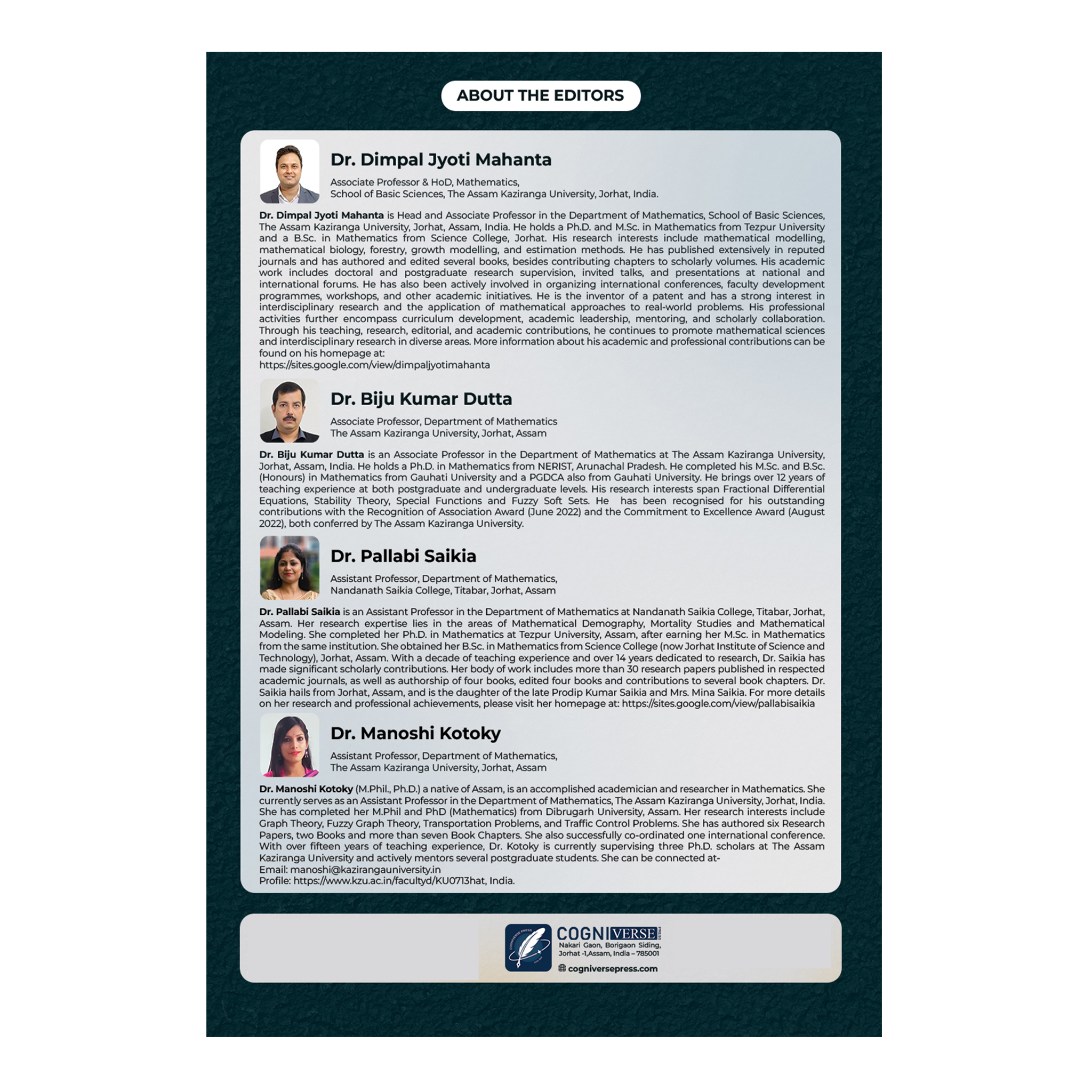
Editors: Dr. Dimpal Jyoti Mahanta, Dr. Biju Kumar Dutta, Dr. Pallabi Saikia, Dr. Manoshi Kotoky
Publisher: Cogniverse Press, Nakari Gaon, Borigaon Siding, Jorhat – 1, Assam, India
First Edition: August, 2026
DOI: https://doi.org/10.5281/zenodo.22093641
ISBN: 978-81-68073-03-6 (Print Edition)
e-ISBN: 978-81-68073-04-3 (Digital Edition)
Cover Designing: Cogniverse Press Digital Team
Editors
- Dr. Dimpal Jyoti Mahanta – Associate Professor & Head, Department of Mathematics, The Assam Kaziranga University, Jorhat, Assam, India
- Dr. Biju Kumar Dutta – Associate Professor, Department of Mathematics, The Assam Kaziranga University, Jorhat, Assam, India
- Dr. Pallabi Saikia – Assistant Professor, Department of Mathematics, Nanda Nath Saikia College, Titabor, Jorhat, Assam, India
- Dr. Manoshi Kotoky – Assistant Professor, Department of Mathematics, The Assam Kaziranga University, Jorhat, Assam, India
Preface
The rapid advancement of knowledge in the contemporary world has increasingly blurred the boundaries between traditional academic disciplines. Many of the challenges faced by society today are complex in nature and require knowledge, methods, and perspectives drawn from multiple fields. Advances Beyond Boundaries: Interdisciplinary Perspectives in Science, Engineering and Social Sciences is conceived in this spirit, bringing together diverse scholarly contributions that reflect the breadth and richness of contemporary interdisciplinary inquiry.
This edited volume presents a collection of scholarly works spanning science, engineering, and social sciences, covering a wide range of ideas, approaches, and applications. The contributions demonstrate how disciplinary knowledge can intersect, complement one another, and provide new perspectives for understanding both theoretical and practical problems. From scientific and technological developments to social and human-centred perspectives, the chapters collectively highlight the importance of collaboration and knowledge exchange across academic boundaries.
One of the strengths of an interdisciplinary volume lies in the diversity of its contributors and the varied ways in which they approach their respective subjects. The chapters presented in this volume encourage readers to look beyond the limitations of individual disciplines and appreciate the possibilities that emerge when different areas of knowledge come together.
The editors sincerely thank all contributing authors for sharing their research, ideas, and scholarly insights. The valuable efforts of everyone involved in bringing this volume together are also acknowledged. It is hoped that Advances Beyond Boundaries will serve as a useful academic resource for students, researchers, educators, and professionals, while inspiring further research, dialogue, collaboration, and innovation across disciplines.
Editors
Key Themes
- Mathematical Sciences
- Statistics and Data Analysis
- Environmental Science and Public Health
- Agriculture and Agribusiness
- Artificial Intelligence and Generative AI
- Education and Educational Technology
- Fluid Mechanics and Heat Transfer
- Biotechnology and Gene Therapies
- Traditional Knowledge and Agricultural Heritage
- Engineering and Materials Science
- Optical and Fiber Optic Communication
- Finite Element Analysis
- Quantum Graphs and Nanoscience
- Microwave Absorption
- Deep Learning and Computational Simulation
- Social Sciences and Human Development
Table of Contents
Chapter 1. Some Identities and Connection Formulas for Lucas Polynomials
Author: Yashwant K. Panwar
Page: 1
Chapter 2. Advanced Statistical Modeling for Environmental Exposure and Public Health Research
Authors: Thilagavathy K P, Vasanth J and Kavin R S
Page: 9
Chapter 3. Arithmetic Structure of Through Zero-Divisor and Total Graphs
Author: Anurag Baruah
Page: 19
Chapter 4. Applications of ICT in Agriculture: A Special Reference to Indian Agribusiness Management
Authors: Potnuru Santosh Kumar and P. Swarnalatha
Page: 25
Chapter 5. Artificial Intelligence and Generative AI in Modern Agriculture: Applications, Challenges and Future Perspectives
Authors: P. Swarnalatha and Potnuru Santosh Kumar
Page: 34
Chapter 6. Beyond the Classroom Walls: Technology Integration and Personalised Learning in Higher Education
Author: Dimpal Das
Page: 47
Chapter 7. Numerical Study on MHD Micropolar Fluid Flow Due to A Stretching Cylinder
Author: Dr. Surajit Dutta
Page: 57
Chapter 8. Empirical Evidence of New Education Policy (2020) of India
Authors: Ankit Kumar Maurya, Rahul Kumar Rai, Vaishali Gangwar & Diksha Patel
Page: 67
Chapter 9. The Insulin Plant (Costus pictus): Current Advances in Phytochemistry, Therapeutic Potential, and Functional Food Applications
Authors: Sagarika Chakraborty, Animesh Naskar
Page: 73
Chapter 10. Advanced mRNA and Gene Therapies: Emerging Technologies, Clinical Applications and Future Perspectives
Authors: Nibedita Roy, Dhruba Jyoti Bora, Neha Gogoi, Lipika Khataniar, Nikhita Deka
Page: 91
Chapter 11. GI Protecting Traditional Knowledge, Agricultural Heritage and Rural Knowledge
Authors: Aslesha Borbaruah, Dilirani Buragohain, Denish Dao, Lipika Khataniar, Rashmita Saikia
Page: 102
Chapter 12. Common Factors of Dickson k-Fibonacci and Dickson k-Lucas Polynomials
Authors: Yashwant K. Panwar, Seema Kabra, Monika Tomar
Page: 113
Chapter 13. The El Nino Effect and Its Impact on Indian Agriculture: A Risk Management Perspective for Agribusiness Decision-Making
Authors: Potnuru Santosh Kumar and P. Swarnalatha
Page: 122
Chapter 14. Multi-Objective Optimization for Equitable Health-Resource Allocation: A Mathematical Programming Approach for Rural Indian Settings
Author: Santosh Kumar
Page: 132
Chapter 15. Microbial Stimulant in Soil Heavy Metal Content
Authors: Purbasha Kalita, Hasinuddin Ahmed, Sahil Ali, Lipika Khataniar, Joshila Enhippi
Page: 146
Chapter 16. From Equations to Intelligence: The Evolution of Mathematics in the Era of Data Science and Artificial Intelligence
Authors: Dr. Dhruvathara B S, Dr. Srihari M Subodha, Ms. Parvathi M
Page: 158
Chapter 17. Study of Casson Nanofluid Flow Through a Vertical Porous Surface in the Presence of a Heat Source/Sink
Authors: Jayanta Saikia, Dr. Ardhendu Sekhar Khound
Page: 171
Chapter 18. Identification of Best Fitting Distribution for Seasonal Rainfall of Jorhat District of Assam, India
Author: Abhijit Bhuyan
Page: 183
Chapter 19. Soil Stabilization with Cement-Lime Composite: A Comparative CBR Study
Authors: Bristi Handique, Khushi Jikaliya Deori, Kritika Phukon, Piyush Priyam Borah, Mr. Bhargav Jyoti Borah
Page: 194
Chapter 20. Mathematical and Statistical Science
Author: Dr. Anushree Pandey
Page: 204
Chapter 21. Millets-Based Cropping System: A Sustainable Approach
Authors: Vaishali Gangwa and Rahul Kumar Rai
Page: 218
Chapter 22. Numerical Simulations for Environmental Impacts
Authors: K. P. Thilagavathy, J. Ashwini and P. Aravind Kumar
Page: 241
Chapter 23. On Sums of the -Fibonacci Polynomials and -Lucas Polynomials
Authors: Yashwant K. Panwar, Seema Kabra, Monika Tomar
Page: 255
Chapter 24. Thermal and Hydrodynamic Characteristics of Channel Couette Flow in Presence of a Transverse Magnetic Field
Authors: Rousel W Shabong, Chaname D. Sangma, Sujit Talukdar
Page: 264
Chapter 25. Exploring the Dynamics Between Transmitter Power, Attenuation Coefficient, Optical Loss, and Maximum Link Length in Fiber Optic Communication Systems
Authors: Partha Pratim Borah, Jerif Zayeed, Devika Phukan
Page: 276
Chapter 26. Simulation and Analysis of Chromatic Dispersion in Finite-Length Single-Mode Optical Fibres for Efficient Signal Transmission
Authors: Partha Pratim Borah, Matiur Ahmed, Devika Phukan
Page: 291
Chapter 27. Regression-Based Prediction of Soil Shear Strength Parameters from Corrected SPT N-Values: A Case Study of Chirang District, Assam, India
Authors: Bhargav Jyoti Borah, Harshita An Deka, Shaheena Afreen, Parthiv Das, Ranadeep Patowary, Parbin Sultana
Page: 303
Chapter 28. Shortest Path Optimization under Intuitionistic Fuzzy Environment Using Fuzzy Programming Techniques
Author: Sathi Mukherjee
Page: 314
Chapter 29. Solution of the Symmetric Finite Element Model Updating Problem for the Damped Model
Author: Dr. Suman Rakshit
Page: 335
Chapter 30. Spectral Theory of Quantum Graphs: Mathematical Foundations, Vertex Conditions, and Applications to Nanoscale Networks
Authors: Shwetha Dasan, Parvathi M
Page: 344
Chapter 31. Structural Perforation Strategies for Improved X-Band Microwave Absorption
Author: Dr. Bidyut Bikash Saikia
Page: 353
Chapter 32. Hybrid Deep Learning Framework for Real-Time 3D Heat Transfer Simulation
Author: A. Mohanapriya
Page: 362
Chapter 33. The Role of Modern Statistical Methods in Data Analysis and Decision-Making
Authors: P. Swarnalatha, Potnuru Santosh Kumar
Page: 375
Chapter 34. Understanding Educational Challenges among Youth in the Phom Community: Evidence from Yachem Village, Nagaland
Authors: Manimugdha Medhi, I Bamong
Page: 386
Chapter 35. Women Education and Empowerment: Human Geography and Environmental Sustainability
Author: Dr Leanora Pereira
Page: 400
Chapter 36. A Study on Emotional Intelligence and Professional Commitment of Secondary School Teachers in Relation to Their Demographic Characteristics
Author: Dr. A. Srinivasacharlu
Page: 410
Chapter 37. A Study on Bipolar Complex Fuzzy Hom-Semiring
Authors: Chandra Kanta Uzir, Apil Uddin Ahmed
Page: 423
Chapter 38. Copper Conductivity and Advanced Alloy Development: A Review of India’s Market Growth and Industrial Prospects
Authors: Lingaabarani V, Manojit Ghosh, Snehanshu Pal
Page: 434
Chapter 39. A Chapter on a New Class of R#-Closed Sets in Topological Spaces
Authors: Raghavendra K, Govardhanareddy H G, Veeresha A Sajjanar
Page: 453
Chapter 40. Hazard Rate Behavior of Extreme Order Statistics: Theoretical Bounds, Increasing Failure Rate Preservation, and a Predictive Simulation Framework for Reliability and Survival Analysis
Authors: Raju Bhakta, Indraneel Chatterjee
Page: 464
Chapter 41. Investigation of Thermoelectric Performance of MoSe2-Based Heterostructures with Graphene
Authors: Himakhi Borah and Gazi Ameen Ahmed
Page: 486
Chapter 42. Strain-Tunable Electronic Nature of Black Phosphorene with Compound Point Defect
Authors: Dhanjit Talukdar, Bhupali Deka
Page: 503
Chapter 43. A 3D-Printed Humanoid Service Robot with Integrated Face Recognition and Voice Interface for Healthcare and Hospitality Applications
Authors: Lingaabarani V, Saptangshu Saha, Shramana Das, Tiyas Ghosh, Pabitra Kr Bera, Sagnick Som, Arpita Chatterjee, Snehanshu Pal, Aditi Majumdar, Manojit Ghosh
Page: 514
About the Book
Advances Beyond Boundaries: Interdisciplinary Perspectives in Science, Engineering and Social Sciences is a peer-reviewed edited volume that brings together scholarly contributions across science, engineering, mathematics, technology, education, agriculture, environmental studies, health, and social sciences.
The volume highlights the growing importance of interdisciplinary research in addressing complex theoretical and practical challenges. Its chapters explore diverse subjects ranging from mathematical theory, statistical modelling, artificial intelligence, agriculture, biotechnology, education, fluid mechanics, environmental research, and materials science to optical communication, computational simulation, quantum systems, engineering, and social development.
By bringing together varied disciplinary perspectives, the book demonstrates the value of collaboration, knowledge exchange, and interdisciplinary approaches in contemporary research and innovation. It is intended as a useful academic resource for students, researchers, educators, and professionals seeking perspectives across science, engineering, and social sciences.
Copyright and Disclaimer
© Authors
The views, interpretations, and research findings presented in this publication are solely of the respective authors. The publisher bears no responsibility or liability for the accuracy, completeness, or validity of the content herein.



Reviews
There are no reviews yet.