

Description
Book Details
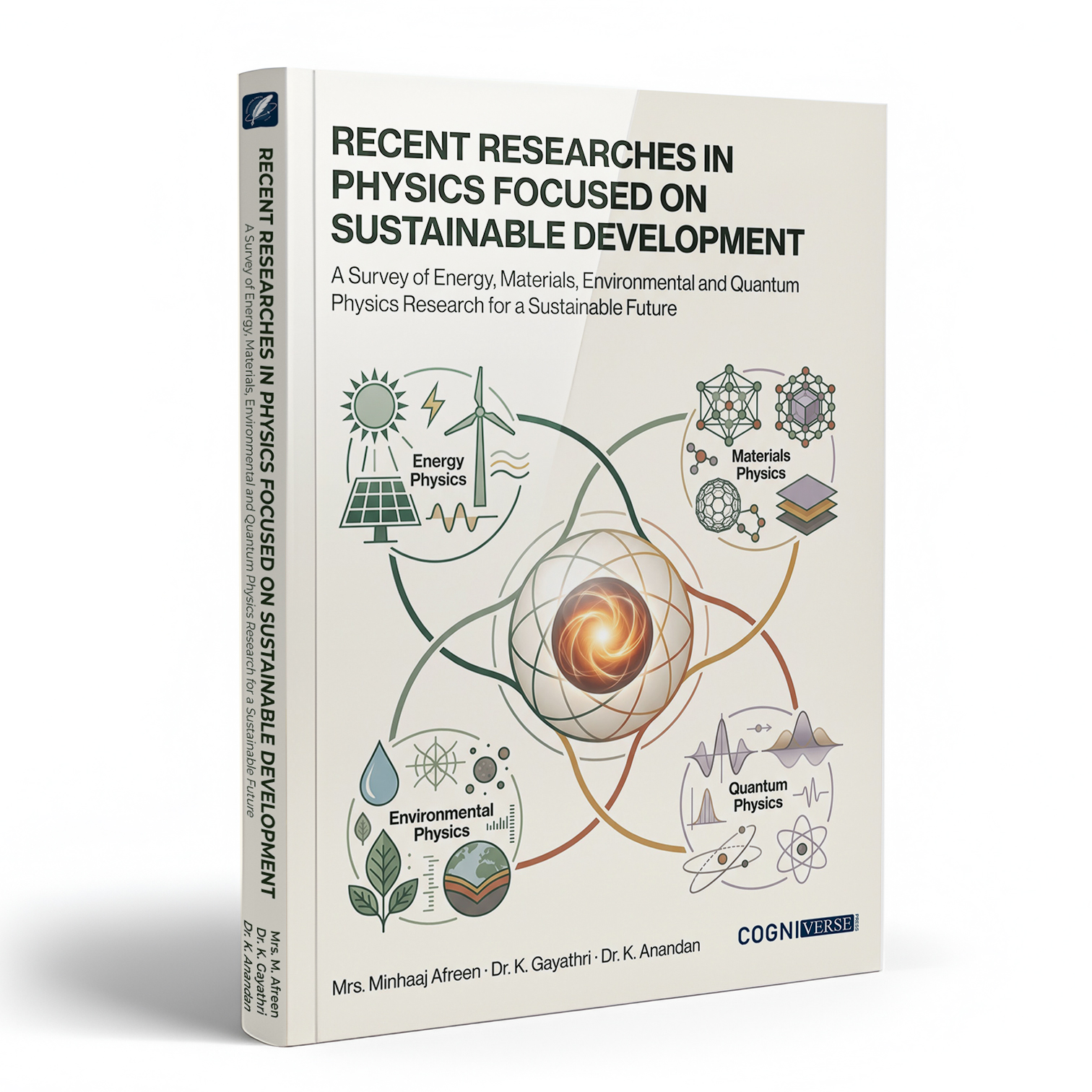
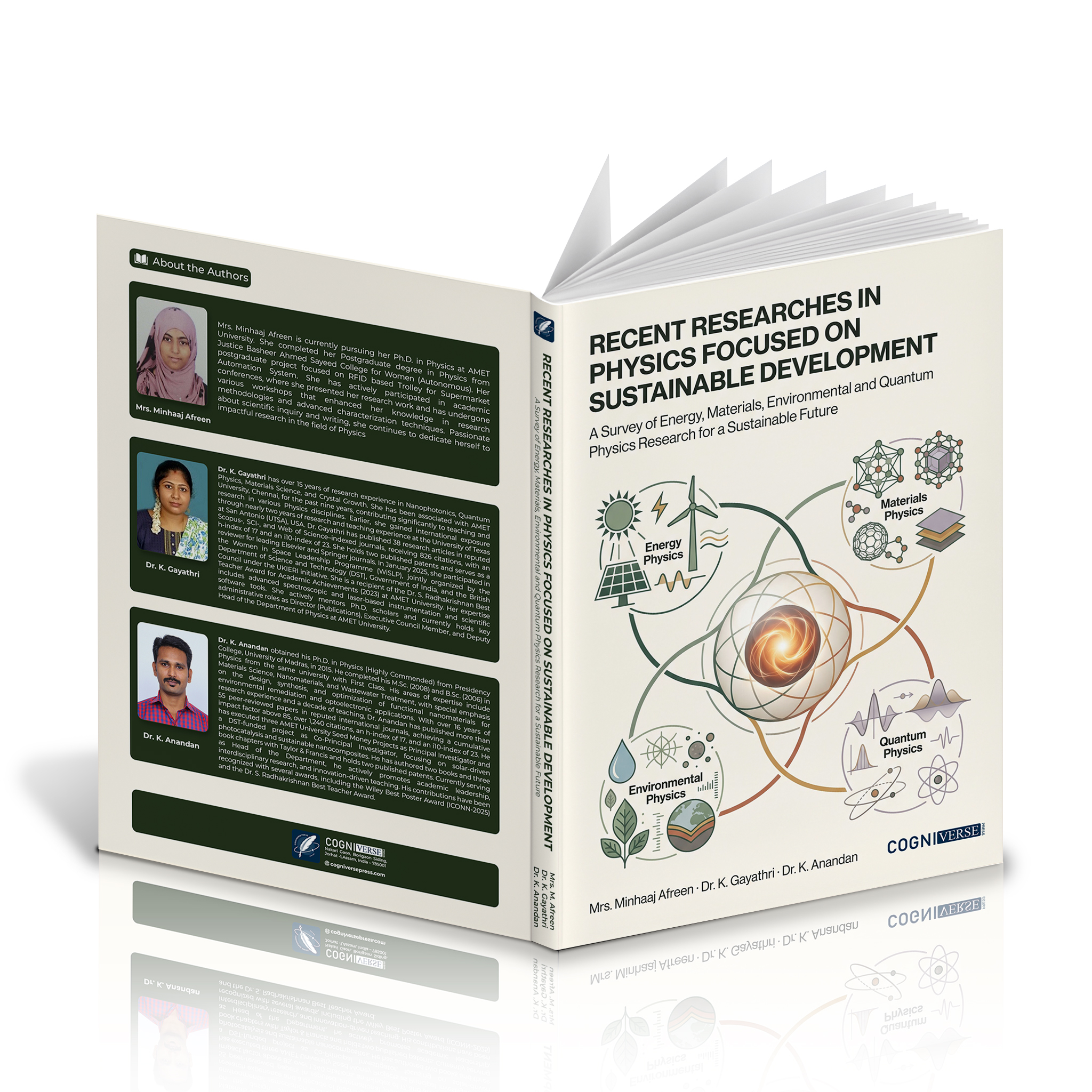
Title: RECENT RESEARCHES IN PHYSICS FOCUSED ON SUSTAINABLE DEVELOPMENT
Subtitle: A Survey of Energy, Materials, Environmental and Quantum Physics Research for a Sustainable Future
Author(s): Mrs. Minhaaj Afreen, Dr. K. Gayathri, Dr. K. Anandan
Publisher: Cogniverse Press
Edition: First Edition
Publication Date: September, 2026
ISBN: 978-81-68073-27-2
e-ISBN: 978-81-68073-28-9
DOI: https://doi.org/10.5281/zenodo.22295641
Total Pages: 85
Preface
The twenty-first century presents humanity with a defining challenge: sustaining economic growth and improving quality of life for a growing global population while safeguarding the planet’s ecological systems for future generations. Physics, as the foundational science describing the behaviour of matter and energy, sits at the heart of this challenge. From the photons striking a solar cell to the neutrons sustaining a fusion reaction, the language of physics underlies nearly every technology that promises a more sustainable future.
This book, Recent Researches in Physics Focused on Sustainable Development, offers students, researchers, and interested professionals a broad survey of how modern physics research contributes to the global sustainability agenda. The chapters examine renewable energy generation, energy storage, nuclear fusion, hydrogen technologies, quantum science, power-grid physics, advanced materials, and environmental and climate physics, each connecting fundamental principles with the engineering research translating them into deployable technology.
While sustainability is often discussed in the language of policy and economics, the technological solutions making ambitious climate and development targets achievable are, in large part, products of physics research. Understanding this underlying physics matters not only for scientists and engineers, but for policymakers, educators, and citizens seeking to judge the feasibility and limitations of proposed solutions.
This book does not claim to be exhaustive; such a task would require many volumes and would quickly date given the pace of research. Instead, it offers a coherent overview of the major research directions, illustrated with representative studies from the recent literature, with each chapter discussing relevant physical principles, reviewing recent research, and considering open challenges. The author gratefully acknowledges the global community of physicists and engineers whose published research made this survey possible.
Table of Contents
Chapter 1. Physics and the Sustainability Imperative
- 1.1. Introduction
- 1.2. The Thermodynamic Foundations of Sustainability
- 1.3. Energy, Entropy and the Anthropocene
- 1.4. Structure of This Book
Chapter 2. Solar Photovoltaics – Materials and Device Physics
- 2.1. The Physics of Photovoltaic Conversion
- 2.2. Crystalline Silicon and Its Continuing Evolution
- 2.3. Perovskite Solar Cells
- 2.4. Thin-Film and Emerging Photovoltaic Technologies
- 2.5. System-Level Considerations and Outlook
Chapter 3. Wind Energy – Aerodynamics and Turbine Physics
- 3.1. The Betz Limit and Momentum Theory
- 3.2. Blade Aerodynamics and Structural Physics
- 3.3. Offshore Wind and Atmospheric Boundary-Layer Physics
- 3.4. Wind Farm Wake Modelling
- 3.5. Outlook
Chapter 4. Energy Storage – Batteries, Supercapacitors and Beyond
- 4.1. Why Storage Matters
- 4.2. Lithium-Ion Battery Physics
- 4.3. Beyond Lithium: Alternative Chemistries
- 4.4. Supercapacitors and Power-Dense Storage
- 4.5. Mechanical and Thermal Storage
- 4.6. Outlook
Chapter 5. Nuclear Fusion – Progress Toward Clean Baseload Power
- 5.1. The Physics of Fusion Reactions
- 5.2. Magnetic Confinement: Tokamaks and Stellarators
- 5.3. Inertial Confinement Fusion
- 5.4. High-Temperature Superconducting Magnets
- 5.5. Remaining Challenges and Outlook
Chapter 6. Thermoelectric Materials and Waste-Heat Recovery
- 6.1. The Seebeck Effect and Thermoelectric Figure of Merit
- 6.2. Nanostructuring and Phonon Engineering
- 6.3. Applications in Waste-Heat Recovery and Sustainable Power
- 6.4. Outlook
Chapter 7. The Hydrogen Economy – Physics of Production and Fuel Cells
- 7.1. Why Hydrogen?
- 7.2. Electrolysis: Splitting Water with Electricity
- 7.3. Hydrogen Storage Physics
- 7.4. Fuel Cells: Converting Hydrogen Back to Electricity
- 7.5. System Efficiency and Outlook
Chapter 8. Quantum Technologies for Energy Efficiency and Sensing
- 8.1. Introduction
- 8.2. Quantum Sensing for Environmental and Resource Monitoring
- 8.3. Energy Efficiency of Quantum and Classical Computation
- 8.4. Superconducting and Cryogenic Technologies
- 8.5. Outlook
Chapter 9. Smart Grids, Power Electronics and Superconductivity
- 9.1. The Physics Challenge of Grid Integration
- 9.2. Power Electronics and Wide-Bandgap Semiconductors
- 9.3. Superconducting Power Transmission
- 9.4. Smart Grid Sensing and Control
- 9.5. Outlook
Chapter 10. Advanced Materials – Perovskites, 2D-Materials and Metamaterials
- 10.1. Materials Physics as an Enabling Discipline
- 10.2. Two-Dimensional Materials
- 10.3. Metal-Organic Frameworks and Porous Materials
- 10.4. Metamaterials for Radiative Cooling
- 10.5. Outlook
Chapter 11. Environmental and Climate Physics
- 11.1. Radiative Transfer and Climate Sensitivity
- 11.2. Climate Modelling and Computational Physics
- 11.3. Remote Sensing and Earth Observation Physics
- 11.4. Carbon Capture and Sequestration Physics
- 11.5. Outlook
Chapter 12. Physics for Sustainable Buildings and Green Computing
- 12.1. Building Physics and Thermal Efficiency
- 12.2. Radiative Cooling and Urban Heat
- 12.3. The Growing Energy Footprint of Computing
- 12.4. Physics-Driven Efficiency in Computing Hardware
- 12.5. Outlook
Chapter 13. Challenges, Policy Interfaces and Future Directions
- 13.1. From Laboratory to Deployment
- 13.2. Critical Materials and Resource Constraints
- 13.3. Lifecycle Analysis and Embodied Energy
- 13.4. The Physics-Policy Interface
- 13.5. Open Research Questions
Chapter 14. Conclusion
- 14.1. Synthesis
- 14.2. The Interconnected Nature of the Sustainability Challenge
- 14.3. Reasons for Optimism
- 14.4. Closing Remarks
Chapter 15. Physics of Sustainable Transportation
- 15.1. The Scale of the Transportation Challenge
- 15.2. Electric Vehicle Physics
- 15.3. Aviation and the Challenge of Energy Density
- 15.4. Maritime Shipping and Heavy Freight
- 15.5. Outlook
Chapter 16. Emerging Frontiers – AI-Accelerated Discovery and Space-Based Solar Power
- 16.1. Machine Learning as a Tool for Physics Discovery
- 16.2. Physics-Informed Machine Learning
- 16.3. Space-Based Solar Power
- 16.4. Outlook
Chapter 17. Case Studies in Physics-Driven Sustainability Research
- 17.1. Purpose of This Chapter
- 17.2. Case Study: The ITER International Fusion Collaboration
- 17.3. Case Study: National Renewable Energy Laboratories and Applied Photovoltaic Research
- 17.4. Case Study: Developing-Country Research Capacity in Renewable Energy Physics
- 17.5. Lessons from These Case Studies
Chapter 18. Physics Education and Workforce Development for Sustainability
- 18.1. The Human Capital Dimension
- 18.2. Curriculum Evolution
- 18.3. Diversity and Global Participation
- 18.4. Public Physics Literacy
- 18.5. Outlook
Chapter 19. The Physics of Recycling and the Circular Economy
- 19.1. Why Recycling Physics Matters for Sustainability
- 19.2. Battery Recycling Physics and Chemistry
- 19.3. Photovoltaic Module Recycling
- 19.4. Rare-Earth Magnet Recycling
- 19.5. Outlook
Chapter 20. The Water-Energy Nexus and Desalination Physics
- 20.1. An Interconnected Resource Challenge
- 20.2. The Thermodynamics of Desalination
- 20.3. Emerging Desalination and Water-Harvesting Technologies
- 20.4. Outlook



Reviews
There are no reviews yet.