


Description
Book Details
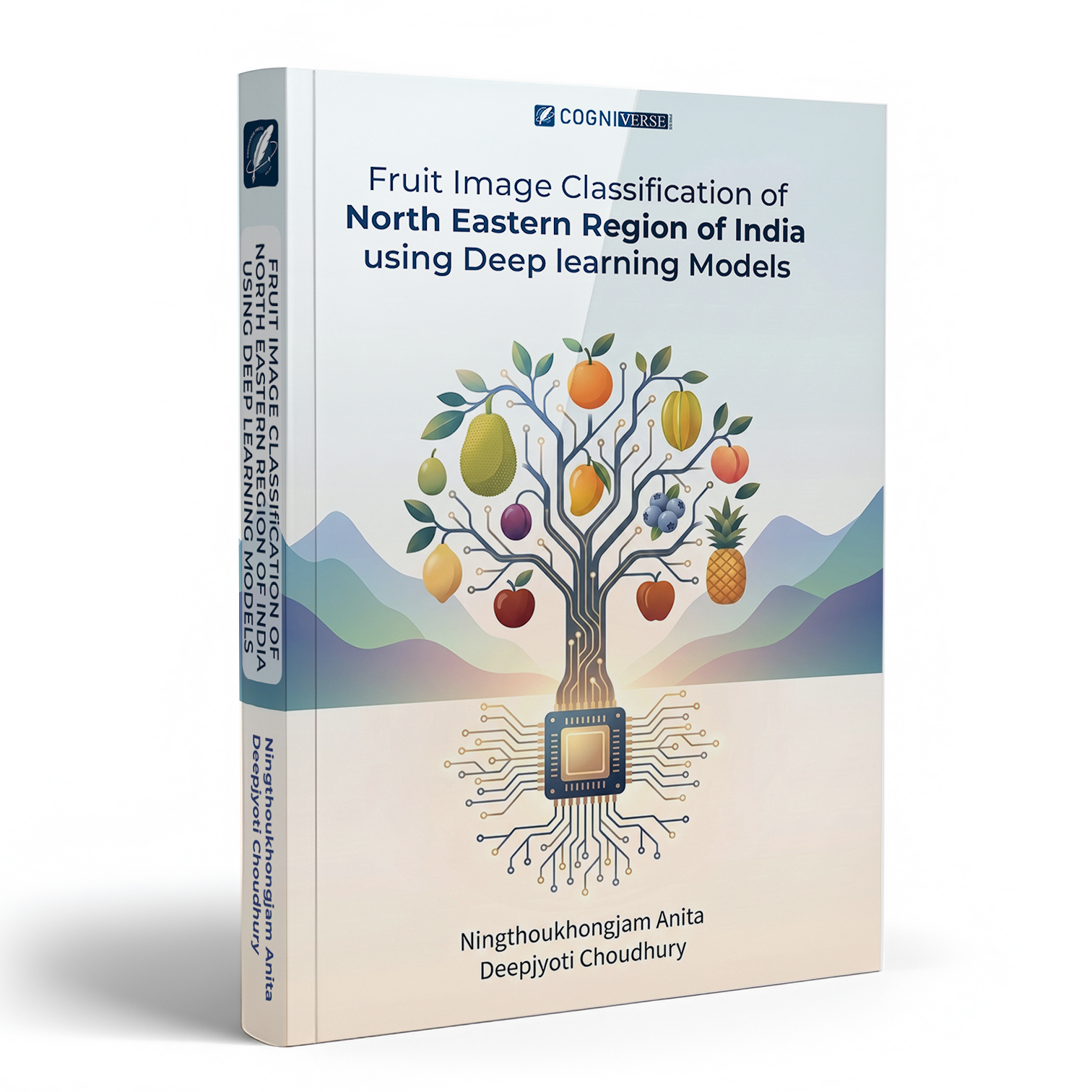
Title: Fruit Image Classification of North Eastern Region of India using Deep Learning Models
Author(s): Ningthoukhongjam Anita, Deepjyoti Choudhury
Publisher: Cogniverse Press, Jorhat, Assam, India
First Edition: June 2026
DOI: 10.5281/zenodo.21107527
ISBN: 978-81-688286-4-3 (Print Edition)
e-ISBN: 978-81-688286-5-0 (Digital Edition)
Cover Designing: Cogniverse Press Digital Team
Copyright: © Authors
Authors
- Ningthoukhongjam Anita – M.Tech. (Computer Science & Engineering), Department of Computer Science and Engineering, Royal School of Engineering and Technology, The Assam Royal Global University, Guwahati, Assam, India
- Deepjyoti Choudhury – Associate Professor & Head, Department of Computer Science and Engineering, Royal School of Engineering and Technology, The Assam Royal Global University, Guwahati, Assam, India
Publisher Information
Cogniverse Press
Nakari Gaon, Borigaon Siding, Jorhat – 1, Assam, India
Preface
The rapid advancement of artificial intelligence is transforming modern agriculture by improving productivity, reducing manual effort, and enabling data-driven decision-making. Among its many applications, image-based recognition has become an essential technology for automating fruit identification, harvesting, sorting, quality assessment, inventory management, and digital commerce. However, many existing deep learning solutions rely on carefully controlled datasets that fail to capture the diversity and complexity of real agricultural environments.
This book presents the outcome of research focused on developing a practical deep learning framework capable of recognising both widely cultivated fruits and indigenous fruit varieties from the North Eastern region of India. Despite their agricultural, nutritional, and commercial significance, these regional fruits remain underrepresented in publicly available image datasets and modern AI-based classification systems.
Unlike conventional approaches that rely on studio-quality images, the research embraces real-world conditions by using photographs collected from orchards, markets, farms, gardens, and households. The dataset undergoes systematic preprocessing through canonical label mapping, duplicate removal, automated sanitization, and consistency checks, demonstrating that high-quality datasets are fundamental to building reliable artificial intelligence systems.
The book covers the complete development lifecycle of an image classification system, including dataset preparation, preprocessing, model design, training, evaluation, and deployment. Several state-of-the-art convolutional neural network architectures—including MobileNetV2, ResNet50, VGG16, DenseNet121, and EfficientNetB0—are comparatively evaluated. MobileNetV2 is identified as the most effective balance between predictive performance and computational efficiency, making it suitable for deployment on mobile devices and resource-constrained agricultural applications.
Beyond experimental evaluation, the book demonstrates how deep learning models can be translated into scalable solutions for farmers, researchers, students, agricultural organisations, and software developers. The methodologies presented also provide a foundation for broader applications in precision agriculture, biodiversity conservation, crop monitoring, and intelligent farming systems.
Intended for students, researchers, and professionals in artificial intelligence, computer science, agricultural engineering, and data science, this book combines theoretical foundations with practical implementation. It aims to inspire future innovations that preserve regional agricultural diversity, empower farming communities through intelligent technologies, and contribute to sustainable agriculture.
Abstract
This book presents a deep learning framework for real-world fruit image classification, addressing the limitations of existing models that depend on controlled datasets and studio-quality images. The research focuses on both common and indigenous fruit varieties from the North Eastern region of India using images captured in natural environments such as markets, orchards, gardens, and households.
The proposed methodology deliberately avoids segmentation, background removal, and manual augmentation, enabling models to learn directly from complex natural scenes. A systematic preprocessing pipeline is introduced to resolve inconsistent labels, duplicate classes, and unnecessary categories through canonical label mapping and automated sanitization. Efficient data loading is achieved using a custom TensorFlow pipeline.
Five state-of-the-art convolutional neural network architectures are evaluated, with MobileNetV2 selected for its optimal balance between accuracy and computational efficiency. A customized classification head incorporating batch normalization, dropout, and L2 regularization is trained using a two-stage fine-tuning strategy. The resulting model achieves 96.12% classification accuracy across 25 fruit categories on unseen real-world images while maintaining strong macro and weighted F1 scores.
The lightweight model is suitable for deployment in mobile and web-based agricultural applications, demonstrating the practical potential of artificial intelligence for precision agriculture, biodiversity documentation, and intelligent farming systems.
Key Themes
- Artificial Intelligence in Agriculture
- Deep Learning
- Computer Vision
- Fruit Image Classification
- Convolutional Neural Networks (CNNs)
- MobileNetV2, ResNet50, VGG16, DenseNet121 and EfficientNetB0
- Agricultural Image Processing
- TensorFlow Data Pipelines
- Image Dataset Preprocessing
- Precision Agriculture
- Biodiversity Documentation
- Mobile AI Applications
- Machine Learning Model Deployment
Table of Contents
Chapter 1: Introduction
- 1.1 Overview
- 1.2 Problem Statement
- 1.3 Objectives
- 1.4 Research Questions
- 1.5 Scope of the Study
- 1.6 Significance of the Work
- 1.7 Organization of the Book
Chapter 2: Literature Review
- 2.1 Introduction
- 2.2 Deep Learning for Fruit and Crop Classification
- 2.3 Lightweight CNN Models and Mobile Deployments
- 2.4 Preprocessing Pipelines for Agricultural Image Datasets
- 2.5 Challenges in Agricultural Image Datasets
- 2.6 Classification of Regional and Underrepresented Fruits
- 2.7 End-to-End Classification Pipelines in Recent Studies
Chapter 3: Methodology
- 3.1 Methodological Framework
- 3.2 Dataset Description
- 3.3 Data Preprocessing Strategy
- 3.4 Image Processing and TensorFlow Data Pipeline
- 3.5 Model Architecture Design
- 3.6 Training Strategy and Optimization
- 3.7 Model Evaluation and Validation
- 3.8 Prediction and Inference Pipeline
- 3.9 Comparative Backbone Evaluation Protocol
Chapter 4: Results and Discussion
- 4.1 Overview of Experimental Evaluation
- 4.2 Test Dataset Characteristics
- 4.3 Overall Classification Performance
- 4.4 Confusion Matrix Analysis
- 4.5 Per-Class Performance Evaluation
- 4.6 Training Convergence Analysis (Final Fine-Tuning Stage)
- 4.7 Comparative Evaluation of Backbone Architectures
- 4.8 Discussion and Key Observations
- 4.9 Streamlit for Front-End Deployment and Real-Time Inference Evaluation
Chapter 5: Conclusion and Future Scope
- 5.1 Conclusion
- 5.2 Future Scope
Chapter 6: Bibliography
Chapter 7: Appendix
- Dataset Availability
- Fruit Classes Used in the Dataset
- Hyperparameter Configuration
- Experimental Environment



Reviews
There are no reviews yet.