


Description
Long Description.txt
100%
Book Details
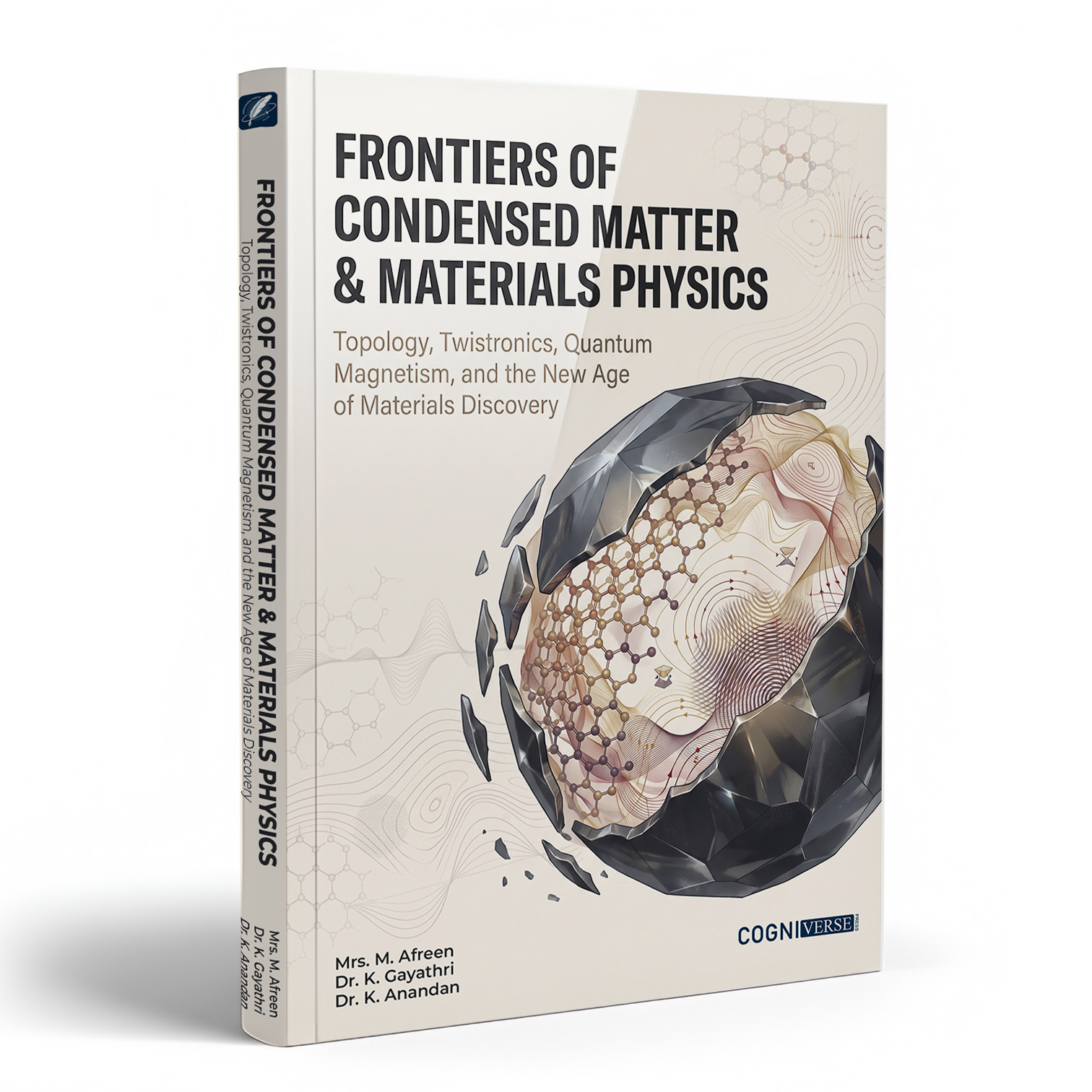
Title: Frontiers of Condensed Matter & Materials Physics
Subtitle: Topology, Twistronics, Quantum Magnetism, and the New Age of Materials Discovery
Author(s): Mrs. Minhaaj Afreen, Dr. K. Gayathri, Dr. K. Anandan
Publisher: Cogniverse Press
Edition: First Edition
Publication Date: September, 2026
DOI: https://doi.org/10.5281/zenodo.22295093
ISBN: 978-81-68073-29-6
e-ISBN: 978-81-68073-30-2
Preface
Condensed matter physics has always been the branch of physics closest to the world of things you can touch — the physics of solids, liquids, and the exotic phases between. The last five years, though, have compressed decades of expected progress into a continuous stream of surprises: whole magnetic phases once absent from textbooks confirmed in the lab, twisted two-dimensional materials producing correlated electron physics that rivals decades-old heavy-fermion compounds, superconductivity resurfacing in unexpected oxide families, and a company with no history in academic solid-state physics putting topological quantum computing back under intense scientific scrutiny.
This book is written for readers who already know what a band gap or a Cooper pair is, and who want an up-to-date map of where the field is moving — not a repetition of foundational theory unchanged since the 1980s. Four forces have reshaped the discipline: the moiré revolution, which turns twisted two-dimensional crystals into programmable quantum simulators; a wave of newly recognized phases — altermagnetism, three-dimensional quantum spin liquids, higher-order topological insulators; artificial intelligence’s shift from an auxiliary tool to a primary discovery engine; and the near-total merging of condensed matter physics with quantum information science.
Each chapter that follows focuses on one such frontier — what it is, why it matters, and where the open controversies lie — making the case that this is one of the most rapidly evolving areas of physics today, precisely because it sits at the intersection of fundamental quantum mechanics and technological urgency.
Table of Contents
Chapter 1. The New Condensed Matter Landscape
- 1.1. From Classification to Design
- 1.2. Why Topology Still Matters
- 1.3. Correlation, Frustration, and the Return of Strongly Interacting Matter
- 1.4. Materials Physics Meets Information Science
- 1.5. How to Read the Chapters That Follow
Chapter 2. Topological Phases of Matter: Beyond the Textbook Insulator
- 2.1. From Surface States to Corners
- 2.2. Topological Semimetals as a Working Platform
- 2.3. Fractional Topological Order without a Magnetic Field
- 2.4. Topology as a Design Tool
Chapter 3. Moiré Quantum Matter: Twistronics and Flat-Band Physics
- 3.1. The Magic of a Small Angle
- 3.2. Twisted Transition Metal Dichalcogenides
- 3.3. Rhombohedral Graphene and Multilayer Stacking
- 3.4. Superconductivity Next Door to Magnetism and Fractionalization
- 3.5. Toward Non-Abelian Physics
- 3.6. Reproducibility as a Practical Challenge
Chapter 4. Frustrated Magnetism and Quantum Spin Liquids
- 4.1. Frustration as a Resource
- 4.2. The Kagome Lattice: A Long-Running Search
- 4.3. A Three-Dimensional Confirmation
- 4.4. Why This Matters Beyond Magnetism
- 4.5. Rydberg Atom Arrays as a Complementary Route
Chapter 5. Unconventional and High-Temperature Superconductivity
- 5.1. Beyond the Cuprate Paradigm
- 5.2. What Nickelates Add to the Debate
- 5.3. Hydrides and the Elusive Room-Temperature Superconductor
- 5.4. An Honest Accounting of the Field
- 5.5. Sample Quality as a Recurring Bottleneck
Chapter 6. Altermagnetism: A Third Fundamental Class of Magnetism
- 6.1. Rewriting a Century-Old Classification
- 6.2. d-Wave, g-Wave, and the Geometry of Spin Splitting
- 6.3. Rapid Experimental Confirmation
- 6.4. Why Spintronics Cares
- 6.5. Open Questions
Chapter 7. Topological Superconductivity and the Contested Search for Majorana Qubits
- 7.1. Why Majorana Modes Are Special
- 7.2. The Hybrid Nanowire Platform
- 7.3. Microsoft’s Topological Qubit Program
- 7.4. A Case Study in How Contested Science Proceeds
- 7.5. Alternative Routes to Topological Quantum Computation
Chapter 8. Two-Dimensional Materials Beyond Graphene
- 8.1. A Maturing Materials Library
- 8.2. Intrinsic Magnetism in Two Dimensions
- 8.3. Ferroelectricity and Sliding Polarization
- 8.4. Beyond Chalcogenides: New Families
- 8.5. Toward Wafer-Scale Integration
Chapter 9. Spintronics, Orbitronics, and Spin-Orbit Phenomena
- 9.1. Spin as an Information Carrier
- 9.2. Antiferromagnetic and Altermagnetic Spintronics
- 9.3. Orbitronics: A New Degree of Freedom
- 9.4. Spin-Orbit Torques and Topological Spin Textures
- 9.5. The Common Thread
Chapter 10. Non-Equilibrium and Floquet-Engineered Quantum Matter
- 10.1. Matter Away from Equilibrium
- 10.2. Floquet Engineering
- 10.3. Light-Induced Superconductivity
- 10.4. Prethermal and Time-Crystalline Phases
- 10.5. Why This Frontier Matters
Chapter 11. Machine Learning and Data-Driven Materials Discovery
- 11.1. From Screening to Generation
- 11.2. Large-Scale Stability Prediction
- 11.3. Generative Models for Inverse Design
- 11.4. Autonomous Laboratories
- 11.5. The Synthesis Gap
- 11.6. Energy and Ethical Considerations
Chapter 12. Quantum Materials for Quantum Information Science
- 12.1. Materials as Qubit Substrates
- 12.2. Superconducting Qubits and the Materials Bottleneck
- 12.3. Topological Qubits Revisited
- 12.4. Spin Qubits and Point Defects
- 12.5. Quantum Simulation as a Parallel Goal
- 12.6. Cryogenic Engineering as an Overlooked Enabler
Chapter 13. Emerging Frontiers: Metamaterials, Neuromorphic Matter, and Topological Photonics and Phononics
- 13.1. Beyond Electrons: Topology for Waves of All Kinds
- 13.2. Metamaterials and Programmable Response
- 13.3. Neuromorphic and Brain-Inspired Materials
- 13.4. Oxide Electronics and Correlated-Material Devices
- 13.5. A Field Without a Settled Endpoint
Chapter 14. Quantum Geometry: Berry Curvature, Orbital Magnetism, and Beyond Band Topology
- 14.1. The Geometry Hidden Inside a Band Structure
- 14.2. Quantum Geometry as a Design Target
- 14.3. Orbital Magnetism without Spin
- 14.4. A Common Language Across Subfields
Chapter 15. Excitons, Polaritons, and Moiré Optics
- 15.1. Excitons in Reduced Dimensions
- 15.2. Moiré Excitons
- 15.3. Exciton-Polaritons and Strong Light-Matter Coupling
- 15.4. Valleytronics
Chapter 16. Phonons, Thermal Transport, and Thermoelectric Materials
- 16.1. Phonons as More Than Heat Carriers
- 16.2. Engineering Thermal Conductivity
- 16.3. Two-Dimensional and Moiré Thermal Transport
- 16.4. Toward Higher-Efficiency Thermoelectrics
Chapter 17. Complex Oxide Heterostructures and Interface Engineering
- 17.1. More Is Different at the Interface
- 17.2. Strain, Symmetry, and Emergent Order
- 17.3. Digital Synthesis and Superlattice Design
- 17.4. Interfaces as a Discovery Platform
Chapter 18. Extreme Conditions and Ultrafast Probes as Discovery Tools
- 18.1. Pressure as a Clean Tuning Parameter
- 18.2. From Static Pressure to Dynamic Compression
- 18.3. Ultrafast Spectroscopy: Watching Electrons Move
- 18.4. X-Ray Free-Electron Lasers
- 18.5. Instrumentation as the Quiet Engine of Discovery
Chapter 19. Conclusion – Reading the Field Going Forward
References
Glossary
Appendix
Displaying Long Description.txt.


Reviews
There are no reviews yet.