

Description
Book Details
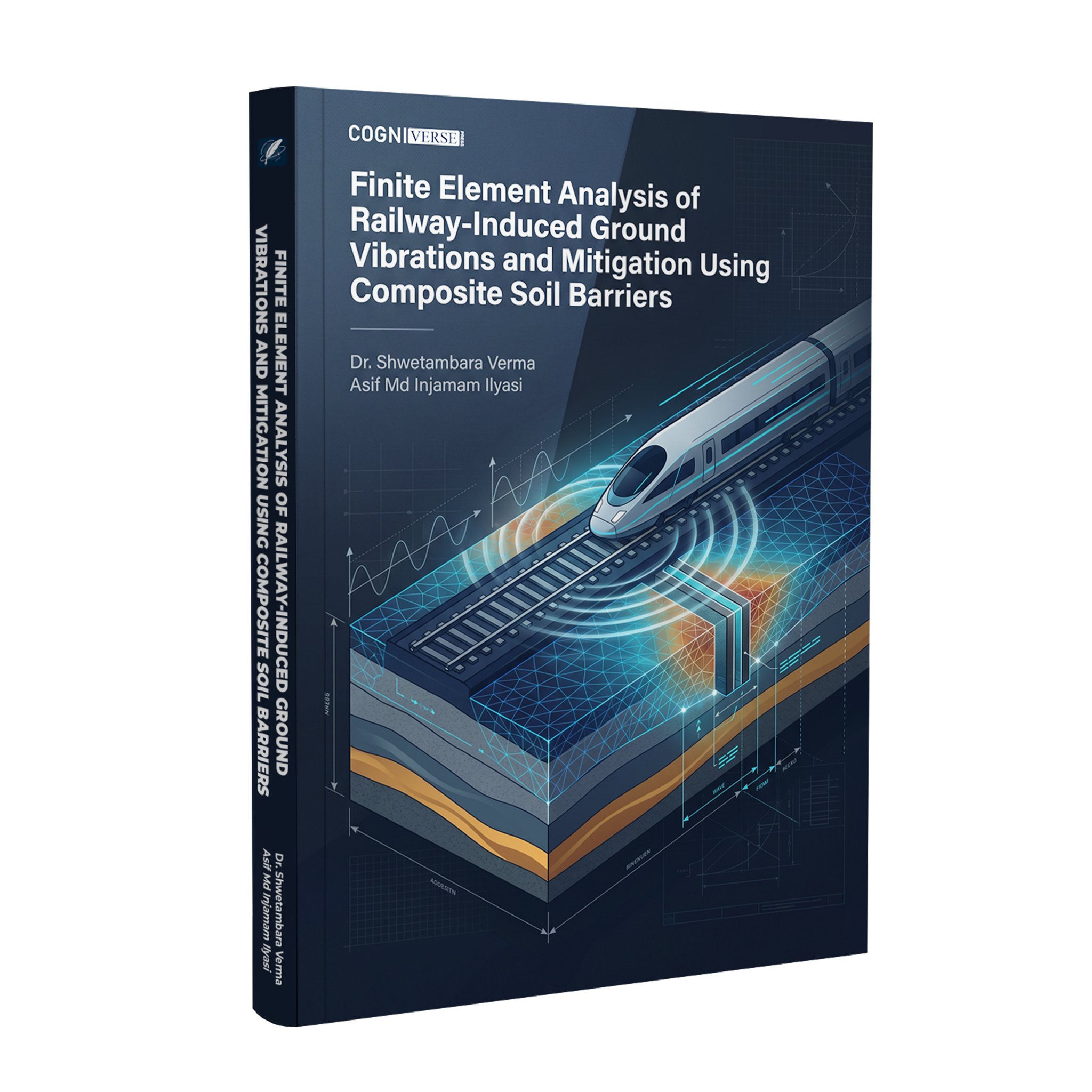
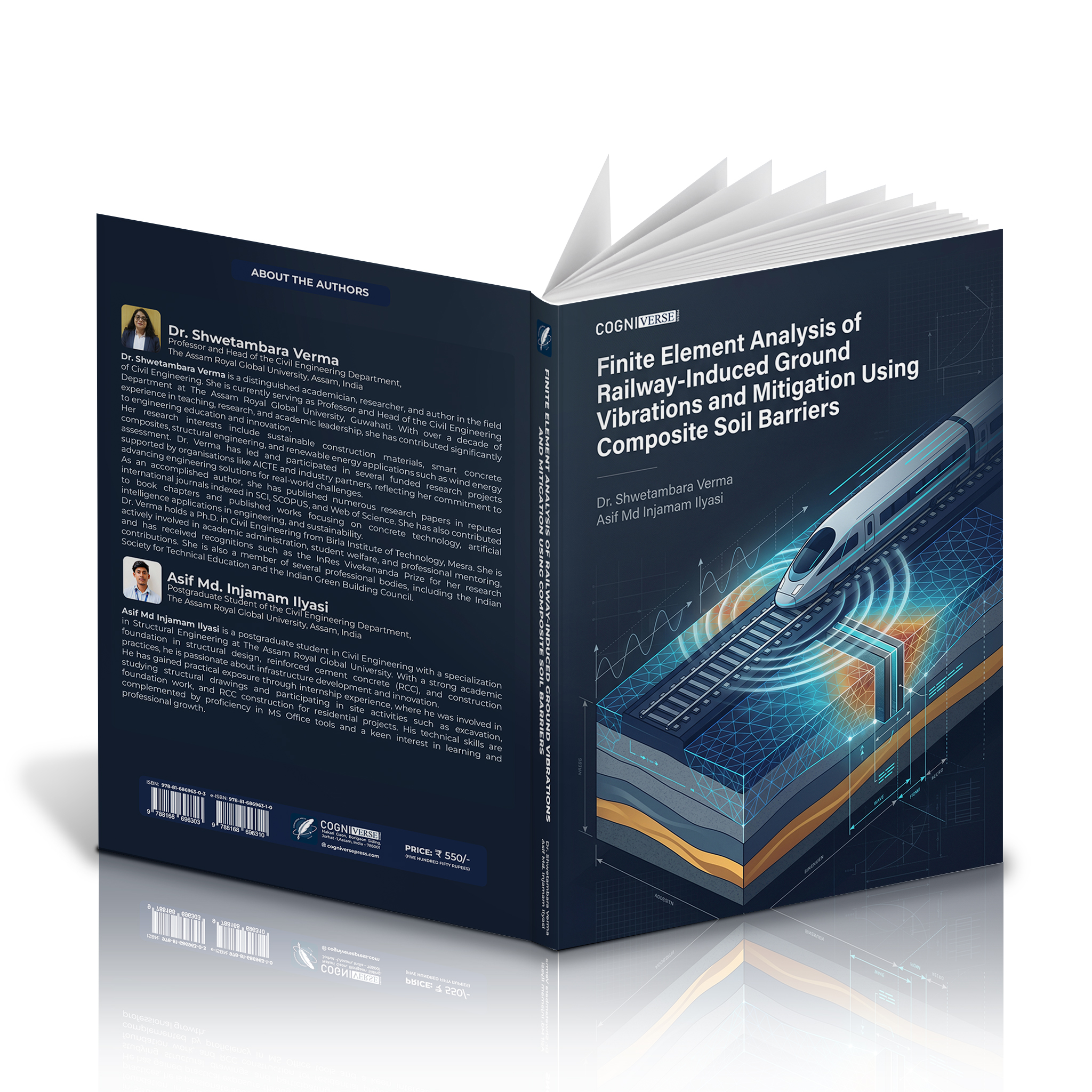
Title: Finite Element Analysis of Railway-Induced Ground Vibrations and Mitigation Using Composite Soil Barriers
Authors: Dr. Shwetambara Verma and Asif Md. Injamam Ilyasi
Publisher: Cogniverse Press, Jorhat, Assam, India
First Edition: May 2026
DOI: 10.5281/zenodo.20351028
ISBN: 978-81-686963-0-3 (Print Edition)
e-ISBN: 978-81-686963-1-0 (Digital Edition)
Preface
This book presents a comprehensive numerical investigation of railway-induced ground vibrations and their mitigation using sustainable composite soil barriers. As railway networks expand and train speeds increase, vibration-related challenges affecting structural safety, underground utilities, and human comfort have become increasingly significant.
The study employs advanced three-dimensional finite element modelling using PLAXIS 3D to simulate train–track–soil interaction under dynamic loading conditions. Both linear elastic and nonlinear soil behaviour models are incorporated to accurately represent ground response under cyclic train loading.
Special emphasis is placed on evaluating sustainable composite barrier materials, including rubber–soil, sawdust–soil, and fly ash–soil mixtures. Through extensive parametric analyses, the research examines the effects of material properties, barrier depth, and placement on vibration attenuation.
The findings demonstrate that rubber–soil composite barriers provide the highest vibration reduction due to their superior damping characteristics, while sawdust–soil and fly ash–soil composites also offer significant mitigation benefits. The study highlights the importance of nonlinear soil modelling in achieving accurate predictions and effective vibration control designs.
This work contributes valuable knowledge to geotechnical and railway engineering and serves as a practical reference for engineers, researchers, and planners involved in the development of vibration-sensitive railway infrastructure.
Acknowledgement
The authors express sincere gratitude to Prof. A. K. Buragohain, Hon’ble Vice Chancellor of The Assam Royal Global University, for his encouragement, visionary leadership, and support throughout the completion of this work.
Special thanks are extended to Prof. Diganta Munshi, Dean, Registrar Administration and Director IQAC, for his continuous guidance and assistance.
Asif Md. Injamam Ilyasi acknowledges his guide, Prof. Shwetambara Verma, for her invaluable mentorship, motivation, and academic support, which played a pivotal role in shaping this research.
The authors also appreciate the contributions of faculty members, colleagues, staff, and students of The Assam Royal Global University for fostering a supportive academic environment. Gratitude is extended to all individuals who directly or indirectly contributed to the successful completion of this publication.
Key Themes
- Railway-induced ground vibrations and their impacts.
- Train–track–soil dynamic interaction.
- Finite element modelling using PLAXIS 3D.
- Linear and nonlinear soil behaviour analysis.
- Sustainable composite soil barriers for vibration mitigation.
- Rubber–soil, sawdust–soil, and fly ash–soil barrier systems.
- Parametric evaluation of barrier performance.
- Vibration attenuation and damping mechanisms.
- Comparison with ISO vibration standards.
- Design implications for railway infrastructure.
Table of Contents
Chapter 1: Introduction
- 1.1 Background of the Study
- 1.2 Mechanism of Train-Induced Vibrations
- 1.3 Railway Development and the Necessity to Study
- 1.4 Mitigation Strategies
- 1.5 Numerical Modelling Approach
- 1.6 Standards and Guidelines
- 1.7 Problem Statement
- 1.8 Significance of the Study
- 1.9 Research Gaps
- 1.10 Objective
- 1.11 Scope and Limitations of the Study
- 1.12 Research Relevance
Chapter 2: Fundamentals of Railway Vibrations and Review of Mitigation Techniques
- 2.1 Overview
- 2.2 Characteristics of Railway-Induced Ground Vibrations and Measurement
- 2.3 Mechanisms of Vibration Generation: Train-Track-Soil Interaction
- 2.4 Vibration Propagation Through the Soil
- 2.5 Dynamic Soil and Composite Material Properties
- 2.6 Impact of Ground Vibrations on Adjacent Structures
- 2.7 Human Comfort, Perception, and Structural Damage Criteria
- 2.8 Numerical Modelling of Railway-Induced Vibrations
- 2.9 Salient Contribution
- 2.10 Literature Summary
Chapter 3: Numerical Modelling Approach
- 3.1 Overview
- 3.2 Geometry of the Model
- 3.3 Soil Profile and Material Properties
- 3.4 Material Models
- 3.5 Boundary Conditions
- 3.6 Dynamic Loading Conditions
- 3.7 Mesh Generation
- 3.8 Dynamic Analysis Setup
- 3.9 Mitigation Modelling
- 3.10 Parametric Study
- 3.11 Vibration Response Evaluation
- 3.12 Summary of Methodology
Chapter 4: Sawdust-Soil Composite Barrier
- 4.1 Overview
- 4.2 Material Properties of Sawdust-Soil Composite Barrier
- 4.3 Numerical Modelling of Sawdust-Soil Mitigation Barrier
- 4.4 Baseline Vibration Response
- 4.5 Linear Dynamic Analysis
- 4.6 Nonlinear Dynamic Analysis of Sawdust-Soil Composite Barrier
- 4.7 Percentage Change in Vibration Response
- 4.8 Comparison Between Linear Elastic and Nonlinear HSsmall Analysis
- 4.9 Comparison with ISO Recommended Vibration Limits
- 4.10 Summary
Chapter 5: Rubber-Soil Composite Barrier
- 5.1 Overview
- 5.2 Material Properties of Rubber-Soil Composite Barrier
- 5.3 Numerical Modelling of Rubber-Soil Mitigation Barrier
- 5.4 Baseline Vibration Response
- 5.5 Linear Dynamic Analysis
- 5.6 Nonlinear Dynamic Analysis
- 5.7 Percentage Change in Vibration Response
- 5.8 Comparison Between Linear Elastic and Nonlinear HSsmall Analysis
- 5.9 Comparison with ISO Recommended Vibration Limits
- 5.10 Summary
Chapter 6: Fly Ash-Soil Composite Barrier
- 6.1 Overview
- 6.2 Material Properties of Fly Ash-Soil Composite Barrier
- 6.3 Numerical Modelling of Fly Ash-Soil Mitigation Barrier
- 6.4 Baseline Vibration Response
- 6.5 Linear Dynamic Analysis
- 6.6 Nonlinear Dynamic Analysis
- 6.7 Percentage Change in Vibration Response
- 6.8 Comparison Between Linear Elastic and Nonlinear HSsmall Analysis
- 6.9 Comparison with ISO Recommended Vibration Limits
- 6.10 Summary
Chapter 7: Comparative Analysis and Design Implications and Applications
- 7.1 Overview
- 7.2 Comparison of Linear Elastic Analysis
- 7.3 Comparison of Nonlinear HSsmall Analysis
- 7.4 Comparison of Percentage Reduction in Vibration Response
- 7.5 Comparison with ISO Recommended Vibration Limits
- 7.6 Discussion on Effectiveness of Mitigation Materials
- 7.7 Summary
Chapter 8: Conclusions and Future Scope
- 8.1 Conclusions
- 8.2 Major Findings
- 8.3 Future Scope
References
Reference Materials and Bibliography



Reviews
There are no reviews yet.