
Description
Book Details
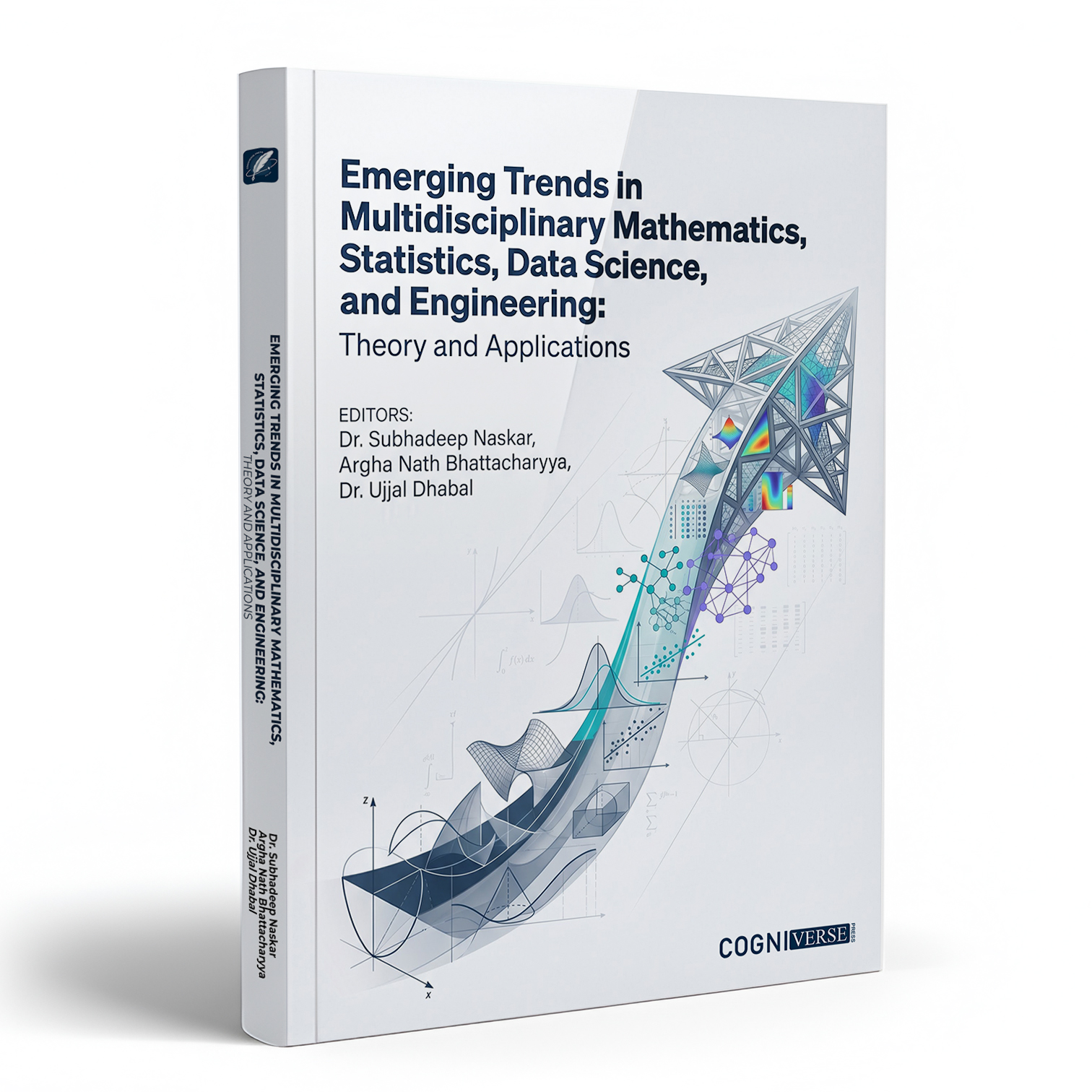
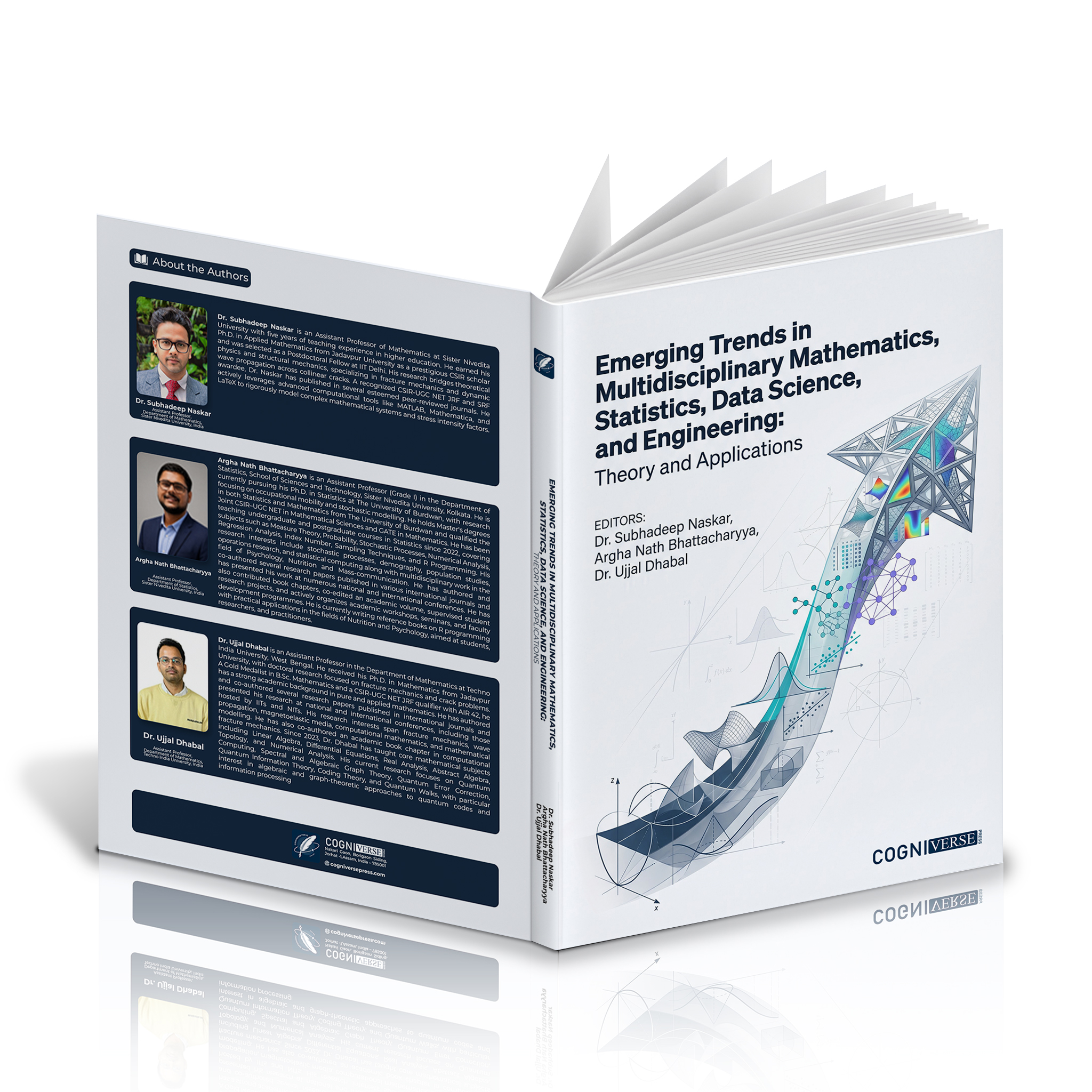
Title: Emerging Trends in Multidisciplinary Mathematics, Statistics, Data Science, and Engineering: Theory and Applications
Editor-in-Chief: Dr. Subhadeep Naskar
Co-Editors: Argha Nath Bhattacharyya, Dr. Ujjal Dhabal
Publisher: Cogniverse Press
ISBN: 978-81-688771-8-4
e-ISBN: 978-81-688771-9-1
DOI: https://doi.org/10.5281/zenodo.21342535
Edition: First Edition
Publication Date: July, 2026
Preface
It gives us immense pleasure to present the edited volume, Emerging Trends in Multidisciplinary Mathematics, Statistics, Data Science, and Engineering: Theory and Applications. This book has been conceived with the objective of providing a comprehensive scholarly platform for researchers, academicians, scientists, engineers, and students to disseminate innovative ideas and recent developments in the rapidly evolving fields of mathematical sciences, statistics, computational methodologies, data science, and engineering. In recent years, the boundaries separating these disciplines have become increasingly interconnected, giving rise to collaborative research that addresses complex real-world challenges through integrated theoretical and computational approaches. This volume is an effort to capture these emerging trends and present them within a single academic framework.
The exponential growth of computational technologies, artificial intelligence, machine learning, and big data analytics has transformed the way scientific investigations are conducted across disciplines. Mathematics continues to serve as the universal language for modelling natural phenomena, engineering systems, and decision-making processes, while statistics provides robust methodologies for inference, uncertainty quantification, and evidence-based conclusions. Simultaneously, data science has emerged as a multidisciplinary domain that combines statistical learning, computational algorithms, and domain knowledge to extract meaningful insights from massive datasets. Engineering, in turn, increasingly relies on mathematical modelling, optimization, and intelligent computational techniques to design innovative systems and solve practical problems. The convergence of these disciplines has created unprecedented opportunities for scientific advancement, making interdisciplinary research more relevant than ever before.
Recognizing this paradigm shift, the present volume brings together a diverse collection of original research contributions that reflect both theoretical advancements and practical applications. The chapters included in this book encompass a broad spectrum of topics, including mathematical modelling, differential geometry, operations research, optimization, numerical methods, scientific computing, statistical theory, probability models, machine learning, data analytics, and multidisciplinary applications across science and engineering.
A distinctive feature of this volume is its balanced emphasis on theoretical foundations and practical implementation. Several chapters focus on developing novel mathematical and statistical methodologies, while others demonstrate their applicability to engineering, industrial, environmental, and computational problems. This integration of theory with application reflects the evolving nature of contemporary research, where abstract mathematical concepts frequently translate into innovative technological solutions.
We believe that this book will serve as a valuable resource for university faculty, research scholars, postgraduate and doctoral students, practicing engineers, statisticians, mathematicians, data scientists, and professionals working in interdisciplinary research. Beyond presenting recent developments, we hope the chapters will inspire new ideas, stimulate future investigations, and encourage readers to explore novel research directions at the interface of mathematics, statistics, data science, and engineering.
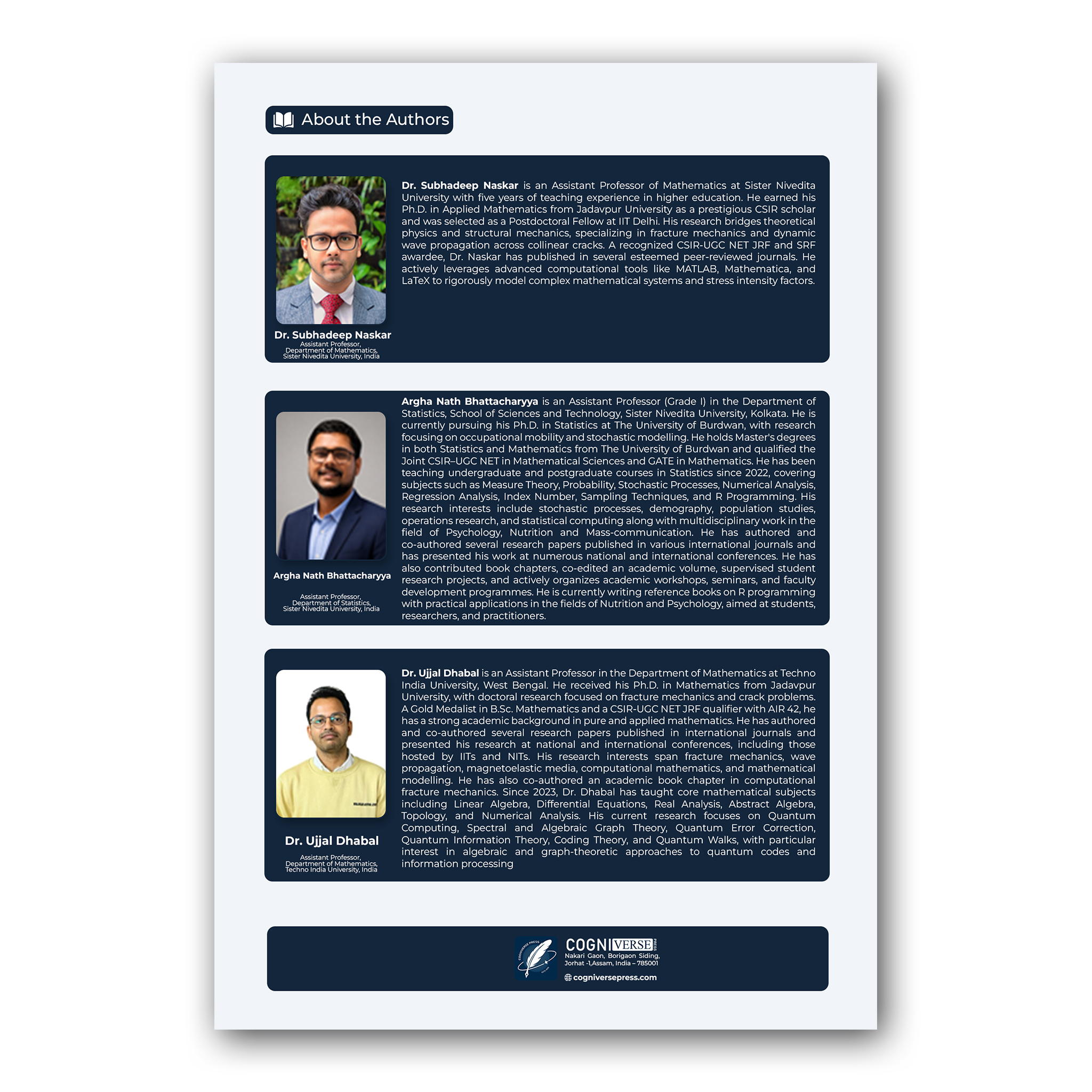
Editors:
Dr. Subhadeep Naskar (Editor-in-Chief)
Argha Nath Bhattacharyya (Co-Editor)
Dr. Ujjal Dhabal (Co-Editor)
Table of Contents
Chapter 1: Robust Statistical Modeling for Imbalance Datasets by Predictive Modeling: A Comparative Study of Cross-Domain Application of Data Science on Health and Banking Systems
Author: Jeet Polley
Abstract: In the modern times of statistics, prediction of rare events is of high value, but at the same time, it is difficult, because the number of rare events is very small, when compared with the number of events that are considered as the norm. This chapter theories and practically connects the medical field with the banking sector as it works with strongly biased and imbalanced data. K-Folds Cross-Validation is used to prevent overfitting and to make the model more consistent by controlling the model. The first part is on the medical field where the R programming language is used for creating risk predictor systems for heart attack and diabetes through Explainable AI (XAI) and SHAP. The second phase expands to digital banking ecosystems utilizing ROSE oversampling and Random Forest algorithms.
1. Introduction
2. Theoretical Framework & Methodology
2.1. Resampling Theory via ROSE
2.2. Algorithmic Modeling: Random Forest Mechanics
2.3. Model Validation: K-Folds Cross-Validation
2.4. Performance Metrics Beyond Accuracy
2.5. SHAP (SHapley Additive exPlanations)
2.6. Explainable AI (XAI) via SHAP
3. Dataset Specifications
3.1. Dataset Taxonomy and Structural Properties
3.2. Missing Value Topology and Preprocessing Protocols
4. Setup and Application: Preprocessing Pipelines
4.1. Domain A: Healthcare Risk Systems
4.2. Domain B: Banking and Financial Security (Credit Card Fraud Classifier)
4.3. Pipeline Execution Environment
5. Experimental Design and Model Configuration
5.1. Validation Design and Model Tuning
5.2. ROSE Parameter Optimization
5.3. Feature Engineering
6. Results
6.1. Predictive Performance and Validation Metrics
6.2. Visualizing Interpretability via SHAP Values
6.3. Advanced Performance Analysis and Statistical Optimization
7. Comparative Analysis: Robust Statistical Validation
7.1. Multidimensional Predictive Efficacy Matrix
7.2. Statistical Significance and Metric Interpretation
7.3. Statistical Significance Testing and Architecture Comparisons
8. Discussion
9. Conclusion
10. Future Work
Chapter 2: Stochastic Queueing Models for Sustainable and Digital Supply Chain Optimization: A Mathematical and Analytical Study
Authors: Raju Bhakta, Parth Surendra Bhoyar
Abstract: This paper presents a stochastic queueing framework for analyzing and optimizing supply chain systems under sustainability and digital transformation. Markovian models such as M/M/1 and M/M/c are used to evaluate congestion, service efficiency, and system performance under uncertain demand and service conditions. Using probabilistic methods and birth–death processes, steady-state results are derived, providing closed-form expressions for queue length, waiting time, utilization, and stability.
1. Introduction
2. Preliminaries
3. Main Results
4. Applications and Discussion
5. Conclusion
Chapter 3: Autonomy in the Void: Redesigning Deep-Space Logistics
Authors: Souvik Das, Swapneel Sharma
Chapter 4: From Bartering to Bitcoin: The Journey of Virtual Currency in the Circular Economy
Author: Arpita Paul
Chapter 5: Analysis of Repairable and Non-Repairable Industrial Systems
Authors: Neetu Rani, Shushant Gupta
Chapter 6: A survey on Arbitrary Pattern Formation by swarm robots
Author: Manash Kumar Kundu
Chapter 7: Geometry Meets Analysis: Liouville Theorems on Manifolds
Author: Sujit Bhattacharyya
Chapter 8: Predictive Thermoelastic Analysis of Exponentially Functionally Graded Skin Tissue under Ramp-Type Heating Based on the Moore–Gibson–Thompson Bioheat Theory
Authors: Debarghya Bhattacharya, Payel Das, Mohsin Islam, Mridula Kanoria
Chapter 9: Nonlocal Moore–Gibson–Thompson Bio heat Modelling of Functionally Graded Skin Tissue Incorporating Perspiration-Induced Cooling and Thermal Memory Effects
Authors: Mohsin Islam, Debarghya Bhattacharya, Payel Das, Pallabi Purkait, Mridula Kanoria
Chapter 10: Integrating Machine Learning with Classical Inventory Models: Predicting Green-Sensitive and Advertisement-Driven Demand in Sustainable Supply Chains
Author: Dr. Anamika Dash
Chapter 11: Inter-State Variations in Cybercrime in India: A Comparative Statistical Study
Authors: Dr. Anindita Ghosal, Jeet Polley
Chapter 12: Forecasting Human Trafficking Patterns Across Continents – A Statistical Analysis
Authors: Dr. Anindita Ghosal, Swastika Deb
Chapter 13: Machine Learning: History, Development, Algorithms, Applications, and Future Directions
Authors: M. A. Kazi, V. V. Kharat
Chapter 14: Data Science – Foundations, Evolution, Methods, Applications, and Future Directions
Authors: V. V. Kharat, M. A. Kazi
Chapter 15: Comparative Evaluation of Ratio, Regression, and Generalized Regression (GREG) Estimators under Unequal Probability Sampling: A Simulation-Based Study
Authors: Manali De, Tiyasha Samanta, Manaswini Mondal
Chapter 16: Advances in Modeling of Rain Drop Size Distribution using Machine Learning
Authors: Anal Chandra Sarma, Dwipen Das




Reviews
There are no reviews yet.