

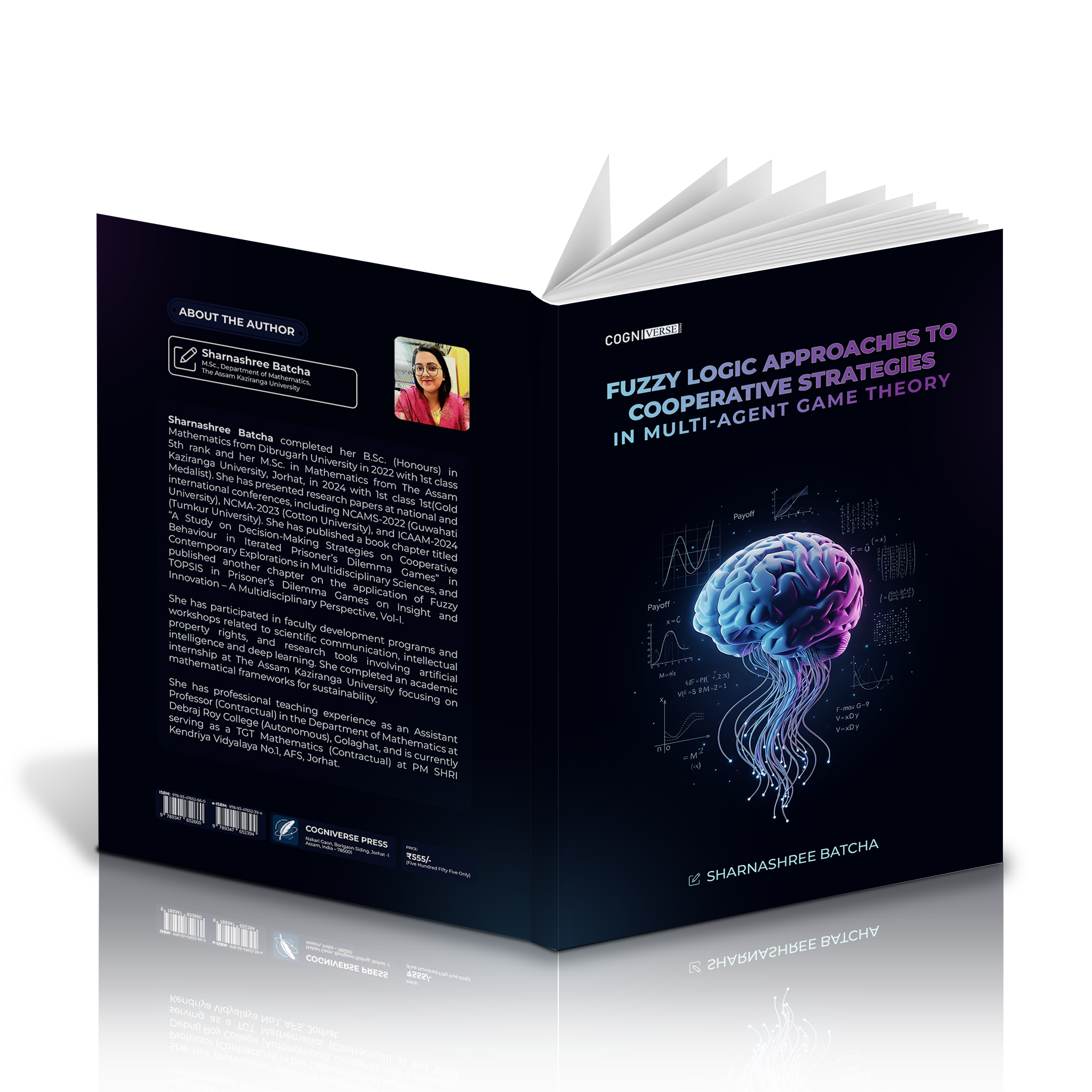
Description
Fuzzy Logic Approaches to Cooperative Strategies in Multi-Agent Game Theory
Author:
Sharnashree Batcha, M.Sc.
Department of Mathematics,
The Assam Kaziranga University,
Jorhat, Assam, India
Publisher:
Cogniverse Press,
Nakari Gaon, Borigaon Siding,
Assam, India, Jorhat – 1
Preface
The primary objective of this book is to explore decision-making processes in complex
environments where individuals must balance self-interest and cooperation, utilizing
fuzzy logic to capture uncertainties inherent in real-world scenarios.
The work focuses on constructing a fuzzy logic-based payoff model for Iterated
Prisoner’s Dilemma games by defining fuzzy sets, establishing inference rules, and
mapping decisions to satisfaction levels using a fuzzy inference system.
The Mean of Maximum defuzzification method is applied to obtain crisp outputs,
while the TOPSIS technique is employed to rank strategic alternatives.
Overall, the study highlights how fuzzy logic enhances modeling and analysis of
cooperative decision-making strategies in multi-agent environments.
Chapter Overview
Chapter 1 introduces fundamental concepts related to decision-making
strategies in multi-agent environments using fuzzy logic. It covers the classical
Prisoner’s Dilemma and its iterated version to examine long-term cooperation.
The chapter also introduces fuzzy sets, Mamdani Fuzzy Inference Systems,
defuzzification techniques, and the TOPSIS procedure for multi-criteria
decision-making.
Chapter 2 explains the application of fuzzy logic to cooperative behaviour
in Iterated Prisoner’s Dilemma games. It outlines the construction of a fuzzy logic
model, definition of fuzzy sets, and application of TOPSIS to analyse and rank
strategies for optimal outcomes.
Acknowledgement
I wish to express my sincere gratitude to my supervisor,
Dr. Sarfraz Ahmed, Assistant Professor, Department of Mathematics,
The Assam Kaziranga University, for his invaluable guidance, encouragement,
patience, and unwavering support throughout this work.
I also extend my heartfelt thanks to Dr. Dimpal Jyoti Mahanta,
HoD and Associate Professor, Department of Mathematics, The Assam Kaziranga
University, and to all faculty members and staff who provided continuous support
during the project.
I am grateful to the School of Basic Science, The Assam Kaziranga University,
for providing the necessary infrastructure and academic environment.
I thank my parents for their constant love and support, which motivated me
throughout this journey.
Finally, I acknowledge the efforts of everyone who contributed directly or indirectly
to the successful completion of this work.
List of Abbreviations
- PD – Prisoner’s Dilemma
- IPD – Iterated Prisoner’s Dilemma
- FS – Fuzzy Set
- FIS – Fuzzy Inference System
- MFIS – Mamdani Fuzzy Inference System
- DEF – Defuzzification
- TOPSIS – Technique for Order Preference by Similarity to Ideal Solution
- DFS – Decision-Making Strategies
- MAE – Multi-Agent Environments
- FL – Fuzzy Logic
- CBIPD – Cooperative Behavior in Iterated Prisoner’s Dilemma Games
Table of Contents
- Chapter 1: Introduction – Page 11
- 1.1 Prisoner’s Dilemma – Page 11
- 1.2 Fuzzy Set – Page 16
- 1.3 Fuzzy Inference System – Page 17
- 1.4 TOPSIS Procedure – Page 21
- 1.5 Literature Review – Page 22
- Chapter 2: Cooperative Strategies in Iterated Prisoner’s Dilemma Games – Page 27
- 2.1 Introduction – Page 27
- 2.2 Mathematical Formulation – Page 30
- 2.3 Numerical Illustration using TOPSIS – Page 39
- 2.4 Result and Discussion – Page 41
- Chapter 3: Conclusion – Page 45
- Chapter 4: References – Page 47




Reviews
There are no reviews yet.