

Description
Book Details
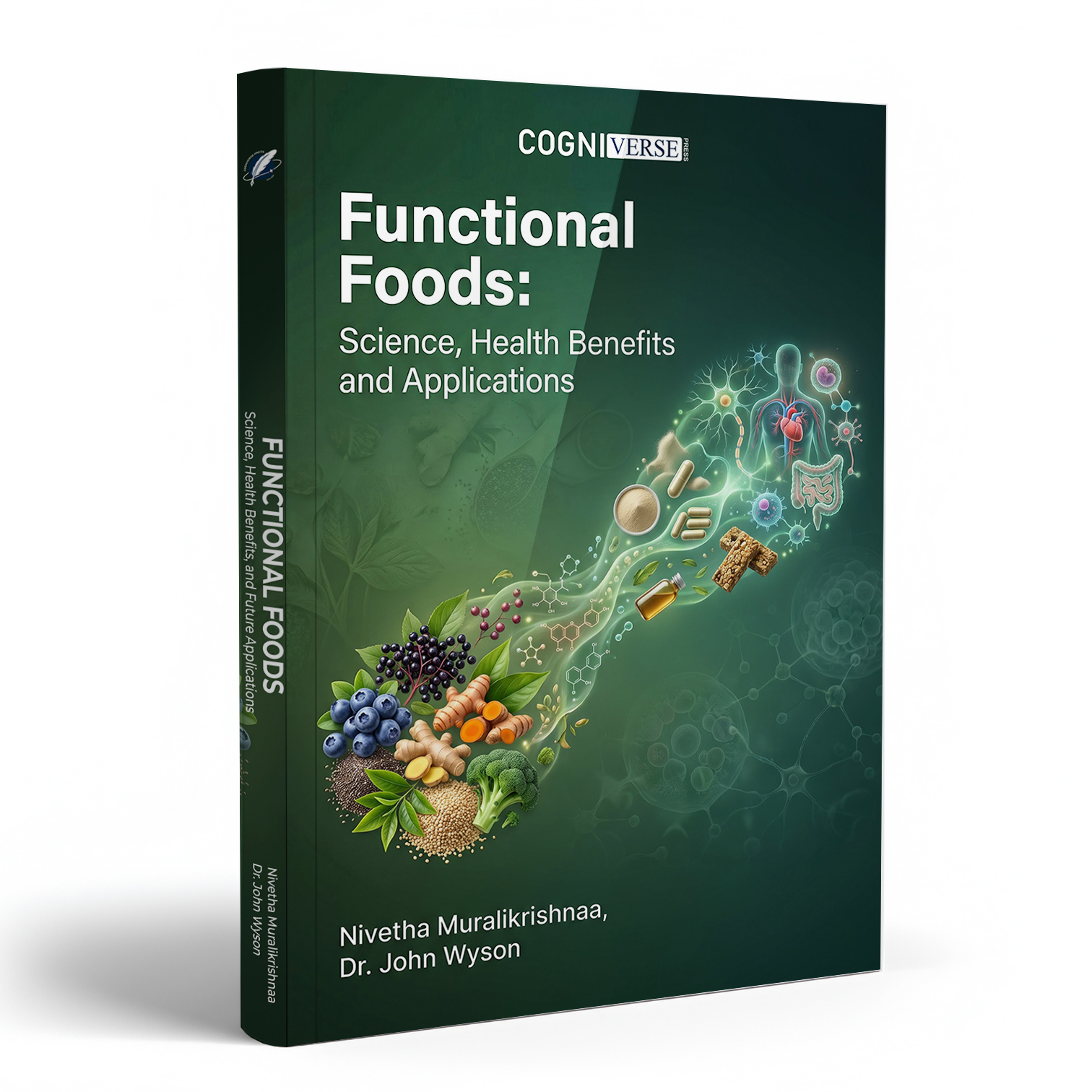
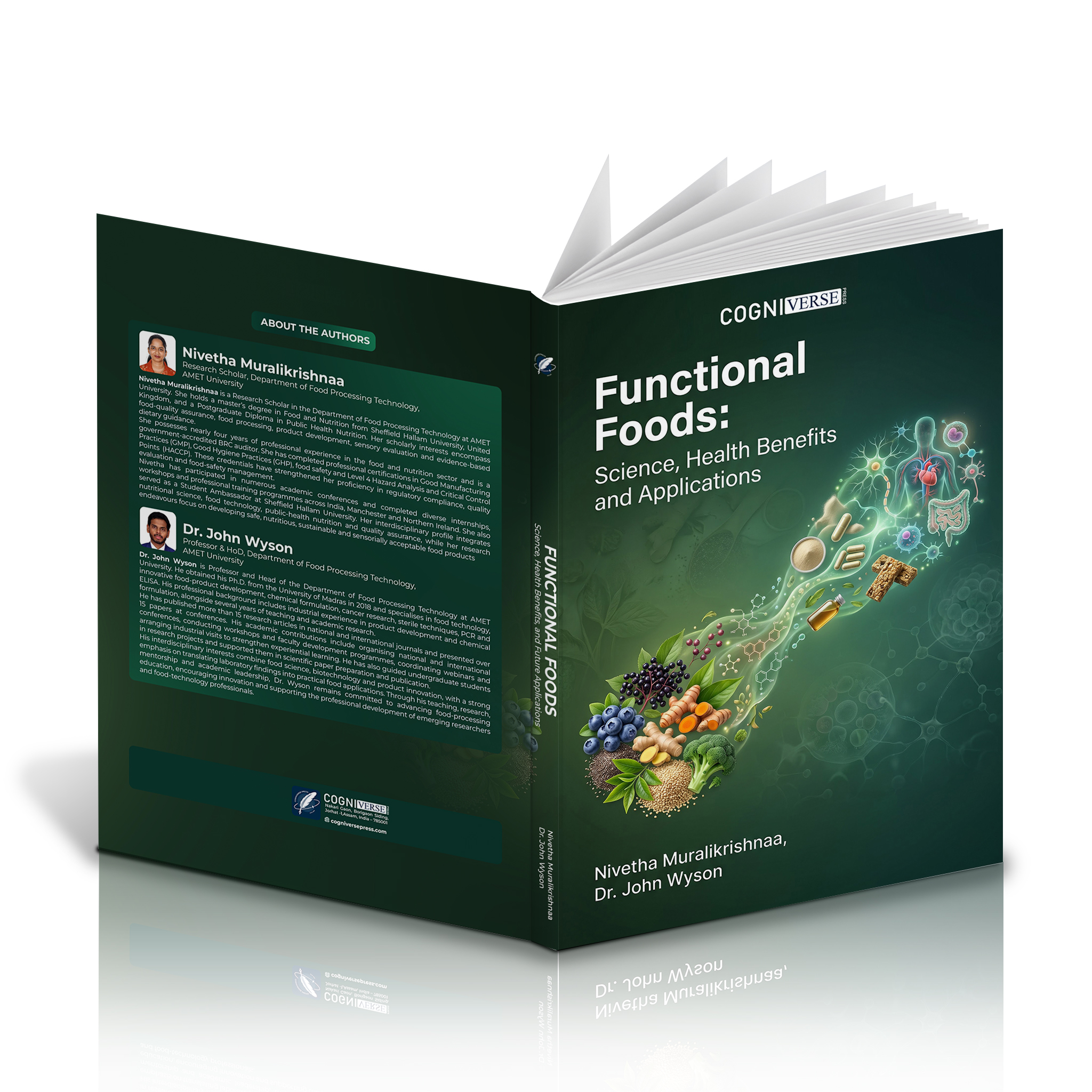
Title: Functional Foods: Science, Health Benefits and Applications
Authors:
- Nivetha Muralikrishnaa – Department of Food Processing Technology, Academy of Maritime Education and Training (AMET), Deemed to be University, Chennai, Tamil Nadu, India
- Dr. John Wyson – Department of Food Processing Technology, Academy of Maritime Education and Training (AMET), Deemed to be University, Chennai, Tamil Nadu, India
Publisher: Cogniverse Press, Jorhat, Assam, India
First Edition: August 2026
DOI: https://doi.org/10.5281/zenodo.22105587
ISBN: 978-81-68073-13-5 (Print Edition)
e-ISBN: 978-81-68073-14-2 (Digital Edition)
Published by: Cogniverse Press, Nakari Gaon, Borigaon Siding, Jorhat – 1, Assam, India
Website: cogniversepress.com
Email: cogniversepress@gmail.com
Cover Designing: Cogniverse Press Digital Team
Copyright: © Authors
Publisher’s Note
The views, interpretations, and research findings presented in this publication are solely those of the respective authors. The publisher bears no responsibility or liability for the accuracy, completeness, or validity of the content herein.
Preface
Food has always played a central role in human health, disease prevention, and longevity. While early nutrition science focused primarily on essential nutrients and deficiency disorders, contemporary research has demonstrated that foods also contain bioactive compounds capable of influencing physiological functions beyond basic nourishment. This recognition has established functional foods as an important area of nutrition and food science.
Functional foods may promote health, reduce chronic-disease risk, and improve quality of life. Their benefits are associated with compounds such as polyphenols, flavonoids, carotenoids, dietary fibres, probiotics, prebiotics, omega-3 fatty acids, bioactive peptides, and phytosterols. These constituents can influence antioxidant defence, inflammation, metabolism, immunity, intestinal health, and cardiovascular function.
The increasing burden of cardiovascular disease, diabetes, obesity, osteoporosis, and cancer has strengthened the need for evidence-based dietary strategies. Advances in food technology, biotechnology, microbiome research, nutrigenomics, and personalised nutrition have created opportunities to develop products addressing specific physiological needs and have transformed understanding of the relationship between food and health.
Functional Foods: Science, Health Benefits and Applications presents a multidisciplinary overview of the scientific foundations, health effects, technological developments, and future prospects of functional foods. The book examines bioactive components, mechanisms of action, health applications, processing technologies, product development, sustainable sourcing, safety, regulation, and emerging innovations.
Particular attention is given to preventive healthcare, healthy ageing, personalised nutrition, and sustainable food systems. Artificial intelligence, microbiome-based interventions, precision nutrition, and circular-bioeconomy strategies illustrate the changing research landscape.
The book is intended for students, researchers, academicians, food scientists, nutritionists, dietitians, healthcare professionals, and industry stakeholders. It aims to support teaching, research, product development, and evidence-based practice.
Future progress will depend on rigorous research, safety, regulatory compliance, ethical communication, affordability, and environmental responsibility. Harnessing food beyond basic nutrition may support healthier populations, reduce disease burden, and strengthen resilient food systems.
Nivetha Muralikrishnaa
Dr. John Wyson
Table of Contents
Chapter 1. Introduction to Functional Foods
- 1.1. Evolution of Food as Medicine
- 1.2. Emergence of Functional Foods
- 1.3. Definitions and Concepts
- 1.4. Historical Development
- 1.5. Global Market Growth
- 1.6. Functional Foods versus Nutraceuticals
- 1.7. Scope and Importance
- 1.8. Role in Public Health
- 1.9. Sustainable Development Goals and Functional Foods
- 1.10. Chapter Summary
Chapter 2. Scientific Foundations of Functional Foods
- 2.1. Food Components and Human Health
- 2.2. Bioactive Compounds
- 2.3. Mechanisms of Biological Action
- 2.4. Gut-Microbiota Interactions
- 2.5. Nutrigenomics and Personalised Nutrition
- 2.6. Bioavailability and Bioaccessibility
- 2.7. Metabolism of Functional Components
- 2.8. Biomarkers of Health Benefits
- 2.9. Evidence-Based Functional-Food Research
- 2.10. Chapter Summary
Chapter 3. Bioactive Components in Functional Foods
- 3.1. Polyphenols
- 3.2. Flavonoids
- 3.3. Carotenoids
- 3.4. Dietary Fibre
- 3.5. Probiotics
- 3.6. Prebiotics
- 3.7. Synbiotics
- 3.8. Omega-3 Fatty Acids
- 3.9. Bioactive Peptides
- 3.10. Phytosterols
- 3.11. Vitamins and Minerals
- 3.12. Functional Proteins
- 3.13. Chapter Summary
Chapter 4. Functional Foods and Human Health
- 4.1. Functional Foods and Cardiovascular Health
- 4.2. Functional Foods and Diabetes Management
- 4.3. Functional Foods and Obesity Prevention
- 4.4. Functional Foods and Digestive Health
- 4.5. Functional Foods and Immune Function
- 4.6. Functional Foods and Brain Health
- 4.7. Functional Foods and Healthy Ageing
- 4.8. Functional Foods and Bone Health
- 4.9. Functional Foods and Cancer Prevention
- 4.10. Functional Foods and Women’s Health
- 4.11. Chapter Summary
Chapter 5. Major Categories of Functional Foods
- 5.1. Probiotic Foods
- 5.2. Fermented Foods
- 5.3. Fortified Foods
- 5.4. Whole-Grain Functional Foods
- 5.5. Functional Dairy Products
- 5.6. Functional Beverages
- 5.7. Functional Fruits and Vegetables
- 5.8. Plant-Based Functional Foods
- 5.9. Marine-Derived Functional Foods
- 5.10. Emerging Functional-Food Products
- 5.11. Chapter Summary
Chapter 6. Processing Technologies and Product Development
- 6.1. Functional Ingredient Extraction
- 6.2. Encapsulation Technologies
- 6.3. Fermentation Technologies
- 6.4. Food Fortification
- 6.5. Preservation of Bioactive Compounds
- 6.6. Functional Food Formulation
- 6.7. Quality Control
- 6.8. Shelf-Life Evaluation
- 6.9. Consumer Acceptance
- 6.10. Chapter Summary
Chapter 7. Functional Foods from Sustainable Sources
- 7.1. Agro-Industrial By-Products
- 7.2. Circular Bioeconomy Approaches
- 7.3. Sustainable Extraction Technologies
- 7.4. Functional Ingredients from Food Waste
- 7.5. Environmental Benefits
- 7.6. Case Studies
- 7.7. Future Opportunities
- 7.8. Chapter Summary
Chapter 8. Safety, Regulations and Health Claims
- 8.1. Safety Assessment
- 8.2. Toxicological Evaluation
- 8.3. Regulatory Frameworks
- 8.4. Functional Food Labelling
- 8.5. Health Claims
- 8.6. Consumer Protection
- 8.7. Ethical Considerations
- 8.8. Challenges in Regulation
- 8.9. Chapter Summary
Chapter 9. Future Perspectives and Emerging Trends
- 9.1. Precision Nutrition
- 9.2. AI in Functional Food Development
- 9.3. Microbiome-Based Functional Foods
- 9.4. Personalized Functional Foods
- 9.5. Future Research Directions
- 9.6. Conclusion
Chapter 10. General Conclusion
Chapter 11. Future of Functional Foods
References
References are provided at the end of the book.
Key Themes
- Scientific foundations of functional foods
- Bioactive food components and their biological functions
- Functional foods and human health
- Major categories of functional foods
- Food processing technologies and product development
- Sustainable sourcing and circular bioeconomy approaches
- Safety, regulations, labelling, and health claims
- Precision and personalised nutrition
- Artificial intelligence and emerging technologies
- Microbiome-based functional foods
- Future research and development of functional foods



Reviews
There are no reviews yet.