

Description
Book Details
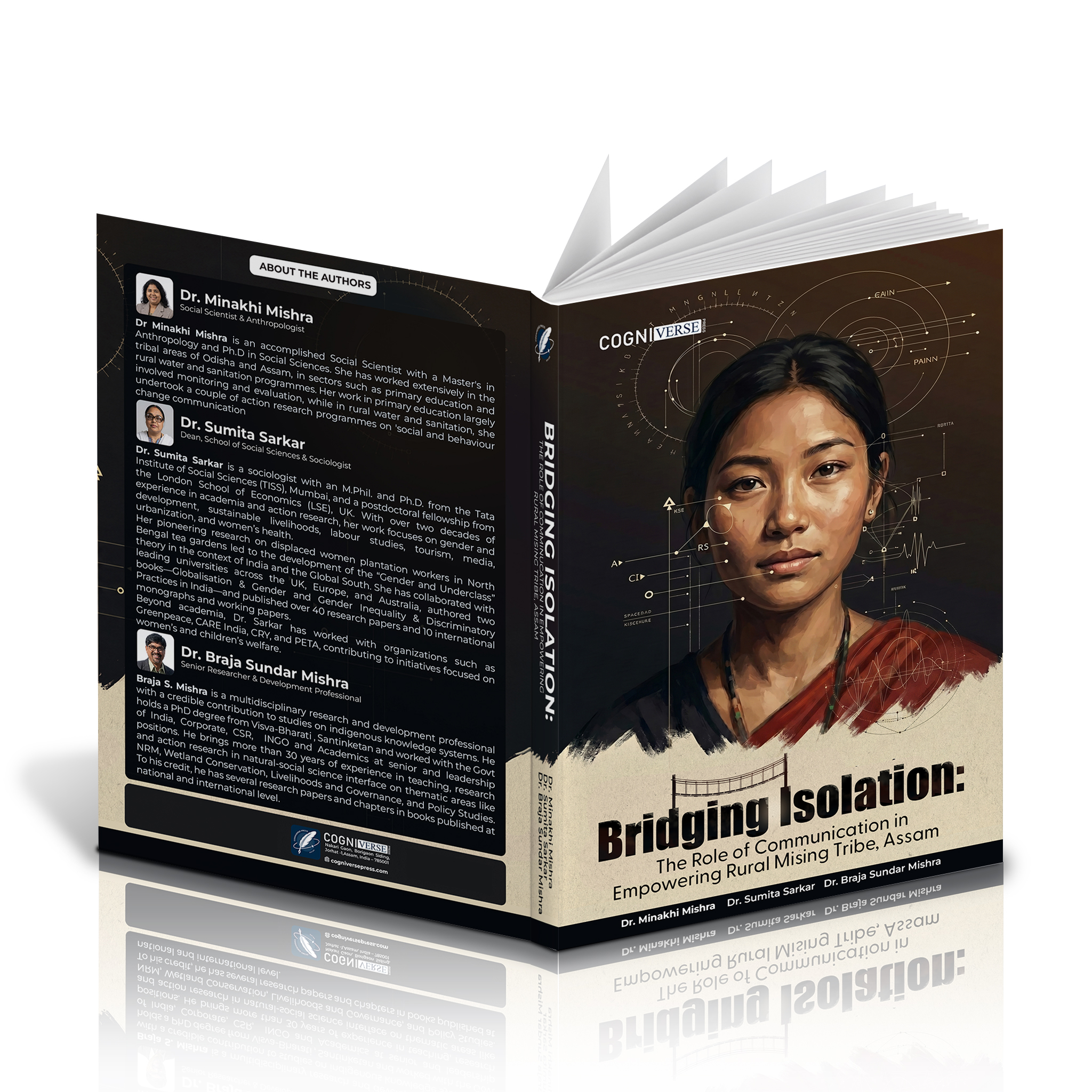
Title: Bridging Isolation: The Role of Mass Communication in Empowering Rural Mising Tribe, Assam
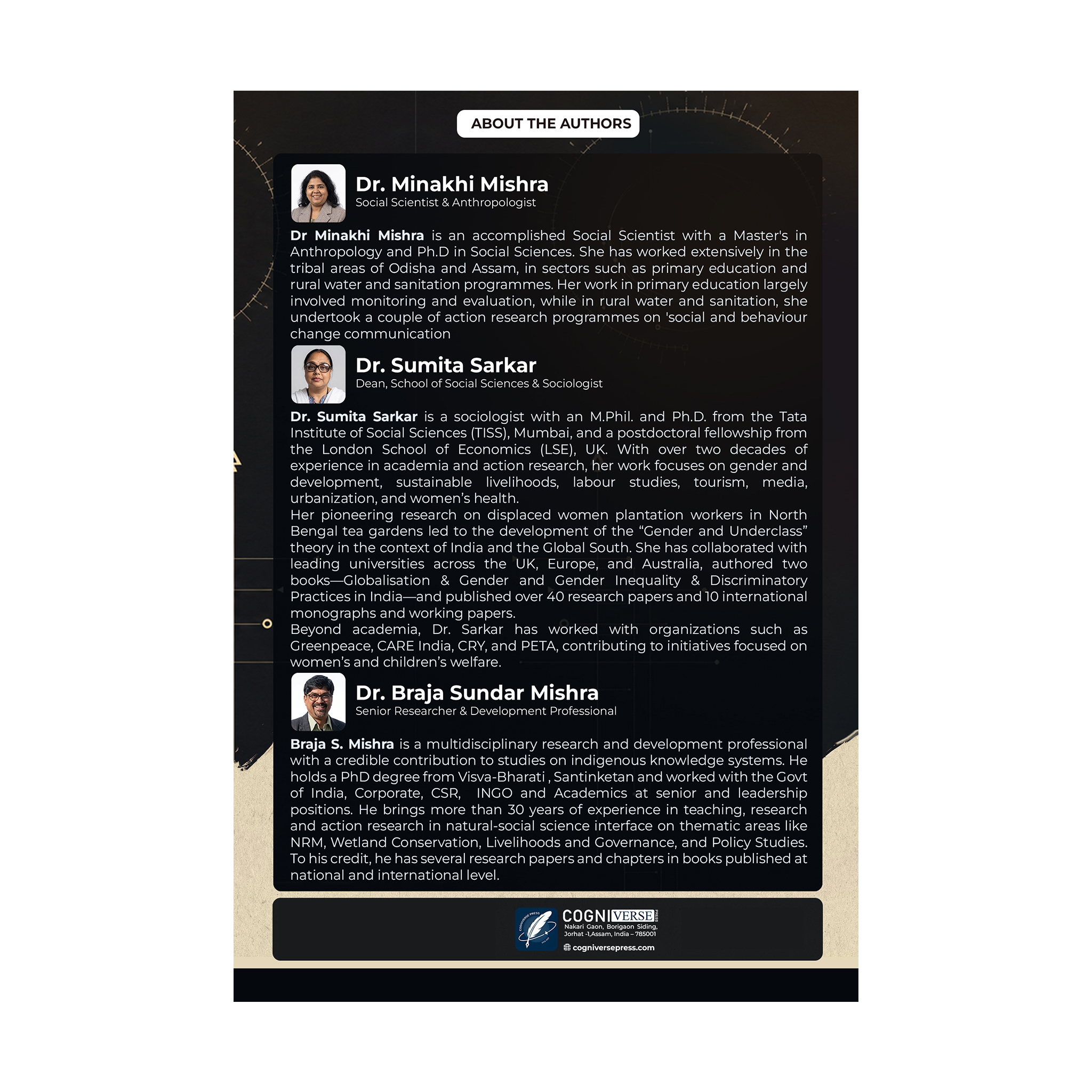
Authors: Dr. Minakhi Mishra, Dr. Sumita Sarkar, Dr. Braja S. Mishra
Publisher: Cogniverse Press, Jorhat, Assam, India
First Edition: July 2026
ISBN: 978-93-47652-05-9 (Print Edition)
e-ISBN: 978-93-47652-18-9 (Digital Edition)
Authors
- Dr. Minakhi Mishra – Social Scientist, Odisha, India
- Dr. Sumita Sarkar – Dean, School of Social Sciences, The Assam Kaziranga University, Assam, India
- Dr. Braja S. Mishra – Independent Consultant, Odisha, India
Preface
Mass communication has long been an important area of inquiry in social sciences, development studies, and development communication. As a strategy for fostering positive social change, development communication has played a significant role in promoting socioeconomic development, particularly in communities that remain relatively marginalised from modern development processes.
This book examines the role of mass communication in the social, cultural, and economic lives of the rural Mising tribal community of Assam. It explores how communication technologies influence everyday life, access to information, aspirations, cultural practices, livelihoods, and participation in wider processes of development.
The work is based on doctoral research focusing on the Mising tribe of Assam. It acknowledges the guidance, academic support, field cooperation, and institutional contributions that enabled the research and its transformation into book form.
The study particularly recognizes the cooperation of the Mising communities in Goroi Mari, Bali Chapori, and Dhansiri Temera under Bokakhat Block in Golaghat district, as well as the Village Heads and elected Panchayat members who contributed to the fieldwork.
Key Themes
- Mass Communication and Rural Development
- Media, Modernity, and Social Change
- Development Communication
- Mising Community, Culture, and Identity
- Media Ethnography
- Radio, Television, and Mobile Communication
- Social Media and Digital Connectivity
- Media, Family Life, and Gender Roles
- Media and Livelihood Practices
- Political Awareness and Civic Participation
- Health Communication and Quality of Life
- Digital Inequality and Uneven Media Access
- Negotiated Modernities
- Media, Tradition, and Cultural Continuity
Research Focus
The book explores how mass communication through radio, television, mobile phones, and social media has entered the everyday lives of the rural Mising community and influenced its social, cultural, economic, and political landscape.
A central argument is that media functions not merely as a channel for transmitting information but as a social institution that shapes aspirations, identities, relationships, awareness, and opportunities. Media exposure is examined in relation to education, health, agriculture, government welfare schemes, employment, markets, and civic participation.
The study emphasizes the concept of negotiated modernity, showing how members of the Mising community selectively interpret and adapt media content within existing cultural values, kinship structures, rituals, traditional institutions, and livelihood practices.
The book also examines unequal media access according to gender, age, education, occupation, and economic conditions, highlighting both the empowering and contradictory dimensions of media expansion in tribal rural society.
Table of Contents
Chapter 1. Media, Modernity, and Margins: Why Mass Communication Matters in Rural Assam
- 1.1 Introduction: Media as a Social Institution
- 1.2 Media and Modernity: Classical Perspectives
- 1.3 Beyond Modernization: Multiple Modernities and Media
- 1.4 Development Communication and Its Discontents
- 1.5 Rethinking Social Change: A Sociological Perspective
- 1.6 Marginality and Media: The Case of Rural Assam
- 1.7 The Mising Community: History, Identity, and Change
- 1.8 Media, Power, and Representation of Tribal Communities
- 1.9 Significance of the Study
Chapter 2. From Development Communication to Digital Media: Theoretical Lenses on Media and Social Change
- 2.1 Introduction: Moving Beyond A Catalogue of Theories
- 2.2 Development Communication and the Promise of Modernization
- 2.3 Diffusion of Innovations and Media Effects
- 2.4 Critical Responses: Dependency and Political Economy Perspectives
- 2.5 Participatory Communication: Re-centering Agency
- 2.6 Cultural Studies and the Active Audience
- 2.7 Digital Media and the Reconfiguration of Communication
- 2.8 Media, Power, and Inequality in the Digital Age
Chapter 3. Researching Media in Everyday Life: Methods, Villages, and Voices
- 3.1 Introduction: Methodology as Situated Practice
- 3.2 Rationale for a Qualitative and Ethnographic Approach
- 3.3 Situating the Study within Media Ethnography
- 3.4 Media Ethnography and the Question of Voice
- 3.5 Engagement with Development Communication Theory
- 3.6 Everyday Media Use and Negotiated Development
- 3.7 Methodological Synthesis: Media Ethnography and Development Communication
- 3.8 Methodological Contribution of the Study
- 3.9 Selection of Field Sites: Villages as Media Contexts
- 3.10 Entering the Field: Access, Trust, and Positionality
- 3.11 Sampling Strategy and Selection of Respondents
- 3.12 Methods of Data Collection
- 3.13 Data Analysis and Interpretation
- 3.14 Reflexivity and the Researcher’s Voice
Chapter 4. The Mising World: Culture, Livelihood, and Social Organization
- 4.1 Historical Background and Settlement Patterns
- 4.2 Social Structure and Kinship Organization
- 4.3 Village Organization and Traditional Institutions
- 4.4 Livelihood Practices and Economic Life
- 4.5 Housing Patterns and Material Culture
- 4.6 Food Habits and Everyday Consumption
- 4.7 Belief Systems, Rituals, and Festivals
- 4.8 Analytical Alignment with Media Ethnography and Development Communication
Chapter 5. Media Enters the Village: Everyday Encounters with Radio, Television, Mobile Phones, and Social Media
- 5.1 Pathways of Media Entry into the Village
- 5.2 Radio: The Intimate and Enduring Medium
- 5.3 Television: Visual Worlds and Collective Viewing
- 5.4 Mobile Phones: Personal Media and Everyday Connectivity
- 5.5 Social Media: New Spaces of Interaction and Expression
- 5.6 Differential Access: Age, Gender, and Occupation
- 5.7 Media Content and Everyday Meaning-Making
- 5.8 Media as Unevenly Embedded Social Practice
Chapter 6. Changing Homes, Changing Work: Media, Family Life, and Livelihood Practices
- 6.1 Introduction: Media, Everyday Life, and the Question of Change
- 6.2 Media and the Reconfiguration of Family Life: Family Structure and Changing Preferences
- 6.3 Media and Family Decision-Making
- 6.4 Marriage Practices: Tradition under Media Influence
- 6.5 Gendered Expectations in Marriage
- 6.6 Media, Gender Roles, and Domestic Negotiation: Expanding Roles of Women
- 6.7 Youth, Masculinity, and Aspirations
- 6.8 Awareness versus Adoption: Media as Agricultural Educator
- 6.9 Structural Constraints
- 6.10 Weaving: Cultural Practice and Media-Induced Aspirations
- 6.11 Fishing, Piggery, and Allied Livelihoods
- 6.12 Media, Consumption, and Aspirational Change
- 6.13 Religious Belief and Cultural Continuity
- 6.14 Theoretical Reflection: Negotiated Modernities
- 6.15 Integrating Demographic Realities
- 6.16 Ethnographic Vignettes
- 6.17 Implications for Policy and Communication Practice
Chapter 7. Politics, Health, and the Quality of Life: Media as a Civic and Moral Force
- 7.1 Introduction: Media, Citizenship, and Everyday Governance
- 7.2 Media and Political Awareness: Political Socialization and Cognitive Effects
- 7.3 Media and Voting Behaviour: Limited Effects and Two-Step Flow
- 7.4 Media, the State, and Civic Morality: Governmentality and Development Communication
- 7.5 Loca Governance and the Mediatization of the Panchayat
- 7.6 Health Communication: Awareness, Risk Framing, and Behavioural Limits
- 7.7 COVID-19: A Crisis of Information and Trust
- 7.8 Hygiene and Sanitation: Media, Discipline, and Symbolic Compliance
- 7.9 Family Planning: Persuasion, Gendered Power, and Negotiated Choice
- 7.10 Media, Savings, and Financial Behaviour: Financial Socialization and Moral Framing
- 7.11 Leisure, Media Use, and Cultural Politics
- 7.12 Media, Morality, and Critical Awareness: Hegemony and Resistance
- 7.13 Negotiated Citizenship: Integrating Family, Livelihood, and Civic Domains
- 7.14 Theoretical Positioning
- 7.15 Media as a Mediated Civic Force
Chapter 8. Negotiated Modernities: What Media Really Changes and What It Doesn’t
- 8.1 Introduction: Returning to the Central Question
- 8.2 Revisiting the Theoretical Framework: From Modernization to Mediation
- 8.3 What Media Changes: Awareness, Aspirations, and Moral Discourses
- 8.4 Livelihood Constraints and Structural Limits
- 8.5 Uneven Access and Digital Inequality
- 8.6 Negotiated Modernities: Integrating the Domains
- 8.7 Implications for Development Policy
- 8.8 Implications for Media Practice
- 8.9 Implications for Research on Rural and Tribal Media
- 8.10 Methodological Reflections and Contributions
- 8.11 Conclusion: Rethinking Media and Social Change
Bibliography
Bibliography
Annexures
- Annexure 1: Mising Women Dancing on Ali Ayé Lígang
- Annexure 2: Handicraft Work by Mising Community Women
- Annexure 3: Woven Handicraft by Mising Women




Reviews
There are no reviews yet.