
Description
Book Details
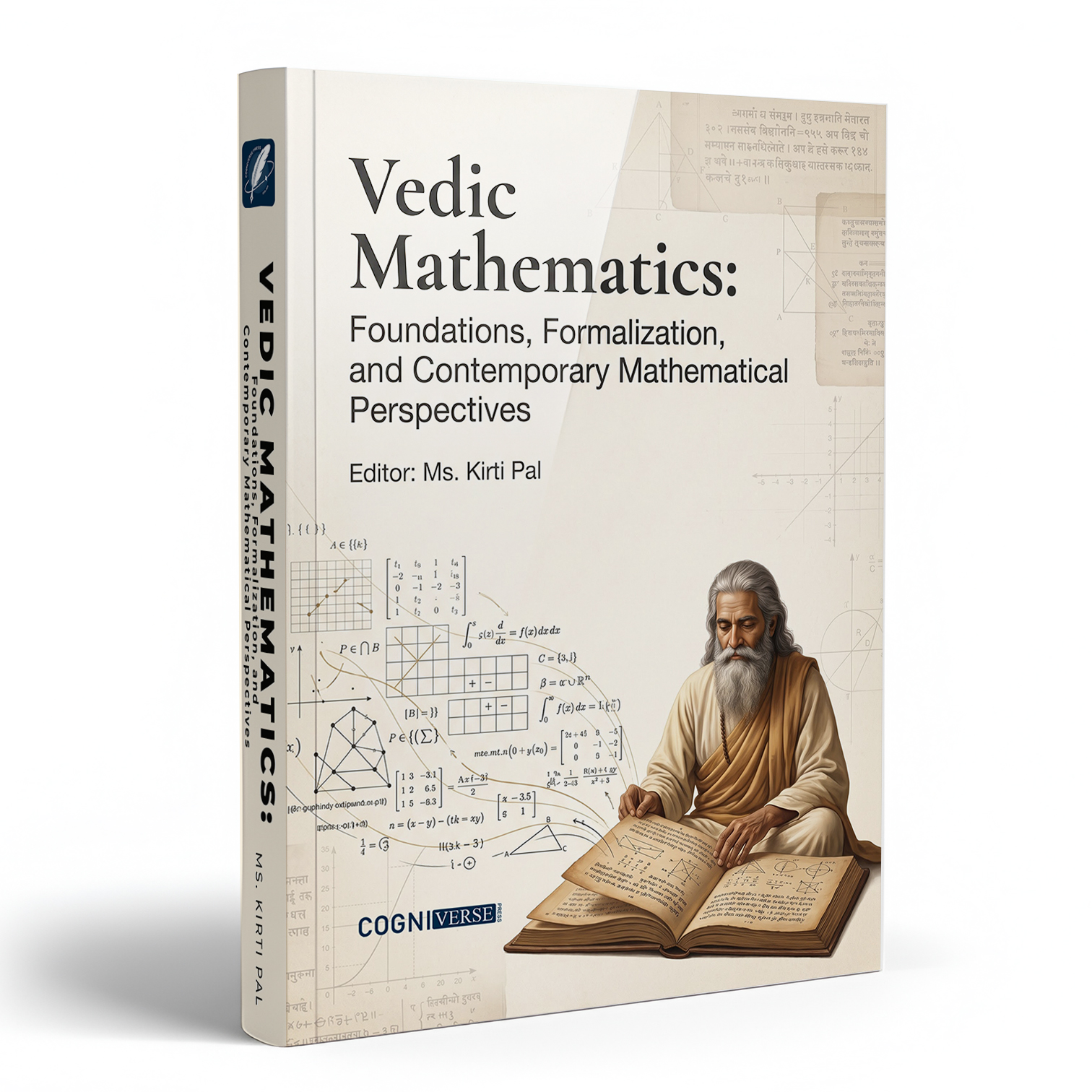
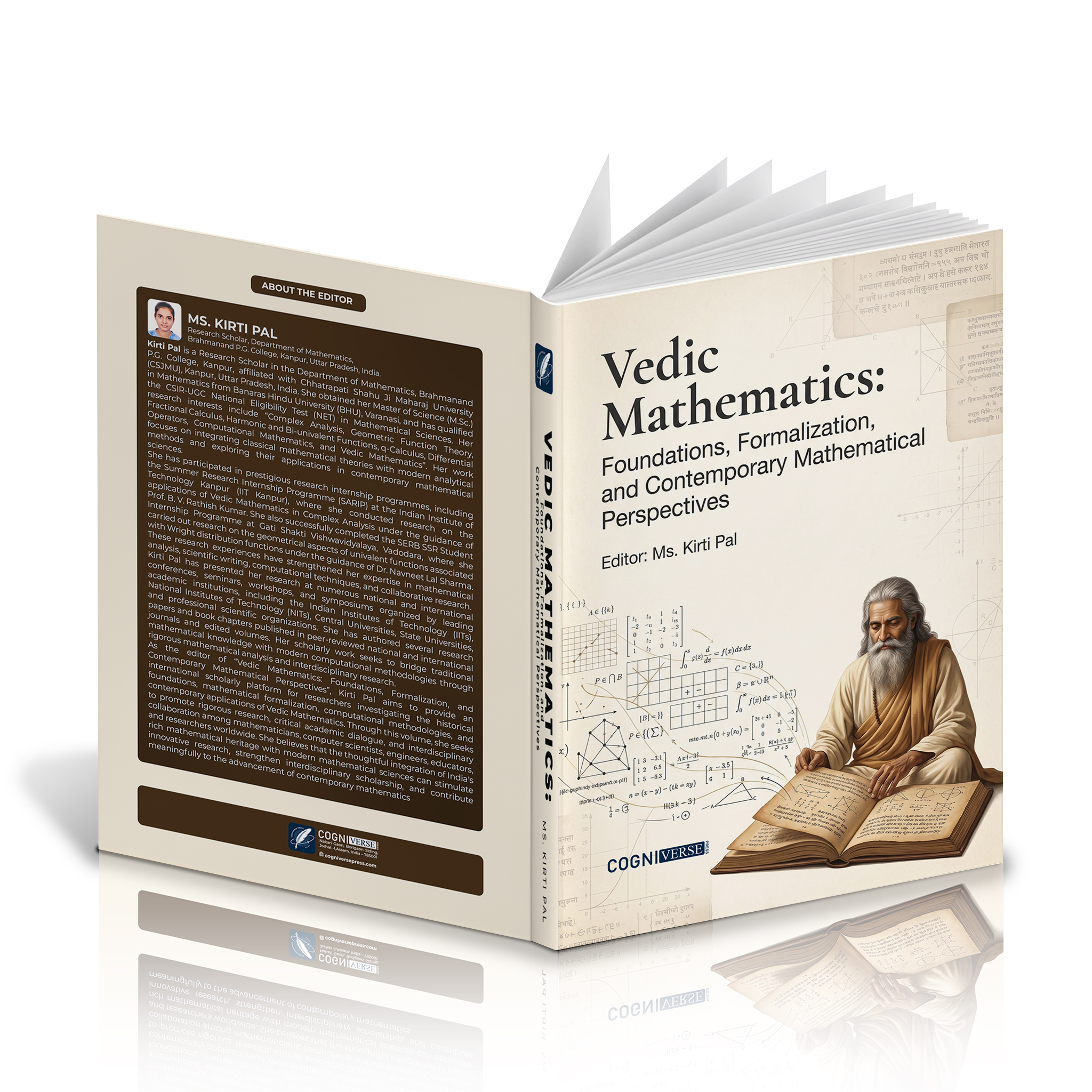
Title: Vedic Mathematics: Foundations, Formalization, and Contemporary Mathematical Perspectives
Type: Peer Reviewed Edited Book
Editor: Ms. Kirti Pal
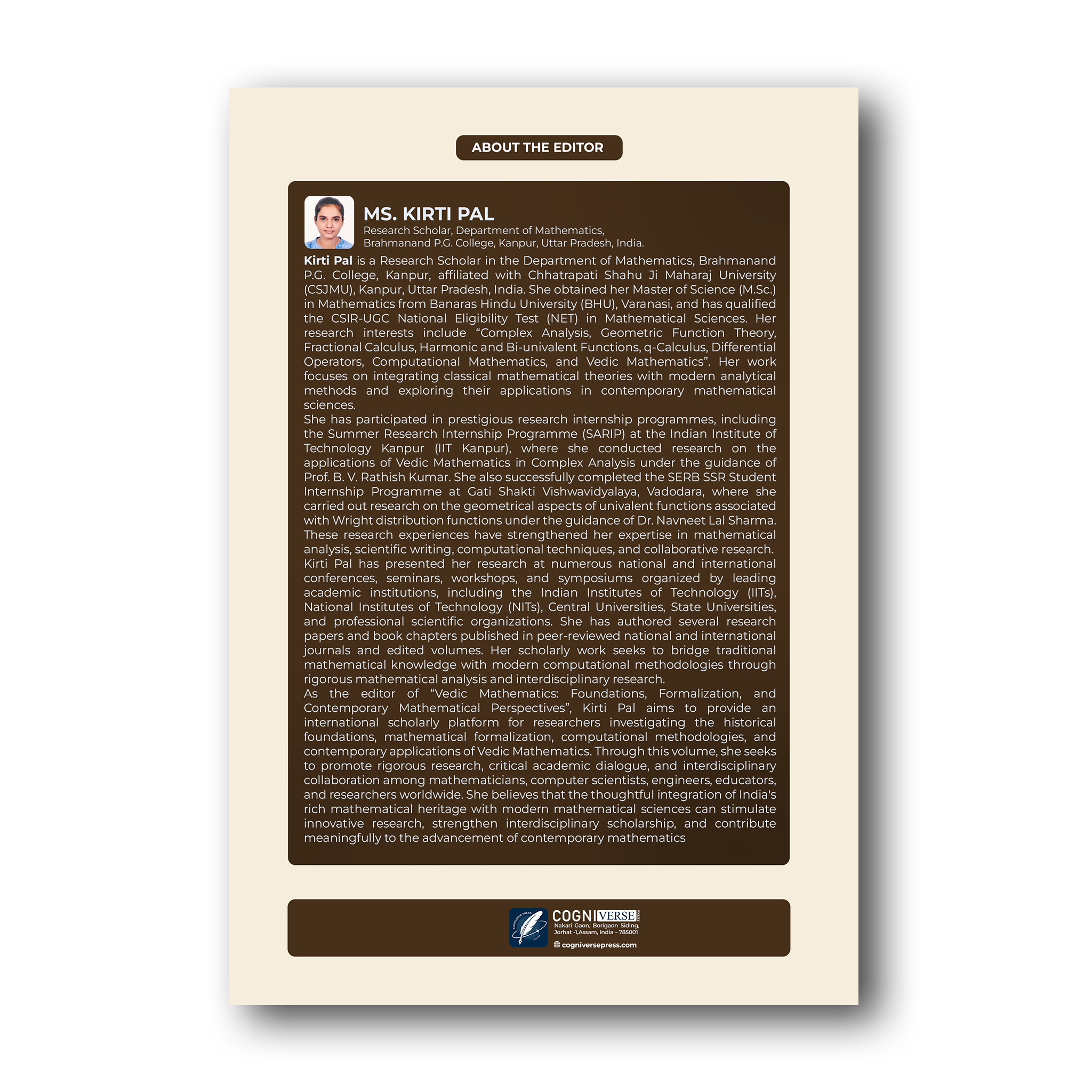
Editor Details:
- Ms. Kirti Pal
Research Scholar, Department of Mathematics
Brahmanand P.G. College, Kanpur
Uttar Pradesh, India
Publisher: Cogniverse Press, Jorhat, Assam, India
Address: Nakari Gaon, Borigaon Siding, Jorhat – 1
First Edition: August, 2026
DOI: https://doi.org/10.5281/zenodo.21816866
ISBN: 978-81-68073-01-2 (Print Edition)
e-ISBN: 978-81-68073-02-9 (Digital Edition)
Cover Designing: Ms. Manohari, III BALSP Student, AIISH
Website: cogniversepress.com
Email: cogniversepress@gmail.com
Copyright: © Authors
The views, interpretations, and research findings presented in this publication are solely of the respective author. The publisher bears no responsibility or liability for the accuracy, completeness, or validity of the content herein.
Preface
Mathematics is one of humanity’s oldest and most enduring intellectual pursuits. It has evolved continuously over millennia and remains one of the few truly universal languages, transcending cultures, civilizations, and generations. Throughout history, different civilizations have developed distinctive mathematical traditions in response to practical needs, philosophical inquiry, and scientific advancement. Among these, the Indian mathematical tradition occupies a distinguished place for its pioneering contributions to arithmetic, algebra, geometry, trigonometry, combinatorics, and numerical computation. Within this rich intellectual heritage, Vedic Mathematics has gained widespread recognition for its elegant computational techniques, algorithmic simplicity, and remarkable efficiency in numerical calculations.
Popularized through the pioneering work of Jagadguru Bharati Krishna Tirthaji Maharaj, Vedic Mathematics presents a system of computation based on sixteen Sutras (aphorisms) and thirteen Sub-sutras. These principles have become widely known for simplifying mathematical calculations and promoting analytical thinking. Consequently, they have found applications in mathematics education, mental arithmetic, and competitive examinations across the world.
Despite their educational significance, comparatively little attention has been devoted to investigating their mathematical foundations, formalization, computational complexity, algorithmic interpretation, and interdisciplinary applications. As modern mathematics increasingly intersects with computer science, artificial intelligence, engineering, cryptography, optimization, data science, and digital technologies, there is a growing need to examine these traditional computational principles through rigorous mathematical and scientific inquiry.
The idea for this edited volume emerged from the realization that much of the existing literature on Vedic Mathematics focuses primarily on computational shortcuts and classroom applications, while comparatively less attention has been given to theoretical analysis and contemporary mathematical research. This book has therefore been conceived as an effort to bridge the gap between traditional mathematical wisdom and modern mathematical sciences.
Rather than presenting Vedic Mathematics merely as a collection of rapid calculation techniques, the present volume seeks to establish it as a subject of systematic academic inquiry through mathematical formalization, algorithmic analysis, computational implementation, and interdisciplinary exploration.
The title, Vedic Mathematics: Foundations, Formalization, and Contemporary Mathematical Perspectives, reflects the three guiding objectives of this volume. Foundations emphasize the historical development, philosophical background, and mathematical principles underlying Vedic Mathematics. Formalization highlights the importance of expressing traditional computational methods within the framework of modern mathematical language, logical reasoning, and rigorous mathematical structures. Contemporary Mathematical Perspectives recognizes the growing relevance of these ideas in computational mathematics, artificial intelligence, algorithm design, digital systems, cryptography, numerical analysis, optimization, engineering, and related scientific disciplines.
The primary objective of this volume is to provide a scholarly platform for researchers, educators, mathematicians, engineers, computer scientists, and interdisciplinary scholars interested in exploring Vedic Mathematics from diverse perspectives. The chapters included in this book examine historical developments, mathematical theory, algorithmic structures, computational complexity, educational methodologies, software implementation, engineering applications, comparative analyses, and emerging research directions.
Collectively, these contributions demonstrate that Vedic Mathematics is not merely a historical curiosity but an evolving area of research with the potential to inspire innovative mathematical ideas and computational methodologies.
One of the principal editorial objectives has been to maintain a balanced, evidence-based, and research-oriented approach. Genuine scholarship requires objective historical investigation, logical reasoning, mathematical rigor, computational verification, and open academic dialogue. Accordingly, contributors were encouraged to present research supported by sound mathematical arguments, critical analysis, and, where appropriate, computational validation.
The preparation of this book has been guided by the belief that meaningful innovation often emerges when traditional knowledge is examined through the lens of modern scientific inquiry. Ancient mathematical ideas continue to offer valuable insights that, when studied rigorously, can contribute to contemporary mathematical sciences and inspire new directions in research, education, and technology. This volume represents an effort to strengthen the dialogue between historical mathematical traditions and modern scientific developments.
This edited volume has been made possible through the dedication and collaborative efforts of many individuals. As Editor, I express my sincere gratitude to all the contributing authors for sharing their original research, innovative ideas, and scholarly expertise. Their commitment to academic excellence has transformed this volume into a rich and diverse collection of contemporary research on Vedic Mathematics.
I also extend my sincere appreciation to the reviewers for their careful evaluations, insightful comments, and constructive suggestions, which have significantly enhanced the quality, clarity, and academic rigor of the chapters. Their valuable contributions have played a vital role in maintaining the scholarly standards of this publication.
I express my heartfelt gratitude to Dr. Anokhe Lal Pathak, Head of the Department of Mathematics, Brahmanand P.G. College, Kanpur, and Dr. Rakesh Bhatia, coordinator of Shiksha Sanskriti Utthan Nayas, New Delhi, for their constant encouragement, invaluable guidance, and unwavering support throughout the preparation of this volume. Their insightful suggestions, constructive criticism, and scholarly mentorship have been a continuous source of inspiration and have significantly shaped both the direction and the quality of this work.
I also extend my sincere appreciation to the publishing team for their professional guidance, technical assistance, and dedicated support throughout the editorial and publication process. Their cooperation, efficiency, and commitment to maintaining high publishing standards have been instrumental in transforming this vision into reality.
Finally, it is my sincere hope that this volume will serve as a valuable reference for researchers, educators, postgraduate students, and professionals while inspiring further exploration into the mathematical foundations, formalization, and contemporary applications of Vedic Mathematics. May this book encourage rigorous scholarship, foster interdisciplinary collaboration, and deepen appreciation for one of the world’s most remarkable mathematical traditions.
Kirti Pal
Editor
Need for the Book
The book addresses the need to examine Vedic Mathematics beyond computational shortcuts and classroom applications. It focuses on the mathematical foundations, formalization, computational complexity, algorithmic interpretation, and interdisciplinary applications of traditional computational principles.
The volume seeks to bridge traditional mathematical wisdom and modern mathematical sciences through mathematical formalization, algorithmic analysis, computational implementation, and interdisciplinary exploration. It is particularly relevant to contemporary areas including computational mathematics, computer science, artificial intelligence, engineering, cryptography, optimization, data science, numerical analysis, and digital technologies.
Key Themes
- Indian Mathematical Tradition
- Foundations of Vedic Mathematics
- Mathematical Formalization
- Algorithmic Analysis
- Computational Complexity
- Vedic Mathematics and Education
- Mathematics Pedagogy
- Artificial Intelligence
- Computer Science and Digital Technologies
- Cryptography
- Optimization
- Numerical Analysis
- Engineering Applications
- Data Science
- Interdisciplinary Mathematical Research
Table of Contents
Chapter 1: Integrated Machine Learning and IoT Framework for Cardiovascular Disease Detection and Monitoring: A Contemporary Computational Perspective Inspired by Vedic Mathematics
Author: B. Sumithra
Page: 1
Chapter 2: Swami Bharati Krishna Tirtha and the Evolution of Vedic Mathematics: Historical Foundations and Modern Applications
Author: Jini Varghese P
Page: 17
Chapter 3: Integration of Vedic Mathematics in Education and Pedagogy
Authors: Nithyakala G, Surya Devi B, Meenakshi S, Varshith D R
Page: 34
Chapter 4: A Modern Analytical and Algorithmic Framework for Vedic Mathematics: Theoretical Foundations and Interdisciplinary Applications
Authors: Raju Bhakta, Parth Surendra Bhoyar
Page: 67
Chapter 5: Vedic Mathematics and the Contribution of Bharati Krishna Tirtha: Educational, Philosophical, and Computational Perspectives
Authors: Ritabrata Biswas, Subhajit Pal
Page: 99
Chapter 6: Analysis and Application of Vedic Mathematics in Problem-solving
Author: Prem Kumar Karn
Page: 125
Chapter 7: Vedic Mathematics in Science and Technology: Bridging Ancient Computational Wisdom with Modern Innovations
Authors: Sanjay Kumar Mahto, Kumar Amrendra, Anuradha Sharma
Page: 142
Chapter 8: Vedic Mathematics: Sutras, Sub-Sutras and Their Modern Applications
Authors: Biswabandita Datta Bag, Gita Bag
Page: 157
Chapter 9: Integration of Vedic Mathematics into Classroom Pedagogy for 4C Skill Development
Authors: Shyamal Kumar Hui and Biswabismita Bag
Page: 174
Chapter 10: Contribution of Bharati Krishna Tirtha to Vedic Mathematics
Authors: Bidya Kundu, Rajesh Ali and Pritikana Tudu
Page: 199
Chapter 11: The Historical Evolution of Ancient Mathematics: From Empirical Foundations to Abstract Systems
Authors: Souvik Dubey and Sathi Chatterjee
Page: 229
Chapter 12: Vedic Mathematics in Modern Education: Relevance, Applications, and Educational Impact
Authors: Jagrati Mishra, A.L. Pathak, Kirti Pal
Page: 246
Chapter 13: A Comparative Study of Vedic Mathematics and Modern Computational Methods in Information Technology
Authors: Kumar Amrendra, Wakil Kumar, Sanjay Kumar Mahto, Anuradha Sharma
Page: 292
Chapter 14: Indian Knowledge System in Statistics: Ancient Foundations and Modern Contributions
Author: Soma Dhar
Page: 313
Chapter 15: Ekanyuna Purveṇa – A Formal Analysis of Multiplication by Numbers Composed of Nines
Author: Manoj Kumar Singh
Page: 323
Chapter 16: The Strategic Role of Vedic Mathematics in Higher Mathematics
Author: Jini Varghese P
Page: 331
Chapter 17: Urdhva–Tiryagbhyam Multiplication: An Algebraic and Computational Perspective
Authors: Nisha Mary Daniel*, Libin Chacko Samuel
Page: 348
Chapter 18: Development of Arithmetic in Ancient India
Authors: Wakil Kumar, Ashish Kumar Jha, KumarAmrendra
Page: 362
Chapter 19: Evolution of Indian Mathematics: Historical Foundations, Mathematical Innovations, and Contemporary Perspectives
Authors: Pradeep Kumar, A.L.Pathak, Kirti Pal and P.N.Pathak
Page: 378
Chapter 20: Comparative Analysis of Mathematical Traditions: Indian, Greek, and Chinese Perspectives
Author: Kirti Pal
Page: 429
Chapter 21: Applications of Vedic Mathematics in Enhancing Computational Efficiency in Artificial Intelligence
Author: Kanapuram Uday Kiran
Page: 465



Reviews
There are no reviews yet.