

Description
“`html
Book Details
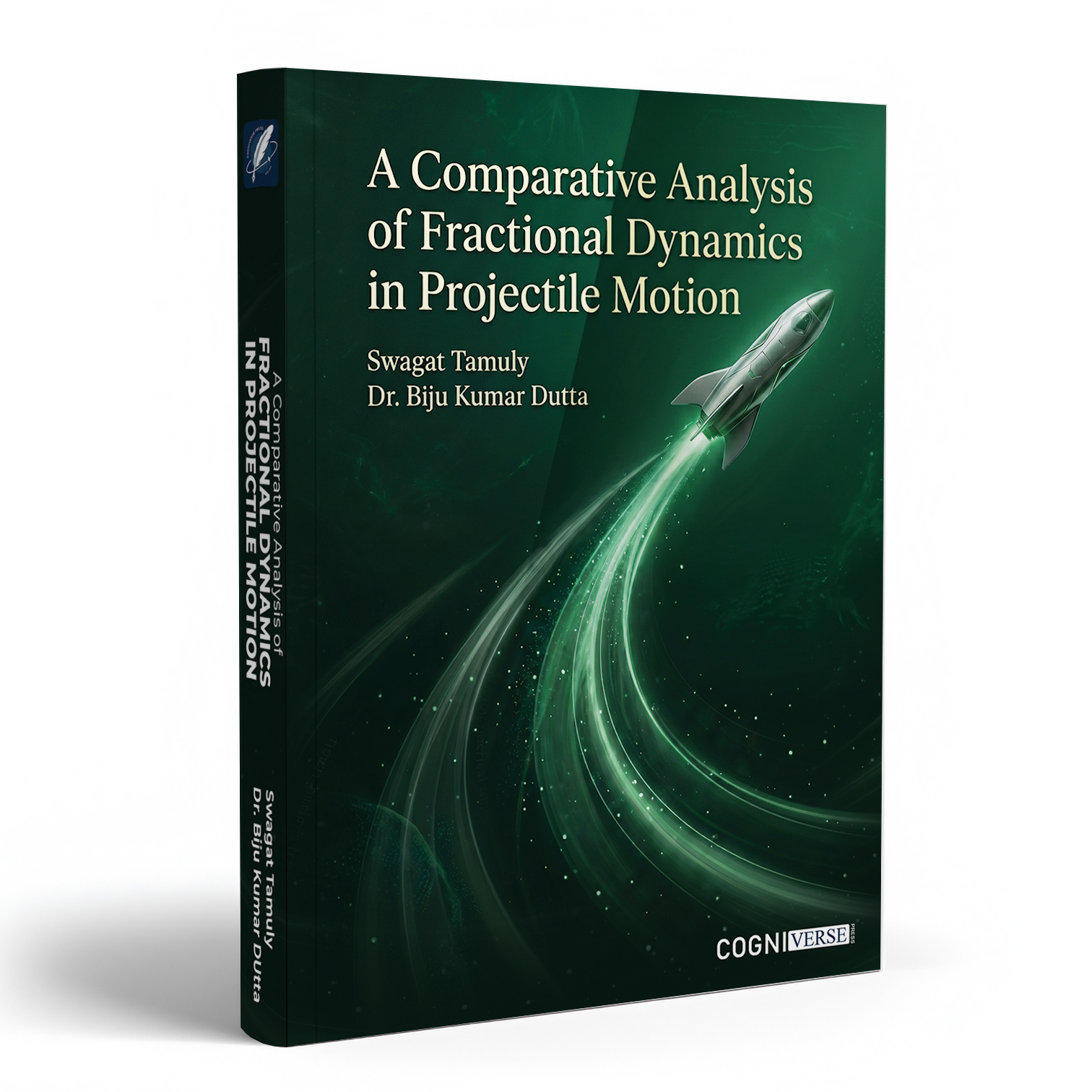
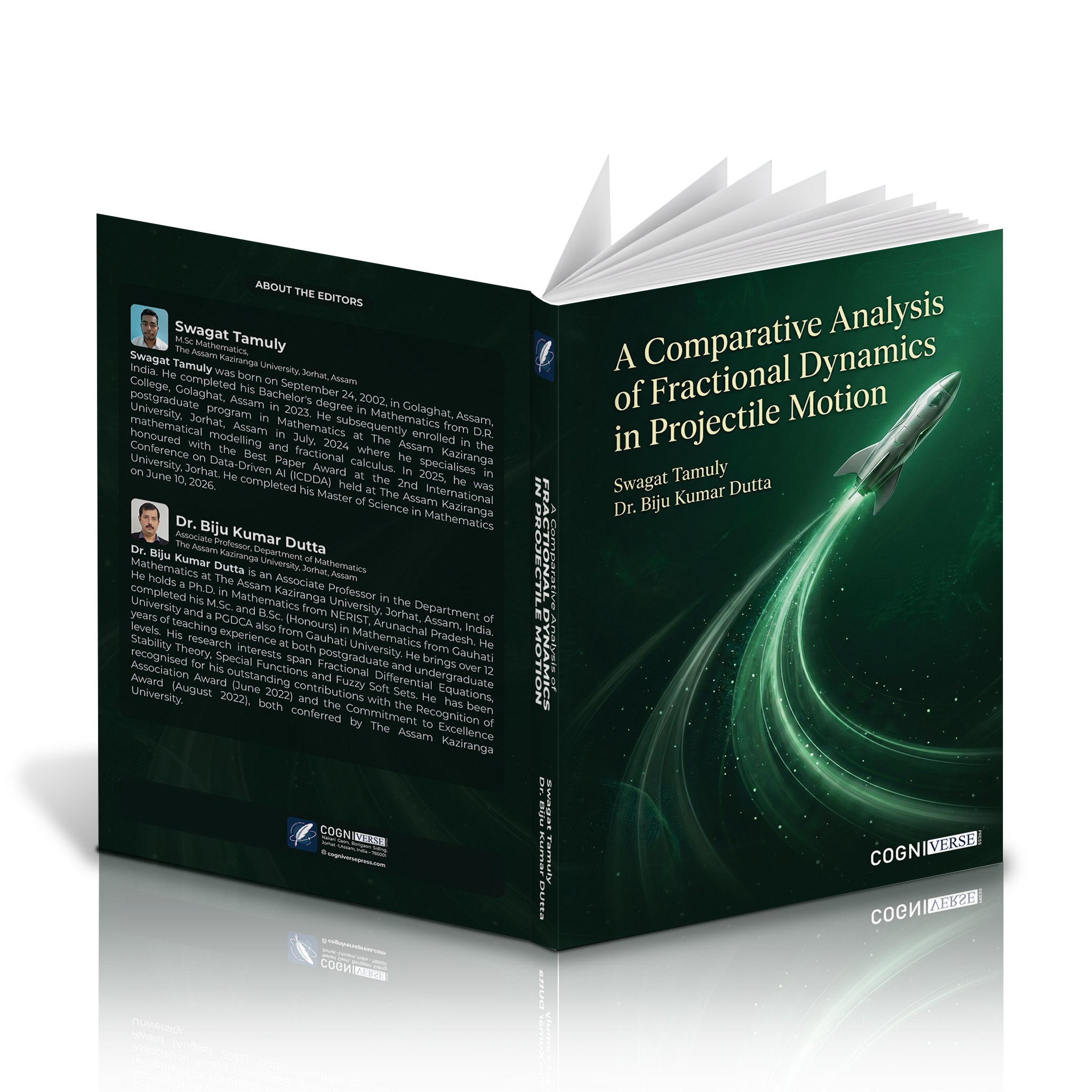
Title: A Comparative Analysis of Fractional Dynamics in Projectile Motion
Authors: Swagat Tamuly, Dr. Biju Kumar Dutta
Publisher: Cogniverse Press, Jorhat, Assam, India
First Edition: June 2026
DOI: 10.5281/zenodo.21079034
ISBN: 978-81-688286-0-5 (Print Edition)
e-ISBN: 978-81-688286-1-2 (Digital Edition)
Cover Designing: Cogniverse Press Digital Team
Copyright: © Authors
Authors
- Swagat Tamuly – Former Postgraduate Student, Department of Mathematics, The Assam Kaziranga University, Assam, India
- Dr. Biju Kumar Dutta – Associate Professor, Department of Mathematics, The Assam Kaziranga University, Assam, India
Publisher Information
Cogniverse Press
Nakari Gaon, Borigaon Siding, Jorhat – 1, Assam, India
Website: cogniversepress.com
Email: cogniversepress@gmail.com
Preface
Projectile motion has long been one of the most fundamental topics in classical mechanics, with its mathematical foundations tracing back to Galileo Galilei and Newtonian calculus. While traditional integer-order models have successfully described ideal projectile trajectories for centuries, they often fail to capture the memory-dependent and non-local characteristics observed in real-world systems, particularly when air resistance and complex physical interactions are involved.
A Comparative Analysis of Fractional Dynamics in Projectile Motion bridges classical mechanics and fractional calculus by investigating projectile motion through two important fractional operators—the Caputo derivative and the Caputo-Fabrizio derivative. Fractional calculus extends conventional differentiation and integration to non-integer orders, providing a powerful mathematical framework for modelling complex dynamical systems, anomalous diffusion, viscoelastic phenomena, and other processes exhibiting memory effects.
The primary objective of this work is to compare the mathematical behaviour, physical interpretation, and predictive accuracy of the Caputo and Caputo-Fabrizio operators when modelling projectile motion under air resistance. While the Caputo derivative has been widely studied in the literature, the Caputo-Fabrizio operator, characterised by its non-singular exponential kernel, remains comparatively underexplored. The models developed in this volume are validated using experimental mortar launch data, allowing meaningful comparisons between theoretical predictions and observed trajectories.
The book is organised progressively. Chapter 1 introduces the mathematical foundations of fractional calculus, including the Riemann–Liouville, Caputo, and Caputo-Fabrizio derivatives together with essential special functions. Chapter 2 develops fractional mathematical models of projectile motion, analyses trajectories under varying fractional orders and initial conditions, and compares theoretical results with experimental observations. Chapter 3 presents the major conclusions, discusses the implications of the findings, and identifies promising directions for future research.
The authors hope this work contributes to the growing body of research on fractional dynamics and demonstrates the potential of non-integer-order calculus for improving trajectory prediction in complex physical environments. The study suggests that fractional models—particularly those employing the Caputo-Fabrizio operator—offer enhanced modelling accuracy where conventional approaches are insufficient.
The authors also acknowledge the encouragement and support received from the faculty members of the Department of Mathematics, The Assam Kaziranga University, whose guidance greatly contributed to the successful completion of this work.
Acknowledgement
The author, Swagat Tamuly, expresses heartfelt gratitude to his supervisor, Dr. Biju Kumar Dutta, Associate Professor, Department of Mathematics, School of Basic & Applied Sciences, The Assam Kaziranga University, for his invaluable guidance, constant encouragement, and unwavering support throughout the course of this research. His mentorship greatly enriched both the conceptual understanding and the successful completion of this work.
Sincere appreciation is also extended to the faculty members of the Department of Mathematics, The Assam Kaziranga University, Jorhat, for their encouragement, insightful comments, and continuous academic support during the preparation of this book.
Swagat Tamuly
Book Overview
This book applies fractional calculus to analyse projectile motion beyond the assumptions of classical mechanics. Using the Caputo and Caputo-Fabrizio fractional operators, it reformulates the equations governing projectile motion to investigate parameters such as range, maximum height, and flight time under both ideal and resistive conditions.
In the absence of air resistance, the fractional models converge to the classical projectile equations. Under resistive conditions, however, the fractional formulations provide a more accurate representation of energy dissipation and trajectory behaviour. Experimental mortar launch data are used to validate the proposed models, demonstrating the effectiveness of fractional calculus in describing complex physical systems.
The study highlights potential applications in aerospace engineering, defence science, sports physics, and other fields where conventional mathematical models may not adequately capture real-world dynamics.
Key Themes
- Fractional Calculus
- Projectile Motion
- Caputo Fractional Derivative
- Caputo-Fabrizio Fractional Operator
- Riemann–Liouville Fractional Derivative
- Classical Mechanics
- Air Resistance Modelling
- Mathematical Modelling
- Fractional Differential Equations
- Experimental Validation
- Graphical Analysis
- Applied Mathematics
Table of Contents
Chapter 1: Introduction
- 1.1 Overview
- 1.2 An Introduction to Fractional Derivatives
- 1.3 Some Basic Functions
- 1.4 Literature Review
- 1.5 Objectives of the Study
Chapter 2: Mathematical Model Formulation on Projectile Motion with Air Resistance
- 2.1 Features of Projectile Motion without Air Resistance in Classical Mechanics
- 2.2 Features of Projectile Motion with Air Resistance in Classical Mechanics
- 2.3 Features of Projectile Motion with Air Resistance in Fractional Calculus (Using Caputo Operator)
- 2.4 Features of Projectile Motion with Air Resistance in Fractional Calculus (Using Caputo-Fabrizio Operator)
- 2.5 Comparison with Experimental Results
- 2.6 Comparison between Caputo and Caputo-Fabrizio Operator
- 2.7 Graphical Analysis
Chapter 3: Final Discussion
- 3.1 Conclusion
- 3.2 Future Scopes
Bibliography
“`


Reviews
There are no reviews yet.