
Description
Book Details
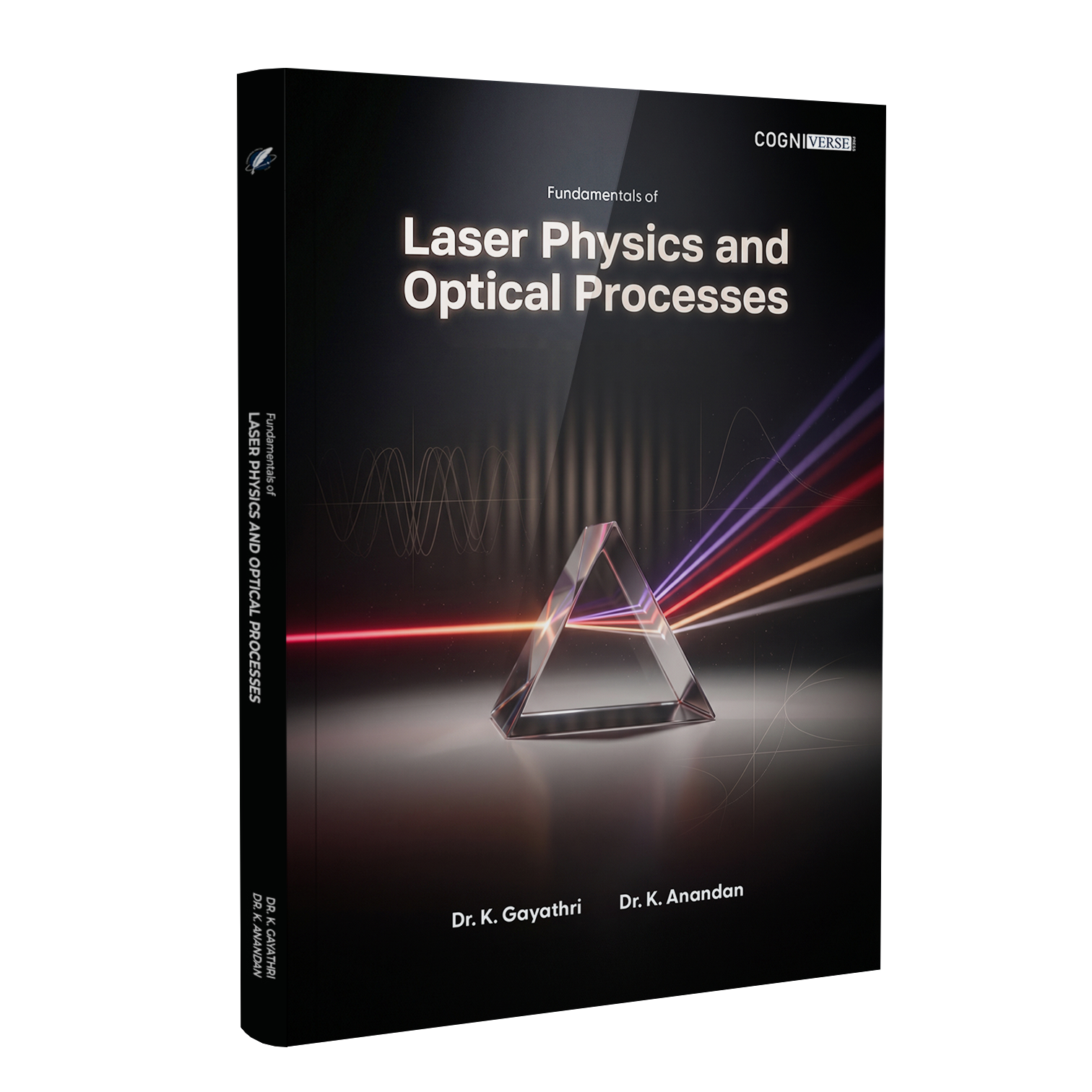
Title: Fundamentals of Laser Physics and Optical Processes
Authors:
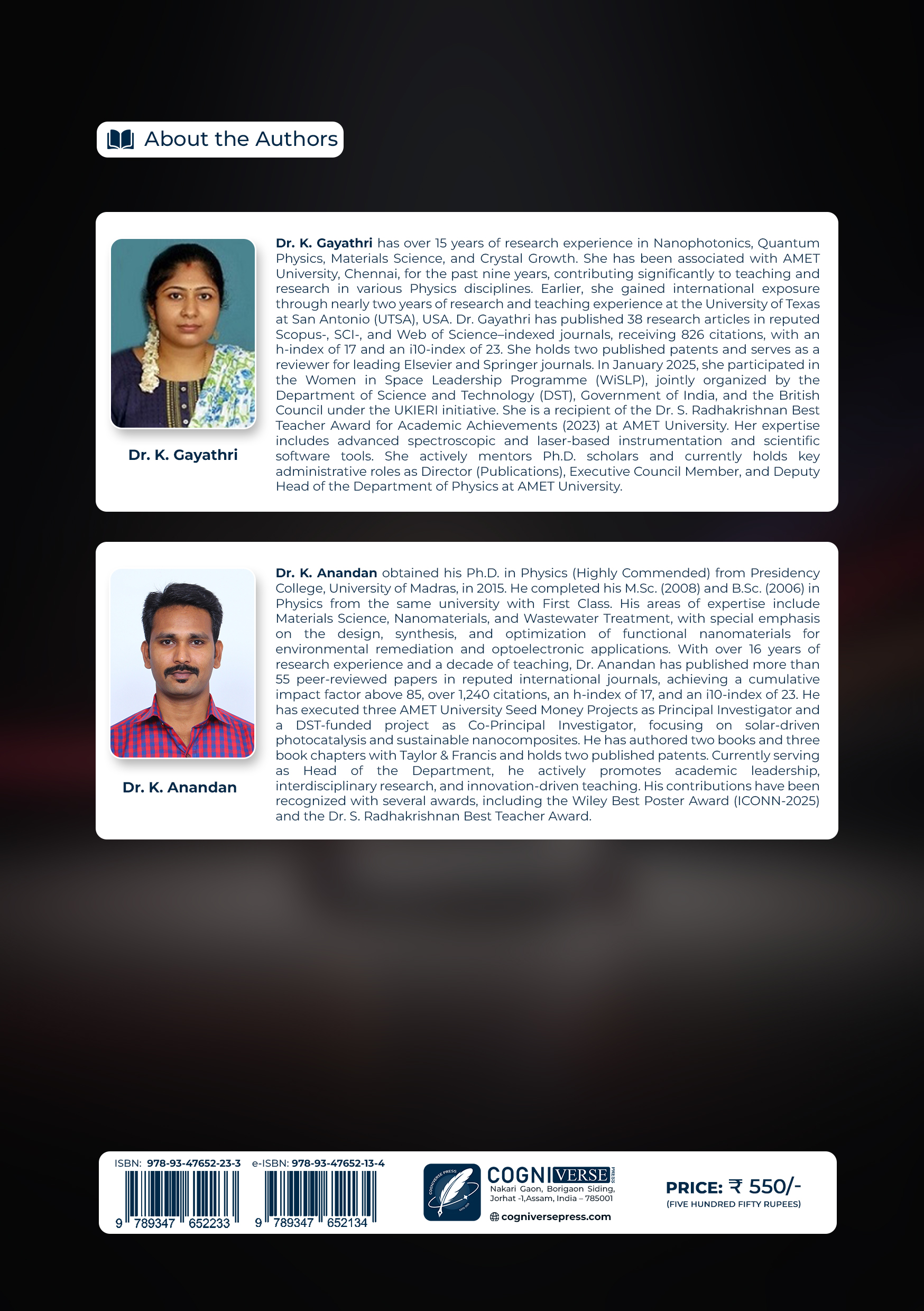
Dr. K. Gayathri – Associate Professor and Dy. Head, Department of Physics, Director – Publications, AMET Deemed to be University, Chennai, India.
Dr. K. Anandan – Associate Professor and Head, Department of Physics, AMET Deemed to be University, Chennai, India.
Publisher: Cogniverse Press, Jorhat, Assam, India
DOI: 10.5281/zenodo.19644448
ISBN: 978-93-47652-23-3 (Print Edition)
e-ISBN: 978-93-47652-13-4 (Digital Edition)
Edition: First Edition, April 2026
Published by: Cogniverse Press, Nakari Gaon, Borigaon Siding, Jorhat – 1, Assam, India
Cover Designing: Cogniverse Press Digital Team
Copyright: © Authors
Disclaimer: The views, interpretations, and research findings presented in this publication are solely those of the respective authors. The publisher bears no responsibility or liability for the accuracy, completeness, or validity of the content herein.
Preface
Laser physics forms the foundation of many modern scientific and technological advancements. Understanding the fundamental principles of light–matter interaction and optical processes is essential for exploring the behavior and operation of laser systems. This volume, Fundamentals of Laser Physics and Optical Processes, has been developed to provide a clear and systematic introduction to the core concepts underlying laser physics.
The book is intended for undergraduate and postgraduate students of physics, electronics, and related disciplines. It presents the subject in a structured manner, beginning with the basic nature of light and progressing through essential topics such as stimulated emission, population inversion, optical resonators, laser systems, and beam characteristics. Special emphasis has been placed on maintaining conceptual clarity while introducing important theoretical models such as rate equations and laser dynamics.
Each chapter is organized to build a strong conceptual base, enabling readers to understand both the physical principles and the mathematical framework of laser operation. The treatment of optical processes, coherence, and line broadening provides deeper insight into the behavior of laser radiation.
This volume serves as the first part of a two-book series and lays the groundwork necessary for understanding advanced laser techniques and applications discussed in the second volume. It is hoped that this book will help students develop a solid foundation and stimulate further interest in the field of laser physics.
Dr. K. Gayathri
Dr. K. Anandan
Authors
Key Themes
- Nature and properties of light
- Light–matter interaction
- Stimulated and spontaneous emission
- Population inversion and laser principles
- Optical resonators and laser modes
- Types of laser systems
- Optical absorption and emission processes
- Beam characteristics and coherence
- Line broadening mechanisms
- Laser dynamics and rate equations
Table of Contents
Chapter 1. Introduction to Laser Physics
- 1.1. Introduction
- 1.2. Nature of Light
- 1.3. Electromagnetic Spectrum
- 1.4. Wave and Particle Nature of Radiation
- 1.5. Interaction of Radiation with Matter
- 1.6. Absorption of Radiation
- 1.7. Spontaneous Emission
- 1.8. Stimulated Emission
- 1.9. Einstein’s Coefficients
- 1.10. Population Inversion
- 1.11. Basic Principles of Laser Operation
- 1.12. Characteristics of Laser Light
- 1.13. Summary
Chapter 2. Optical Resonators and Laser Modes
- 2.1. Introduction
- 2.2. Optical Resonators
- 2.3. Types of Optical Resonators
- 2.4. Stability Condition of Optical Resonators
- 2.5. Resonator Configurations
- 2.6. Longitudinal Modes
- 2.7. Transverse Modes
- 2.8. Mode Selection
- 2.9. Quality Factor (Q-Factor)
- 2.10. Cavity Losses
- 2.11. Summary
Chapter 3. Laser Systems and Types of Lasers
- 3.1. Introduction
- 3.2. Solid-State Lasers
- 3.3. Ruby Laser
- 3.4. Nd:YAG Laser
- 3.5. Gas Lasers
- 3.6. He–Ne Laser
- 3.7. CO₂ Laser
- 3.8. Semiconductor Lasers
- 3.9. Dye Lasers
- 3.10. Comparison of Laser Systems
- 3.11. Summary
Chapter 4. Optical Processes and Beam Characteristics
- 4.1. Introduction
- 4.2. Optical Absorption and Emission Processes
- 4.3. Line Broadening Mechanisms
- 4.4. Homogeneous Broadening
- 4.5. Inhomogeneous Broadening
- 4.6. Laser Beam Properties
- 4.7. Coherence
- 4.8. Directionality
- 4.9. Monochromaticity
- 4.10. Beam Divergence
- 4.11. Summary
Chapter 5. Laser Dynamics and Rate Equations
- 5.1. Introduction
- 5.2. Laser Rate Equations
- 5.3. Two-Level Laser System
- 5.4. Three-Level Laser System
- 5.5. Four-Level Laser System
- 5.6. Threshold Condition for Laser Action
- 5.7. Gain and Saturation
- 5.8. Laser Output Characteristics
- 5.9. Efficiency of Lasers
- 5.10. Summary
Chapter 6. References
- References

Reviews
There are no reviews yet.