
Description
Book Details
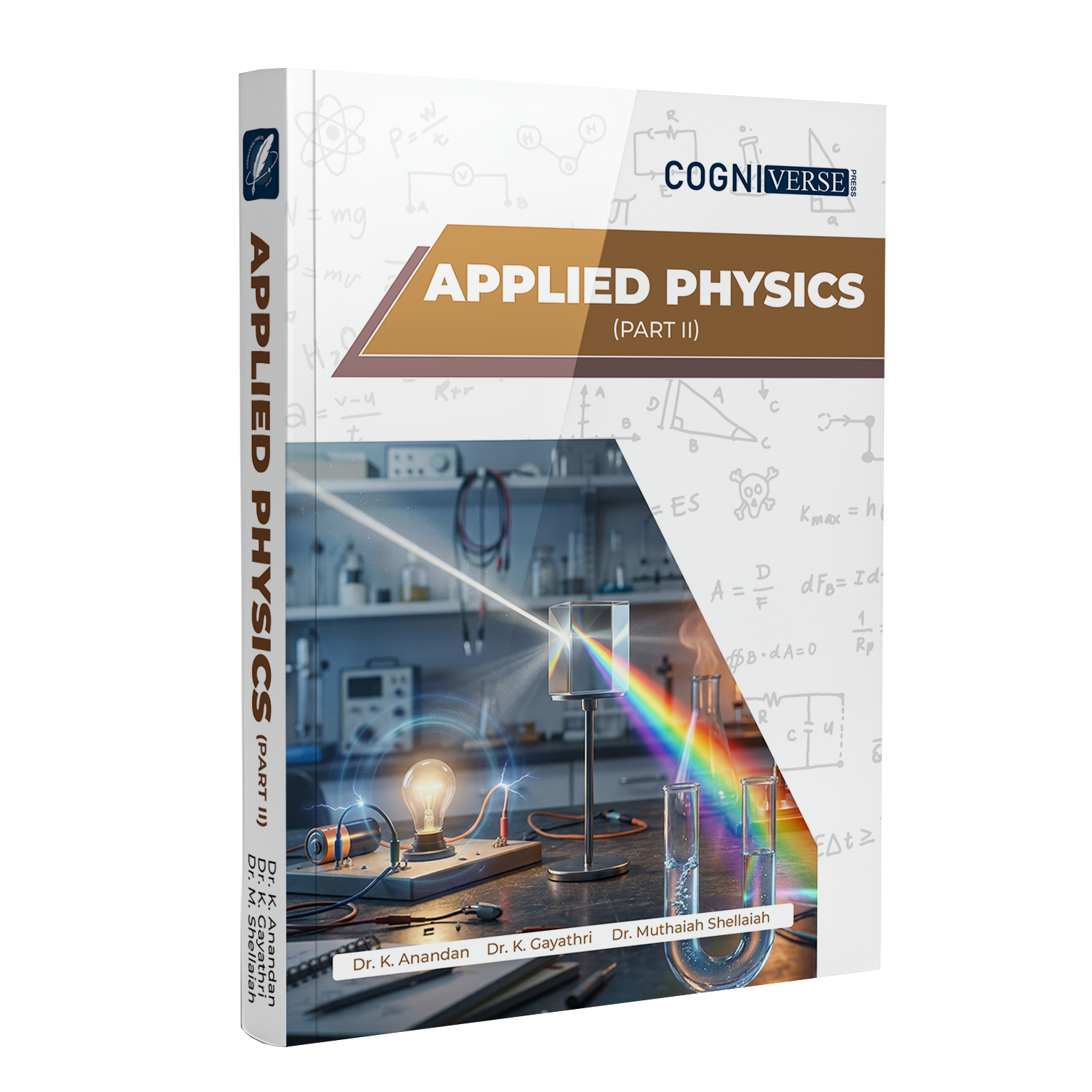
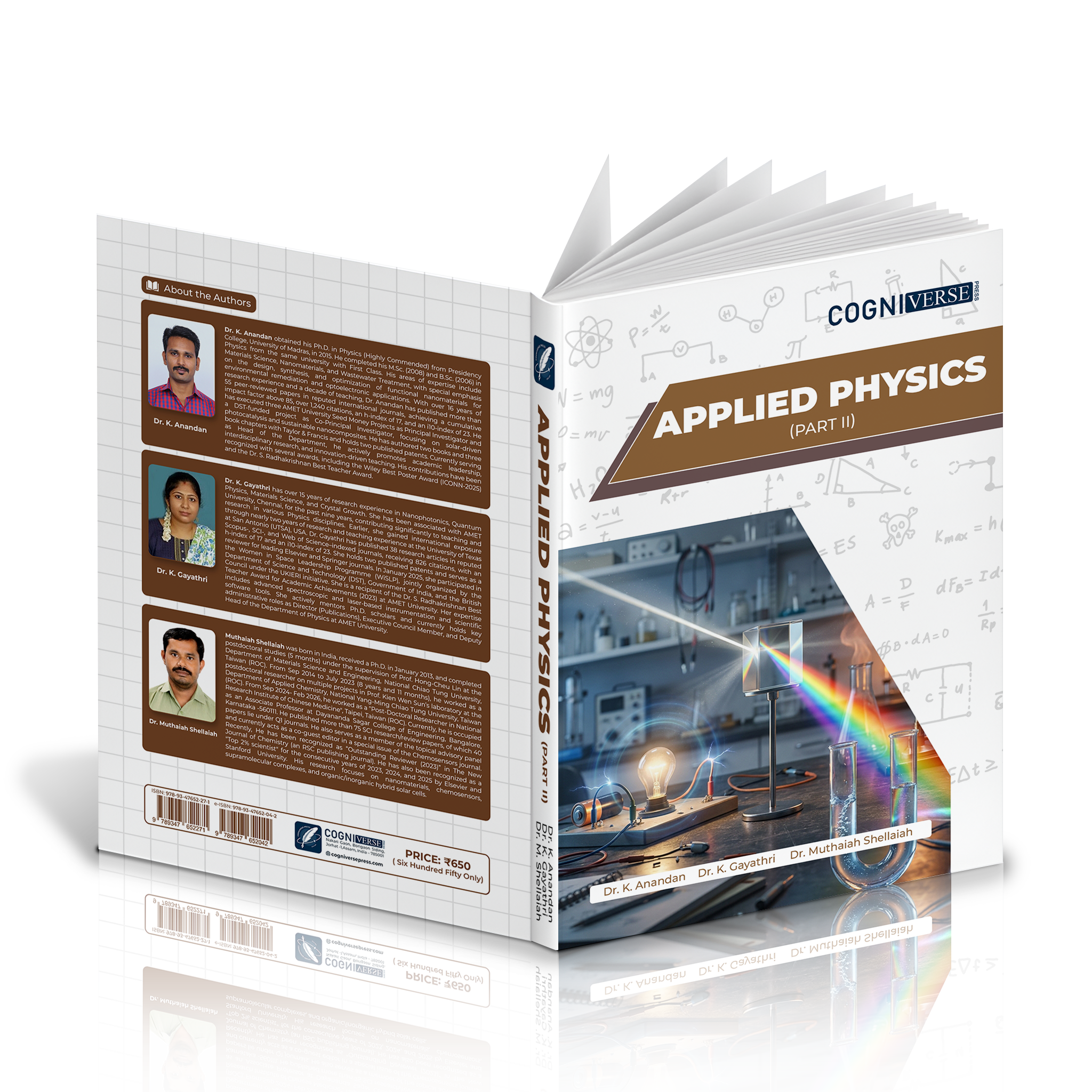
Title: Applied Physics (Part – II)
Authors:
- Dr. K. Anandan – Associate Professor and Head, Department of Physics, AMET Deemed to be University, ECR, Kanathur, Chennai, India
- Dr. K. Gayathri – Associate Professor and Dy. Head, Director – Publications, Department of Physics, AMET Deemed to be University, ECR, Kanathur, Chennai, India
- Dr. Muthaiah Shellaiah – Associate Professor, Department of Chemistry, Dayananda Sagar College of Engineering, Bangalore, Karnataka, India
Publisher: Cogniverse Press, Jorhat, Assam, India
First Edition: April 2026
DOI: https://doi.org/10.5281/zenodo.19632944
ISBN: 978-93-47652-27-1 (Print Edition)
e-ISBN: 978-93-47652-04-2 (Digital Edition)
Published by: Cogniverse Press, Nakari Gaon, Borigaon Siding, Jorhat – 1, Assam, India
Website: cogniversepress.com
Email: cogniversepress@gmail.com
Cover Designing: Cogniverse Press Digital Team
Copyright: © Authors
Publisher’s Note
The views, interpretations, and research findings presented in this publication are solely those of the respective authors. The publisher bears no responsibility or liability for the accuracy, completeness, or validity of the content herein.
Preface
Applied Physics (Part – II) is designed as a continuation of Applied Physics (Part – I) to meet the academic requirements of undergraduate students. The book covers three important units—Hydrostatics and Hydrodynamics, Heat and Light, and Electricity and Magnetism—in a systematic and student-friendly manner. The content aims to provide strong conceptual understanding while remaining aligned with prescribed academic syllabi.
The first unit, Hydrostatics and Hydrodynamics, introduces the principles governing fluids at rest and in motion. Topics include Pascal’s law, Archimedes’ principle, Bernoulli’s principle, laws of floatation, centre of buoyancy, stability of floating bodies, metacentric height, hydrostatic pressure, surface tension, capillarity, and viscosity. Experimental methods such as Stoke’s method and Poiseuille’s flow method are also discussed to connect theoretical principles with practical applications.
The second unit, Heat and Light, focuses on thermodynamic laws, gas laws, specific heat capacities, and heat transfer processes including conduction, convection, and radiation. Experimental methods and applications such as Lee’s disc method and black body radiation are included. The unit further explains reflection, refraction, interference, diffraction, polarization, and optical instruments including the compound microscope and resolving power.
The third unit, Electricity and Magnetism, explains electric current, resistance, circuit laws, magnetic effects of current, electromagnetic induction, generators, and transformers. Concepts such as Kirchhoff’s laws, Wheatstone’s bridge, self and mutual induction, and transformer efficiency are discussed with practical relevance.
This book aims to bridge theoretical understanding with practical applications and is expected to serve as a valuable academic resource for undergraduate students and educators.
Authors
Table of Contents
Chapter 3: Hydrostatics and Hydrodynamics
- Introduction
- Pascal’s Law
- Archimedes Principle
- Bernoulli’s Principle
- Law of Floatation
- Centre of Gravity and Centre of Buoyancy
- Stability of Equilibrium of a Floating Body
- Metacentre and Metacentric Height
- Plimsoll Line (or) International Load Line
- Hydrostatic Pressure
- Centre of Pressure
- Surface Tension
- Angle of Contact
- Capillarity
- Viscosity
- Stoke’s Law of Equation
- Experiment to Find Coefficient of Viscosity – Stoke’s Method
- Experiment to Find Coefficient of Viscosity – Poiseuille’s Flow Method
Chapter 4: Heat and Light
- Introduction
- Heat and Temperature
- Combustion (Fuel (Hydrocarbon) + Oxygen = Heat Energy)
- Hygrometry
- Rain, Snow and Hailstone
- Thermodynamics
- Boyles and Charles Laws
- Heat Capacity and Specific Heat Capacity
- Transmission of Heat
- Light
- Three Main Processes
- Reflection and Refraction
- Resolving Power and Magnification
- Optical Instruments
- Interference
- Diffraction
- Polarization of Light
Chapter 5: Electricity and Magnetism
- Introduction
- Current, Potential Difference and Resistance
- Ohm’s Law
- Resistance and Resistivity
- Kirchhoff’s Laws
- Wheatstone’s Bridge
- Magnetic Effect of Electric Current
- Magnetic Flux
- Biot – Savart’s Law
- Maxwell’s Cork Screw and Right-hand Thumb Rules
- Magnetic Induction Due to Straight Conductor Carrying Current
- Heating Effect of Electric Current
- Electromagnetic Induction
- Fleming Right Hand Rule (or) Generator Rule
- Self-Induction
- Mutual-Induction
- Generator
- Transformer
References
References and supporting academic resources included at the end of the book.
Key Themes Covered
- Fluid Mechanics and Hydrodynamics
- Hydrostatic Pressure and Buoyancy
- Surface Tension, Capillarity, and Viscosity
- Heat Transfer and Thermodynamics
- Reflection, Refraction, Interference, and Diffraction
- Optical Instruments and Resolving Power
- Electric Current and Circuit Laws
- Magnetic Effects of Electric Current
- Electromagnetic Induction and Transformers
- Applications of Physics in Engineering and Technology


Reviews
There are no reviews yet.