

Description
Book Details
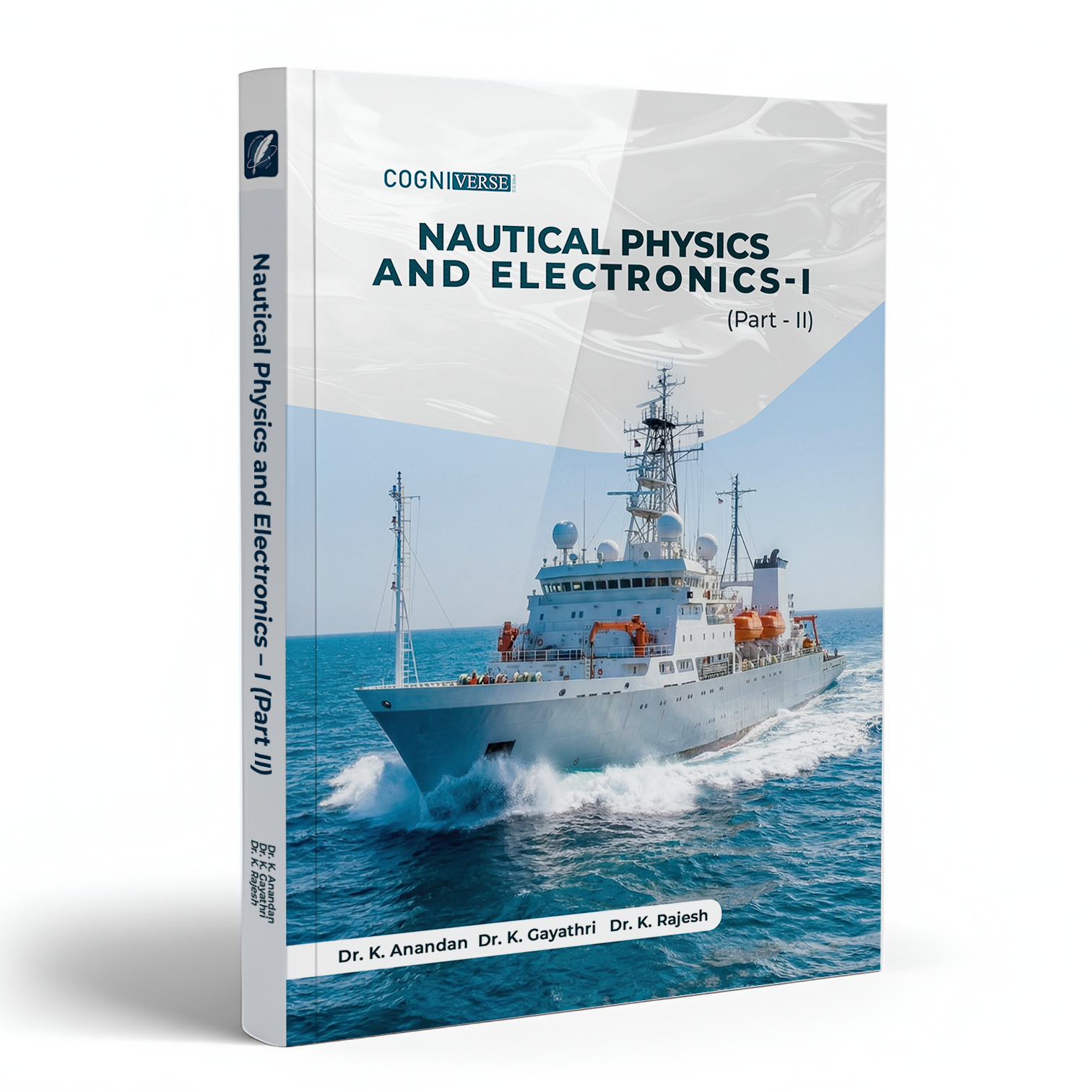
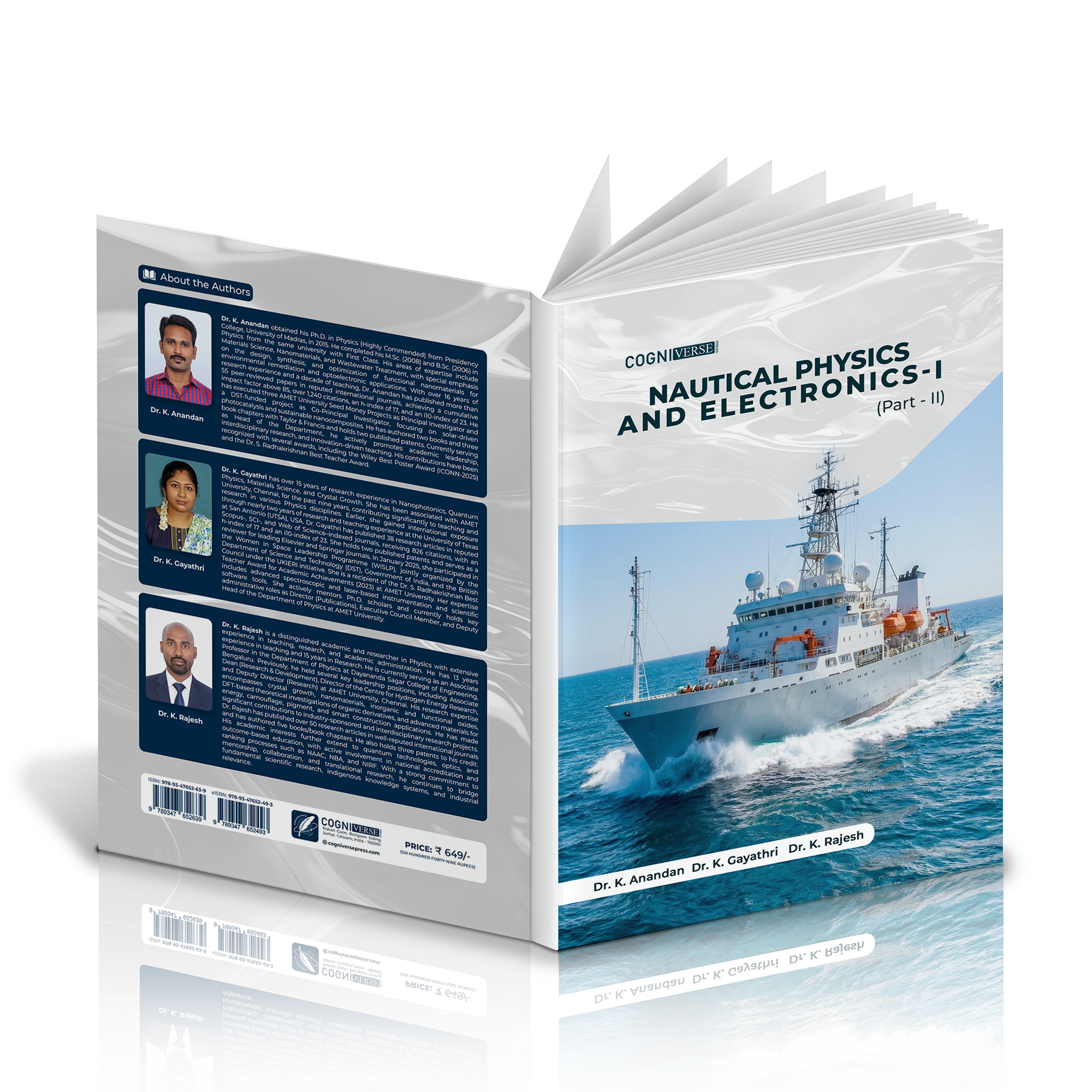
Title: Nautical Physics and Electronics – I (Part II)
Authors:
- Dr. K. Anandan, Associate Professor and Head, Department of Physics, AMET Deemed to be University, Chennai, India
- Dr. K. Gayathri, Associate Professor and Dy. Head, Department of Physics, Director – Publications, AMET Deemed to be University, Chennai, India
- Dr. K. Rajesh, Associate Professor, Department of Physics, Dayananda Sagar College of Engineering, Bangalore, India
Publisher: Cogniverse Press, Jorhat, Assam, India
DOI: 10.5281/zenodo.19222062
ISBN: 978-93-47652-63-9 (Print Edition)
e-ISBN: 978-93-47652-49-3 (Digital Edition)
Edition: First Edition, March 2026
Cover Designing: Cogniverse Press Digital Team
Copyright: © Authors
Publisher Information
Cogniverse Press
Nakari Gaon, Borigaon Siding, Jorhat – 1, Assam, India
Phone: +91-9101730579
Website: cogniversepress.com
Email: cogniversepress@gmail.com
Preface
Physics continues to play a vital role in Nautical Science by providing the fundamental principles required for understanding modern ship operations, navigation systems, and onboard technologies. Nautical Physics and Electronics – I (Part II) has been prepared as a continuation of Part I to meet the academic requirements of students pursuing Maritime Education as prescribed by maritime universities and training institutions.
This volume covers the important units Optics, Electricity and Magnetism, and Electronic Devices and Applications. These topics are essential for understanding optical instruments, electrical systems, and electronic equipment used in marine environments.
The unit on Optics introduces the principles of light, reflection, refraction, and optical instruments such as microscopes, telescopes, cameras, sextants, binoculars, and projectors. It also explains advanced concepts including interference, diffraction, and polarization of light.
The section on Electricity and Magnetism explains current, voltage, resistance, electrical circuits, Ohm’s law, Kirchhoff’s laws, electrostatics, magnetic effects of electric current, and electrical safety measures. These concepts are highly relevant for the safe operation of shipboard electrical systems.
The unit on Electronic Devices and Applications focuses on semiconductors, diodes, transistors, oscillators, and electronic circuits. It introduces the principles of electronic components and their applications in communication systems, navigation equipment, and control systems used onboard ships.
The subject matter has been presented in a clear and systematic manner with simple mathematical treatment, diagrams, solved examples, and review-oriented discussions to support effective learning and examination preparation. Practical maritime applications have been incorporated wherever relevant to connect theoretical concepts with real-world scenarios.
This book is intended to serve as a textbook for undergraduate students of Maritime Education and as a reference source for faculty members and professionals in the field of Nautical Science.
— Authors
Key Themes
- Fundamentals of Optics and Optical Instruments
- Electricity and Magnetism in Marine Applications
- Electronic Devices and Semiconductor Technology
- Practical Applications in Nautical Science
- Shipboard Electrical Safety
- Navigation and Communication Systems
- Marine Instrumentation and Observation Techniques
Table of Contents
Unit III: Optics
- Introduction
- Three Main Processes
- Reflection and Refraction
- Resolving Power and Magnification
- Optical Aberration
- Optical Instruments
- Simple Microscope
- Compound Microscope
- Telescope
- Camera
- Magnifying Glass
- Sextant
- Periscope
- Binoculars
- Projector
- Interference
- Diffraction
- Polarization of Light
Unit IV: Electricity and Magnetism
- Introduction
- Current, Potential Difference and Resistance
- Ohm’s Law
- Electrostatics, Capacitance and Inductance
- Electrical Energy and Power
- Zero Watt Bulb
- Resistance and Resistivity
- Kirchhoff’s Laws
- Wheatstone’s Bridge
- Electrical Appliances on Board Ship
- AC and DC Voltages – Dangerous Levels
- Electrical Safety Measurements
- Earthing
- Magnetic Effect of Electric Current
- Magnetic Flux
- Biot–Savart’s Law
- Maxwell’s Cork Screw and Right-Hand Thumb Rules
- Magnetic Induction Due to Straight Conductor Carrying Current
Unit V: Electronic Devices and Applications
- Introduction
- Semiconductor
- Intrinsic and Extrinsic Semiconductor
- PN Junction Diode
- Crystal Diode Rectifiers
- PN Junction Semiconductor Diode
- Introduction of Electronic Circuit
- Thermistor
- Transistors
- Transistor Connections
- Common Emitter Connection
- Oscillator
- Hartley Oscillator


Reviews
There are no reviews yet.