
Description
Book Details
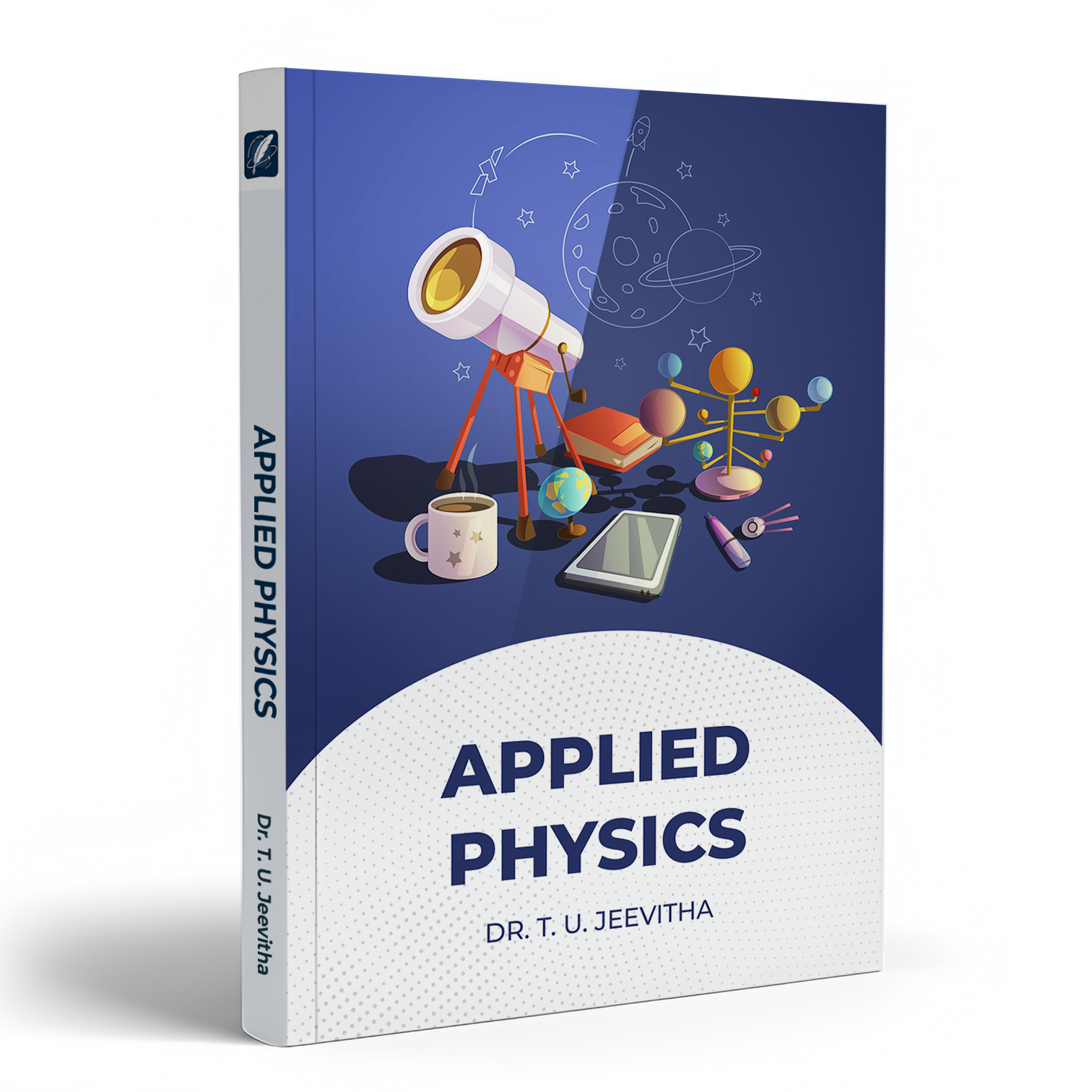
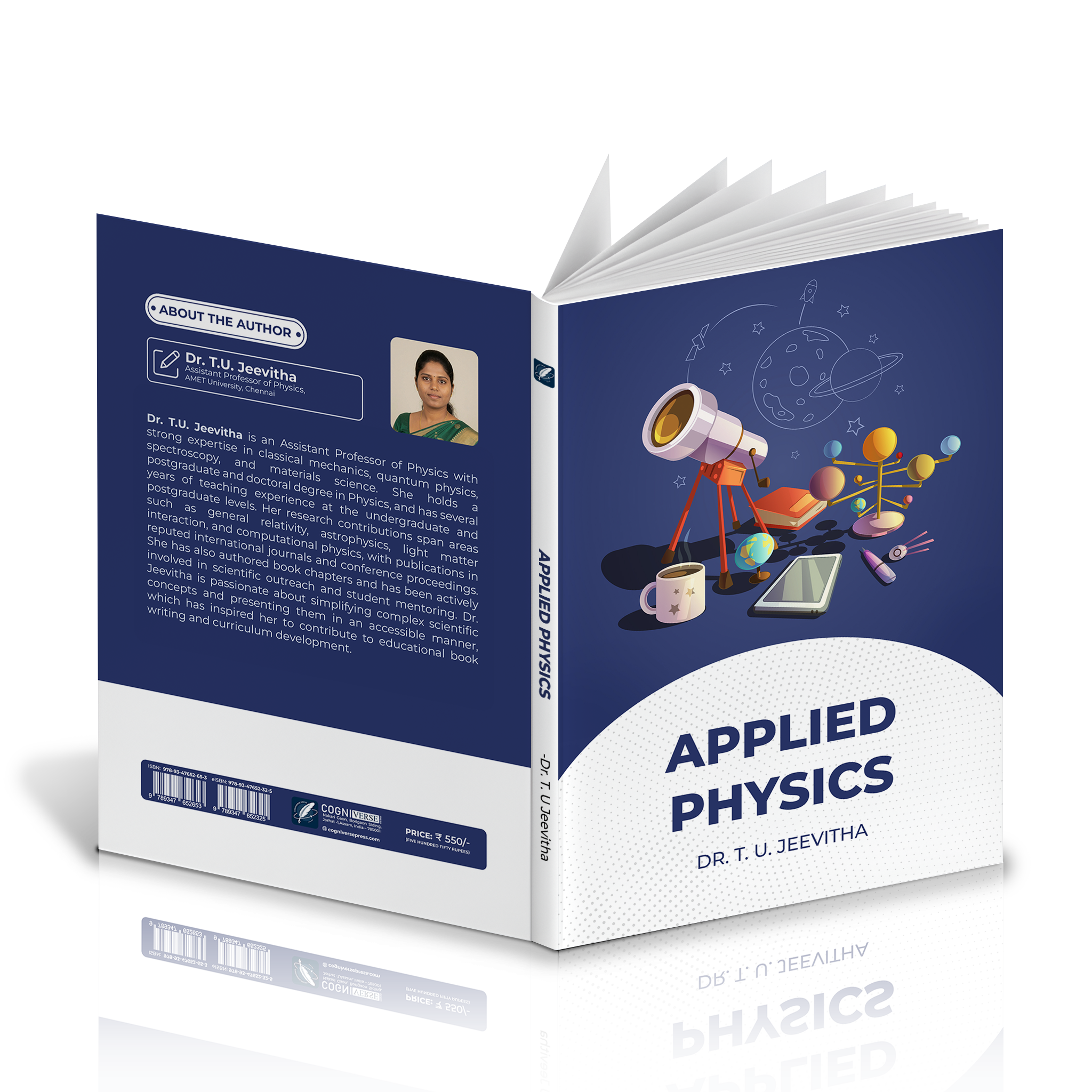
Title: Applied Physics
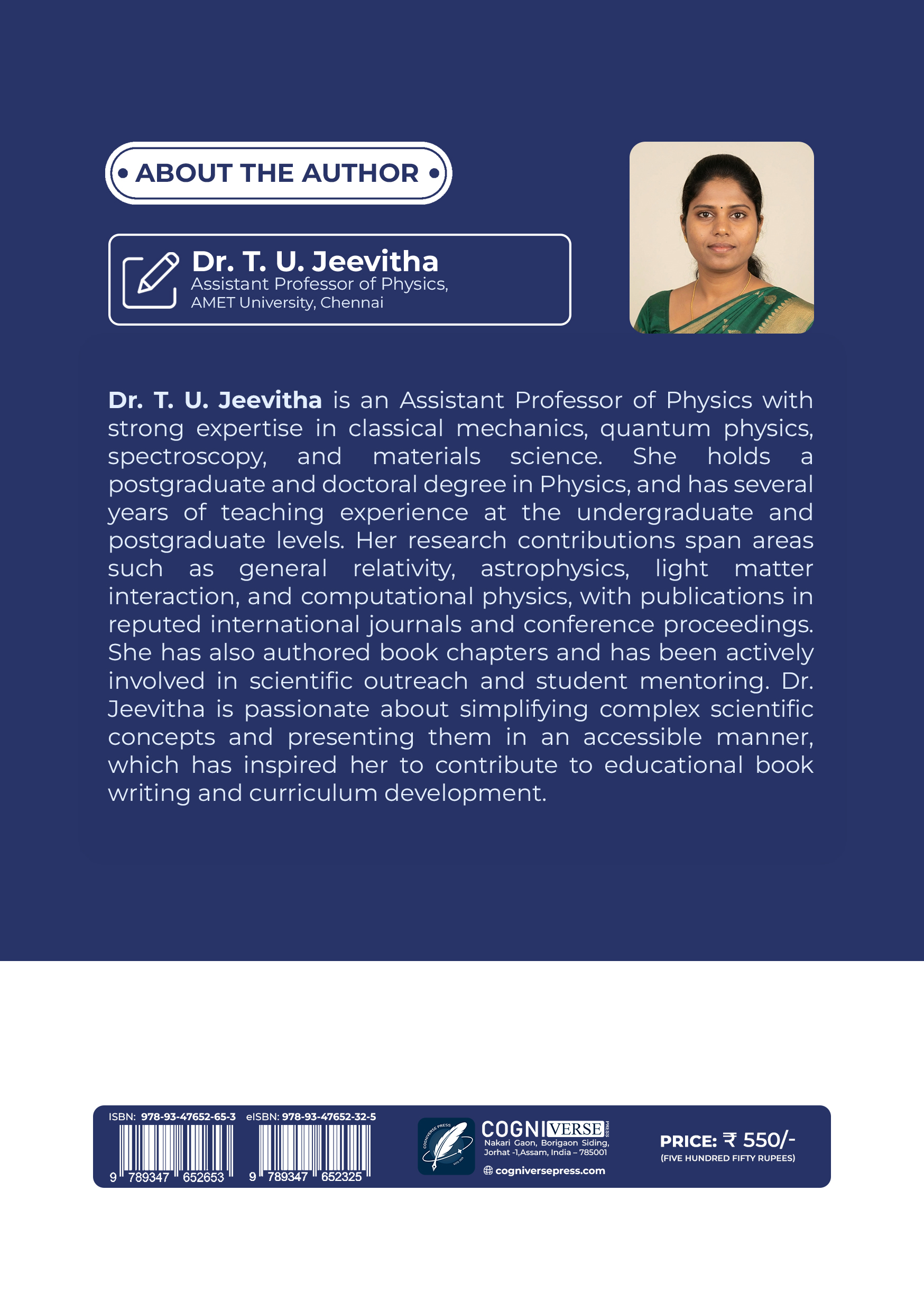
Author: Dr. T. U. Jeevitha
Affiliation: Department of Physics, AMET University, Chennai, India
Publisher: Cogniverse Press, Jorhat, Assam, India
ISBN: 978-93-47652-65-3 (Print Edition)
e-ISBN: 978-93-47652-32-5 (Digital Edition)
Edition: First Edition, April 2026
Cover Designing: Cogniverse Press Digital Team
Preface
Physics forms the foundation for understanding many natural phenomena and modern technological developments. With the rapid progress of science and engineering, it has become essential for students to develop a clear understanding of fundamental physics concepts and their practical applications.
This book has been prepared with the aim of presenting important topics in applied physics in a simple, clear, and systematic manner so that students can easily grasp the basic principles and their significance in real-world technologies.
The book covers key areas such as wave optics, laser physics, quantum physics, modern materials, and renewable energy systems. Each unit explains the fundamental concepts along with their technological applications, enabling students to connect theoretical knowledge with practical developments in science and engineering.
It is hoped that this book will serve as a useful resource for undergraduate students and will help them build a strong foundation in applied physics while encouraging further exploration in the field.
Author
Key Themes of the Book
- Wave optics and interference phenomena
- Atomic structure and spectral analysis
- Laser technology and optical fiber communication
- Quantum mechanics and modern physics concepts
- Modern engineering materials and semiconductors
- Renewable energy systems and sustainable technologies
Table of Contents
Chapter 1: Wave Optics
- 1.1 Introduction
- 1.2 Interference of Light
- 1.3 Young’s Double Slit Experiment
- 1.4 Interference in Thin Films
- 1.5 Newton’s Rings
- 1.6 Diffraction of Light
- 1.7 Polarization of Light
- 1.8 Applications of Polarization
- 1.9 Conclusion
Chapter 2: Atomic Physics
- 2.1 Introduction
- 2.2 Line Spectra and Atomic Spectra
- 2.3 Spectral Series of Hydrogen
- 2.4 Bohr Model of Hydrogen Atom
- 2.5 Quantum Numbers
- 2.6 Radiative Transitions
- 2.7 Selection Rules
- 2.8 Applications: Microwave Spectroscopy and Microwave Oven
- 2.9 Conclusion
Chapter 3: Lasers and Fiber Optics
- 3.1 Introduction
- 3.2 Introduction to Lasers
- 3.3 Einstein Coefficients
- 3.4 Population Inversion
- 3.5 Components of a Laser System
- 3.6 Types of Lasers
- 3.7 Optical Fiber Principle
- 3.8 Types of Optical Fibers
- 3.9 Applications of Optical Fiber
- 3.10 Conclusion
Chapter 4: Quantum Physics
- 4.1 Introduction
- 4.2 Wave–Particle Duality
- 4.3 De Broglie Wavelength
- 4.4 Heisenberg Uncertainty Principle
- 4.5 Schrödinger Wave Equation (Basic Idea)
- 4.6 Particle in a Box
- 4.7 Applications in Modern Physics
- 4.8 Conclusion
Chapter 5: Modern Materials
- 5.1 Introduction
- 5.2 Nanomaterials
- 5.3 Superconductivity
- 5.4 Magnetic Materials
- 5.5 Semiconductor Materials
- 5.6 Applications in Electronics and Technology
- 5.7 Conclusion
Chapter 6: Renewable Energy Systems
- 6.1 Introduction
- 6.2 Basic Principle of Solar Radiation
- 6.3 Wind Energy
- 6.4 Energy Storage Systems
- 6.5 Fuel Cells
- 6.6 Applications of Renewable Energy
- 6.7 Conclusion
References
Reference Section – Page 78
Reviews
There are no reviews yet.