
Description
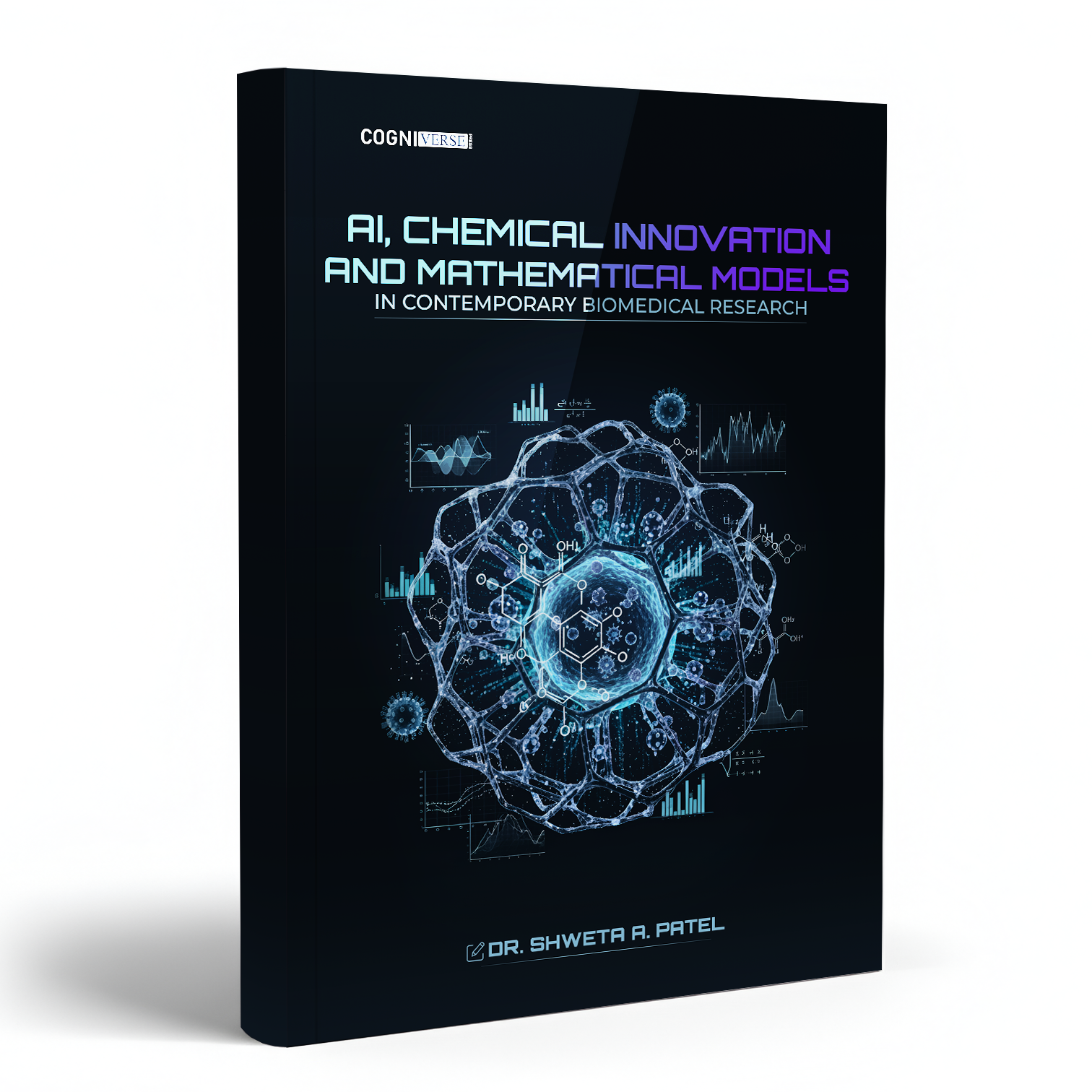
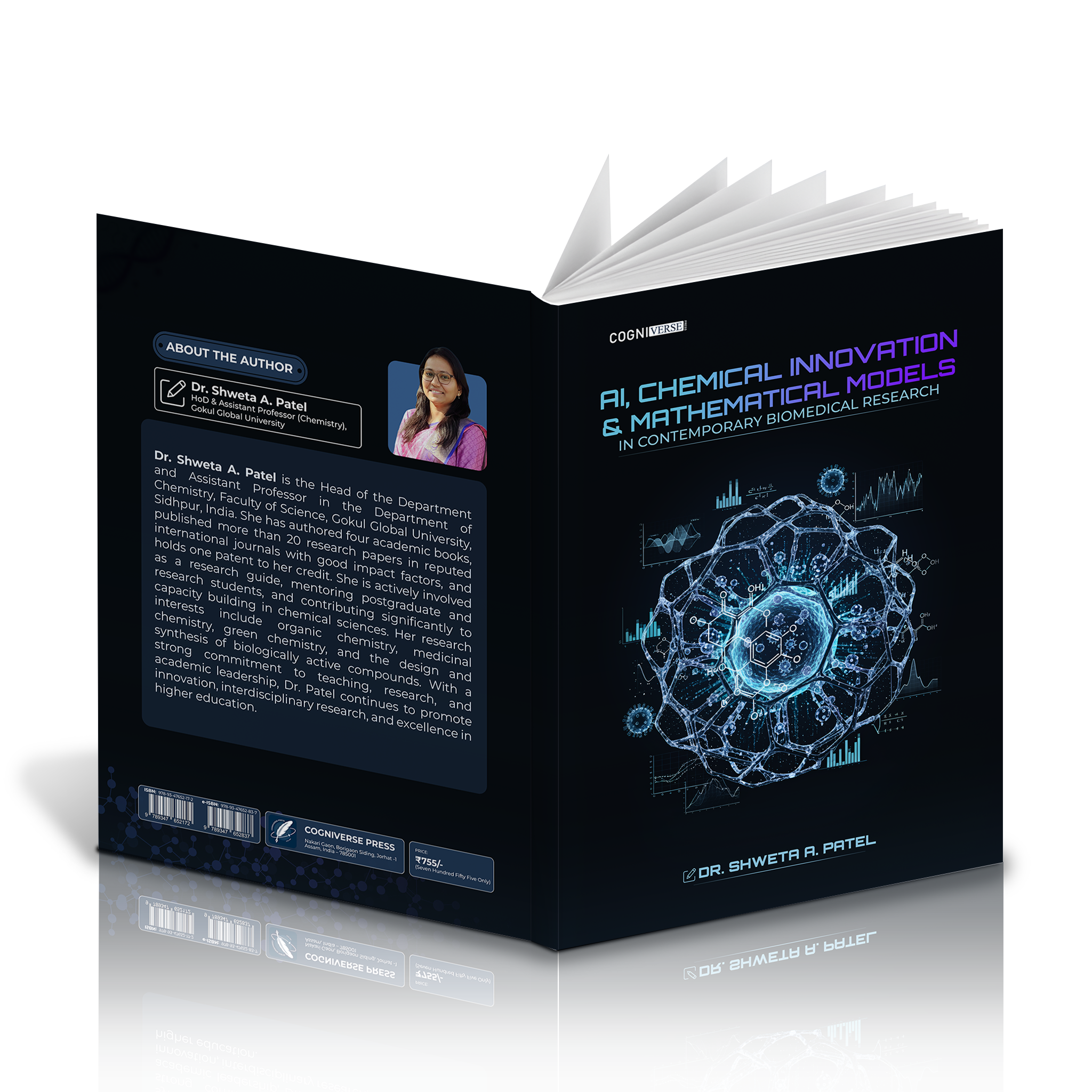
AI, Chemical Innovation and Mathematical Models in Contemporary Biomedical Research
Editor:
Dr. Shweta A. Patel
Department of Chemistry, Faculty of Science,
Gokul Global University, Sidhpur – 384151, India
Publisher: Cogniverse Press, Nakari Gaon, Borigaon Siding, Jorhat – 1
DOI: https://doi.org/10.5281/zenodo.18075231
ISBN: 978-93-47652-17-2 (Print Edition)
e-ISBN: 978-93-47652-83-7 (Digital Edition)
Preface
We are delighted to present AI, Chemical Innovation, and Mathematical Models in Contemporary Biomedical Research,
a comprehensive volume integrating advances in artificial intelligence, chemical synthesis, and mathematical
epidemiology to address challenges in drug discovery, infectious disease dynamics, and therapeutic innovation.
The convergence of these disciplines lies at the intersection of computational biology, pharmaceutical chemistry,
applied mathematics, and global health. Despite remarkable progress in AI-driven molecular design and dynamical
systems modeling, gaps remain in bridging mechanistic chemical insights with predictive mathematical frameworks,
particularly in resource-constrained clinical settings.
This handbook progresses from epidemiological context through mathematical foundations and AI methodologies
to chemical applications. Each chapter functions independently while contributing to an integrated vision
of biomedical innovation.
The Need for This Book
Biomedical research has expanded exponentially, with siloed advances across mathematical epidemiology,
AI-accelerated chemistry, and medicinal synthesis scattered across disciplines. Researchers often navigate
fragmented literature when translating theory into practice.
This volume serves as a unifying resource, synthesizing these domains while preserving disciplinary rigor.
It is particularly relevant for:
- Mathematical epidemiologists modeling HIV, TB, malaria, and coinfection dynamics
- Computational chemists and AI practitioners developing virtual screening and molecular design pipelines
- Medicinal chemists synthesizing bioactive scaffolds such as thiadiazoles and colchicine analogues
- Clinical researchers and policymakers addressing integrated disease management
- Interdisciplinary trainees seeking a bridge between theory, computation, and application
Organization and Content
Chapter 1: HIV Co-infection Interaction Dynamics and Case Studies
Establishes epidemiological context, quantifying synergistic interactions between HIV and co-infections such as TB
and malaria, with regional case studies and intervention thresholds.
Chapter 2: Mathematical Modeling of Infectious Diseases in the Era of Data Science
Covers SIR/SEIR frameworks, bifurcation analysis, Lyapunov stability, Castillo-Chavez methods, and MATLAB
implementations using WHO surveillance data.
Chapter 3: Smart Algorithms in Chemistry: AI-Driven Drug Design and Discovery
Explores machine learning, deep learning, and generative models for molecular prediction, virtual screening,
and de novo drug design.
Chapter 4: Chemical and Mechanistic Perspectives on Colchicine and Its Bioactive Analogues
Examines anti-inflammatory mechanisms and synthetic modifications yielding safer therapeutic analogues.
Chapter 5: Synthetic Approaches and Biological Potency of 1,3,4-Thiadiazole Compounds
Highlights nitrogen-sulfur heterocycles as privileged scaffolds addressing antimicrobial and multidrug-resistant
infections.
Key Themes Across the Book
- Synergistic Integration: Mathematical models guide AI target selection and chemical synthesis.
- Data-Driven Mechanistic Grounding: Surveillance data, AI validation, and experimental synthesis
reinforce predictive accuracy. - Global Health Equity: Resource-optimized modeling and scalable synthesis address access barriers.
- Multiscale Prediction: From population-level dynamics to molecular binding affinities.
- Bench-to-Bedside Translation: Computational predictions inform clinical strategy and trials.
Acknowledgment of Ongoing Questions
- Enhancing real-time data assimilation for coinfection forecasting
- Optimizing generative AI architectures for novel hybrid molecules
- Understanding spatial heterogeneity in bifurcation thresholds
- Scaling AI-optimized synthesis for global drug distribution
- Modeling long-term resistance under combined intervention strategies
Our Vision
This volume aims to catalyze integrated biomedical research beyond traditional boundaries, supporting
clinical translation, policy optimization, pharmaceutical innovation, and interdisciplinary education.
Whether you are a mathematician, chemist, clinician, policymaker, or student, this handbook offers
actionable insights grounded in theory and practice.
Table of Contents
- HIV Co-infection Interaction Dynamics and Case Studies – Page 1
Maitri R. Raval, Dr. Amit K. Parikh - Mathematical Modeling of Infectious Diseases in the Era of Data Science – Page 14
Hiral G. Prajapati, Maitri R. Raval - Smart Algorithms in Chemistry: AI-Driven Drug Design and Discovery – Page 29
Dr. Shweta A. Patel, Dr. Sarika P. Patel - Chemical and Mechanistic Perspectives on Colchicine and Its Bioactive Analogues – Page 39
Nilesh C. Patel, Dr. Shweta A. Patel - Synthetic Approaches and Biological Potency of 1,3,4-Thiadiazole Compounds – Page 50
Arpita Patel, Dr. Shweta A. Patel


Reviews
There are no reviews yet.